Dumbbell Lateral Raise Plank
The Dumbbell Lateral Raise Plank combines two demanding elements into one exercise: a single-arm lateral raise performed from the top of a push-up position. Instead of standing while you lift the dumbbell out to the side, you hold a high plank with one hand stacked under your shoulder while the other arm sweeps the weight out laterally to roughly shoulder height. That plank base is what makes this movement special, because your trunk has to resist rotation every time the weight leaves the floor.
This is a hybrid strength and stability exercise. The moving arm trains the side delts through a familiar abduction pattern, but the supporting arm, shoulders, chest, and entire core work isometrically to keep your hips and torso square to the floor. The obliques and deep core musculature in particular get challenged as anti-rotators, which is a role they rarely play in a standard standing lateral raise.
Setup matters more here than in most shoulder work. Because you are balancing on one arm with a load in the other, the position of your feet, the width of your stance, and the height of your hips all determine whether the movement feels controlled or sloppy. A slightly wider than normal foot stance gives you a more stable base and reduces the temptation to twist. Keeping the hips level and low, in line between shoulders and heels, protects your lower back and keeps the core doing its job.
Execution should be deliberate. Lift the dumbbell out to the side with a slight bend in the elbow, lead with the elbow rather than the hand, and stop at or just below shoulder height before lowering with control. The temptation is to rush the rep or swing the weight, but the plank position punishes that immediately — your torso will rotate and your hips will sag orpike. Slow, honest reps with a light dumbbell beat fast, twisting reps with a heavy one every time.
This exercise suits intermediate lifters who already own both a solid high plank and a basic dumbbell lateral raise, and it fits well as a shoulder finisher, a core-stability drill, or part of a conditioning circuit. Because it demands shoulder stability under load, anyone with irritated shoulders should start with very light weight or master the plank variation without dumbbells first. It also works nicely in minimal-equipment settings, since a single pair of dumbbells and a small patch of floor are all you need.
[ Workout Log & Planner ]
Put your next workout in Fitwill
Keep your plan and training log ready when you are.


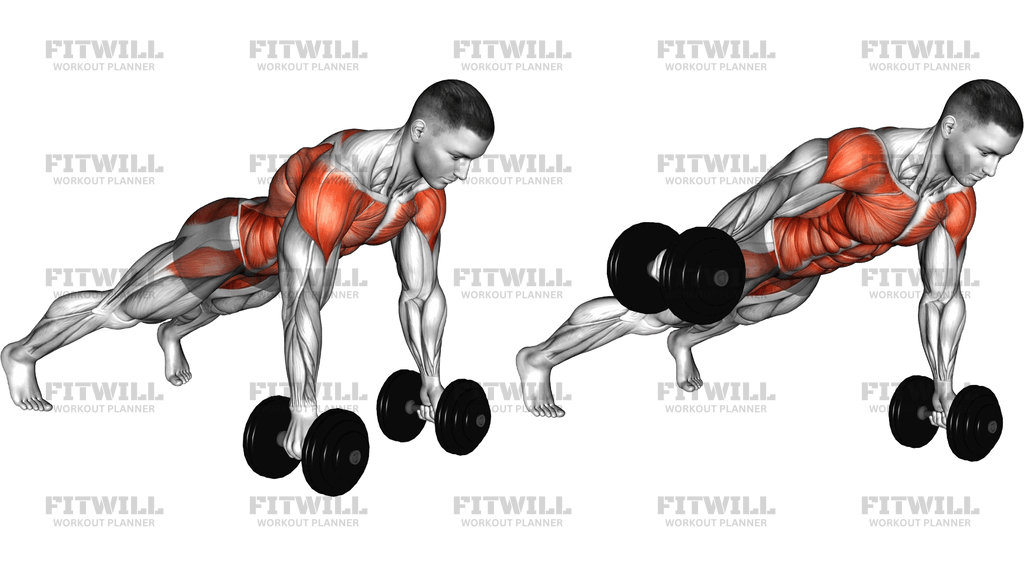
Instructions
- Place two dumbbells on the floor about shoulder-width apart and set up in a high plank position, gripping the handles with your palms facing down and wrists stacked directly under your shoulders.
- Step your feet out slightly wider than hip-width to create a stable base, and form a straight line from your head through your hips to your heels.
- Brace your abdominals and squeeze your glutes so your hips stay level and your torso resists rotation before you lift anything.
- Shift your weight subtly over the supporting arm and press that hand firmly into the dumbbell to anchor your shoulder.
- Raise the opposite-side dumbbell straight out to the side, keeping a soft bend in the elbow and leading with the elbow, until your arm reaches roughly shoulder height.
- Pause briefly at the top with the arm parallel to the floor, without letting your shoulders or hips twist toward the ceiling.
- Lower the dumbbell back to the floor under control, taking about twice as long on the way down as on the way up.
- Breathe steadily throughout: exhale as you raise the weight, inhale as you lower it, and never hold your breath while braced.
- Complete all reps on one side or alternate arms per rep, resetting your plank position and hip height between reps if anything drifts.
Tips & Tricks
- Start with a much lighter dumbbell than you would use for a standing lateral raise — the plank position cuts your usable weight dramatically.
- If your hips twist toward the lifting side, widen your foot stance or place one foot stacked behind the other for a longer, more stable base.
- Watch for the classic failing sign: the supporting shoulder shrugging up toward your ear. Keep that shoulder blade pressed down and away from your neck.
- A sagging lower back usually means the core has disengaged. Reset by tucking the pelvis slightly and squeezing the glutes before the next rep.
- Stop the raise at shoulder height. Lifting higher tends to shift work to the traps and pulls you out of the plank line.
- Keep your neck in line with your spine by looking at a spot on the floor just ahead of your supporting hand rather than craning upward.
- If your wrists ache from pressing on the dumbbell handles, try hex dumbbells with flat sides or grip the handle slightly farther forward.
- Master the movement with no weight or very light weight first — the anti-rotation demand is the hard part, not the raise itself.
- Alternate arms rep by rep if your supporting shoulder fatigues before your lifting arm does; this keeps both sides working evenly.
Frequently Asked Questions
What muscles does the Dumbbell Lateral Raise Plank work?
The primary mover is the side delts of the lifting arm. The core, especially the obliques, works hard isometrically to prevent your torso from rotating, while the supporting arm, chest, and shoulder stabilizers hold the plank position.
How is the Dumbbell Lateral Raise Plank different from a standing lateral raise?
The raise itself is similar, but performing it from a high plank removes momentum from your legs and hips and adds a strong anti-rotation demand on the trunk. As a result, you will use much lighter weight while training core stability at the same time.
Can beginners do the Dumbbell Lateral Raise Plank?
It is best treated as an intermediate exercise. Beginners should first build a solid high plank and a controlled standing or seated lateral raise, then start with very light dumbbells or even no weight to learn the balance.
Why does my torso rotate when I lift the dumbbell in the Dumbbell Lateral Raise Plank?
Rotation usually means the load is too heavy or the core is not braced. Lighten the weight, widen your foot stance, and consciously squeeze your glutes and abdominals before each lift so your hips stay square to the floor.
How heavy should the dumbbells be for this exercise?
Choose a weight you can raise cleanly to shoulder height for 8 to 12 reps without your hips twisting or sagging. For most people this is a fraction of what they would use for a standing lateral raise.
How high should I raise the dumbbell during the Dumbbell Lateral Raise Plank?
Raise the arm to roughly shoulder height, parallel with the floor, leading with the elbow. Going much higher tends to engage the upper traps and pulls your plank position out of alignment.
Can I substitute the Dumbbell Lateral Raise Plank if I do not have dumbbells?
You can perform the same plank-based raise with a light kettlebell or a small resistance band, or do plank shoulder taps instead to train the anti-rotation stability without any equipment.
Should I do all reps on one arm or alternate sides?
Both approaches work. Alternating arms each rep spreads the stability demand evenly and gives your supporting shoulder micro-breaks, while completing all reps on one side before switching builds more unilateral endurance.
Is it safe for my shoulders and lower back?
Generally yes when done with light weight and a braced torso. Stop if you feel pinching in the lifting shoulder or strain in the lower back, and check that your hips are not sagging or your supporting shoulder is not shrugging.
Where should I put the Dumbbell Lateral Raise Plank in my workout?
It works well as a shoulder finisher after your main pressing or raising work, or as a core-stability station in a circuit. Avoid placing it first when your shoulders are fresh and you might be tempted to go too heavy.