Seated Wrist Rotation
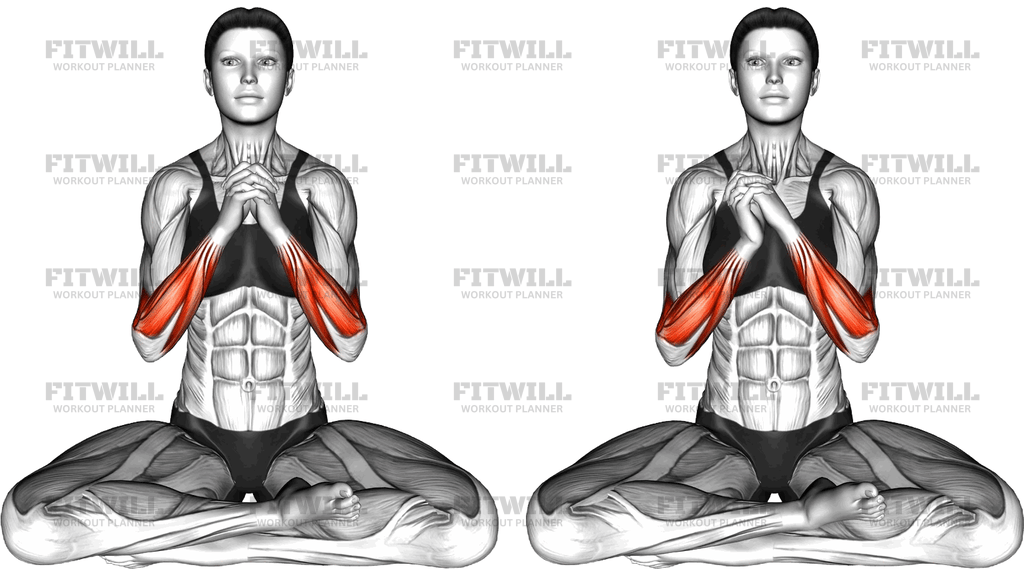
Seated Wrist Rotation is a simple body-weight mobility drill performed sitting cross-legged on the floor with the hands clasped together in front of the chest. With the fingers interlaced and the palms pressed firmly against each other, you slowly roll the wrists in a circular pattern, letting the clasped hands guide the forearms through their full rotational range. The forearm muscles light up visibly in this position because they have to both move and stabilize the wrist joint at the same time.
This exercise is one of the most accessible ways to look after your wrists. Anyone who spends long hours typing, lifting weights, doing yoga, or working in a job that loads the hands can benefit from a couple of minutes of controlled wrist circling. It is especially popular as a warm-up before pressing, gripping, or gymnastic-style work, and as a cooldown after heavy pulling days when the forearms feel tight and fatigued.
The movement primarily trains the wrist flexors and wrist extensors, the two muscle groups that run along the inner and outer sides of the forearm. As the hands rotate, these muscles lengthen and shorten through a smooth arc, while the smaller stabilizing muscles around the wrist joint work to keep the clasped contact secure. Because the resistance is only your own hand pressure, the drill improves range of motion and circulation more than it builds raw strength.
The seated, cross-legged setup matters more than it might seem. Sitting on the floor with an upright spine removes the temptation to slump into a chair or shrug the shoulders toward the ears. Bringing the clasped hands up to chest height keeps the elbows relatively close to the body, so the rotation happens at the wrists rather than turning into a big shoulder swing. If sitting on the floor is uncomfortable, the same hand position works just as well seated on a bench or the edge of a chair.
To execute it well, interlace the fingers fully so the palms stay in constant contact, and let the circles be slow and deliberate rather than quick and bouncy. Rotate in one direction for the planned number of repetitions, pause briefly to notice how the wrists feel, then switch direction. The pressure between the palms should be firm enough that the hands move as one unit, but not so hard that the fingers ache.
Keep the effort modest. A gentle stretching sensation around the wrist crease and along the forearm is the goal; sharp pain, clicking with discomfort, or numbness in the fingers means you should ease off immediately and reduce the circle size. Because no equipment is required, this is an easy habit to build into a daily routine, whether as part of a warm-up, a desk break, or a recovery day.
[ Workout Log & Planner ]
Put your next workout in Fitwill
Keep your plan and training log ready when you are.


Instructions
- Sit on the floor in a cross-legged position with your spine tall and your shoulders relaxed down away from your ears.
- Bring both hands up in front of your chest and interlace the fingers so the palms press fully together, elbows pointing slightly outward.
- Steady your posture by engaging your core lightly and keeping your head stacked over your torso before you start moving.
- Inhale, then begin rolling the clasped hands in a slow circle, letting the wrists bend in every direction as the hands travel.
- Keep the palms glued together and the fingers interlaced throughout the circle so both wrists move through the same path.
- Make the circles small at first, then gradually widen them until you reach the largest range that stays comfortable.
- Complete your repetitions clockwise, then pause and reverse the direction, rotating counterclockwise for the same number of reps.
- Exhale smoothly as you rotate, avoiding any breath-holding as the circles get bigger.
- At the end of the set, unlace the fingers, shake the hands out gently, and reset your posture before another round if needed.
Tips & Tricks
- The most common mistake is letting the palms separate as the circle widens. If the hands start to slip, shrink the circle and re-press the palms together.
- Avoid turning this into a shoulder or elbow swing. If your elbows are traveling in big arcs, brace your upper arms closer to your sides and let the wrists do the work.
- Do not force the circle through a range that causes pinching at the back of the wrist. A smaller, smoother circle trains the joint better than a large, uncomfortable one.
- Keep your shoulders quiet. If they creep up toward your ears, take a breath, drop them down, and restart the circle.
- If your wrists feel stiff first thing in the morning, start with slower, smaller rotations for the first few reps to warm the joint before expanding the range.
- Balance the directions. Most people naturally favor one rotation direction, so always do the same number of circles clockwise and counterclockwise.
- Watch your fingers. If interlacing causes sore knuckles, rest the fingertips more and press with the pads of the fingers rather than forcing a deep grip.
- If sitting cross-legged on the floor bothers your hips or knees, prop your seat on a folded blanket or perform the exact same hand movement seated on a chair.
- Treat this as a feel-based drill rather than a rep-counting challenge. Two focused sets of slow circles beat five rushed ones.
Frequently Asked Questions
What muscles does the Seated Wrist Rotation work?
It primarily targets the forearm muscles, specifically the wrist flexors on the palm side and the wrist extensors on the back of the forearm, along with the small stabilizers around the wrist joint.
Is the Seated Wrist Rotation a strength exercise or a stretch?
It is best treated as a mobility and warm-up drill. Because the only resistance is your own hand pressure, it builds wrist range of motion and control rather than meaningful forearm strength.
Why should my hands stay clasped during the rotation?
Interlacing the fingers keeps both wrists moving through the same arc and provides a gentle self-resistance that guides the joint. If the palms separate, one wrist starts doing more work than the other.
Can beginners do the Seated Wrist Rotation?
Yes, it is one of the most beginner-friendly wrist drills there is. Start with small, slow circles and a light palm pressure, and increase the range only as the wrists feel comfortable.
Do I have to sit cross-legged on the floor?
No. The cross-legged seat encourages an upright posture, but the exact same hand rotation works seated on a bench, a chair, or the edge of a bed as long as your spine stays tall and your hands stay at chest height.
How many rotations should I do in each direction?
A practical starting point is 8 to 12 slow circles clockwise and the same counterclockwise. Adjust the number based on how your wrists feel rather than forcing a fixed count.
When is the best time to include this exercise?
It works well as a warm-up before pressing, pulling, or any grip-heavy training, and it is also a useful mid-day reset if your wrists feel stiff from typing or repetitive hand work.
My wrists click during the rotation. Should I stop?
Painless clicking is usually harmless, but if the clicking comes with discomfort, pinching, or numbness, reduce the circle size and pressure, and stop if the symptoms persist.
Can I use the Seated Wrist Rotation to recover after heavy lifting?
Yes. Gentle circling promotes blood flow through the forearms and can ease that tight, pumped feeling after heavy gripping, but keep the pressure light and stay well short of any painful range.
What is a good alternative if clasping my hands is uncomfortable?
Rotate each wrist individually with the arm extended and the hand relaxed, or perform slow wrist circles with the palms hovering apart without interlacing the fingers until the hands tolerate the clasped position.