Couch Hip Flexor Stretch
The Couch Hip Flexor Stretch is a half-kneeling mobility drill where the top of your rear foot rests against a couch, padded box, or bench behind you while the front knee stays bent at roughly ninety degrees in front. It takes the standard kneeling hip flexor stretch and adds knee flexion, which lengthens the rectus femoris — the quad muscle that crosses both the hip and the knee — alongside the primary hip flexors like the iliopsoas. The result is a noticeably deeper stretch through the front of the rear hip and thigh than you get from a regular lunge stretch.
This is one of the best corrective stretches for people who sit for long hours. Prolonged sitting keeps the hip flexors in a shortened position all day, which commonly shows up as tightness in the front of the hips, an anterior pelvic tilt, or discomfort in the low back during standing and lifting. Desk workers, runners, cyclists, and lifters who squat or hinge heavy all tend to benefit from spending a few minutes in this position a few times per week.
Setup matters more here than in most stretches. The height of the surface behind you, the distance of your front foot, and the position of your pelvis all determine whether the stretch lands in the hip flexors or gets dumped into the lower back. Keep the front shin close to vertical, tuck the tailbone slightly under, and brace the trunk so the ribs stay stacked over the pelvis. If the pelvis tilts forward, the lumbar spine compensates and you lose most of the benefit at the hip.
To execute it, drop into a half-kneel with the rear knee on the floor and the rear foot planted against the couch behind you. Press the rear hip gently forward until you feel a stretch along the front of that hip and thigh, then hold and breathe steadily. The movement is subtle — a controlled shift of the pelvis, not a big lunge. Squeezing the glute on the stretched side helps lock in a neutral pelvis and intensifies the hip flexor stretch safely.
Common use cases include pre-workout hip preparation, post-workout recovery, warm-ups before running or cycling, and evening mobility routines to undo a day of sitting. Hold each side for thirty to sixty seconds, and expect the position to feel easier on the second and third set as the tissue gradually tolerates more range.
A few safety points keep this effective. Pad the rear knee with a mat if the floor is hard, keep the stretch sensation in the muscle rather than at the knee cap or in the low back, and never push into sharp pain. Because the foot is elevated behind you, ease into the position the first few times — the added quad involvement can feel intense if you are not used to it.
[ Workout Log & Planner ]
Put your next workout in Fitwill
Keep your plan and training log ready when you are.


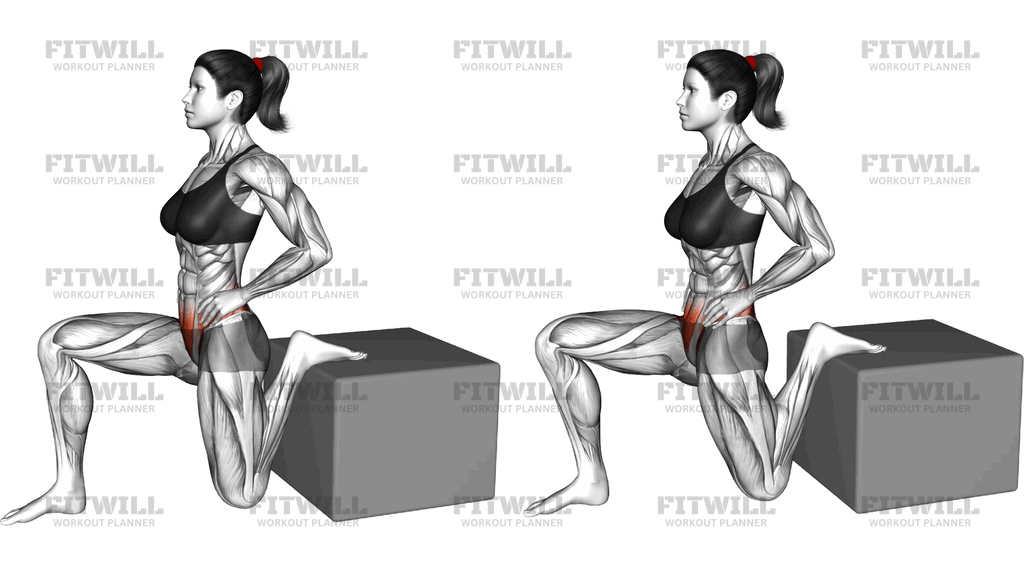
Instructions
- Place a couch, padded box, or bench against a wall and kneel facing away from it, with the top of your rear foot resting on the surface and your rear knee on the floor.
- Position your front foot flat on the floor ahead of you so the front knee bends to about ninety degrees and the shin stays close to vertical.
- Place both hands on your hips, or lightly hold onto the couch or a stable object in front of you for balance.
- Brace your trunk lightly and tuck your tailbone under into a slight posterior pelvic tilt so your ribs stack over your pelvis.
- Squeeze the glute on the rear-leg side and shift your hips gently forward until you feel a stretch along the front of the rear hip and thigh.
- Keep your torso tall and facing forward — avoid leaning the chest back or twisting the hips open.
- Hold the position for 30 to 60 seconds while breathing slowly and steadily, letting the stretch ease deeper on each exhale.
- To release, shift your hips back to the starting half-kneel and carefully lift the rear foot off the surface.
- Switch legs, kneel on the opposite knee, and repeat for the same number of holds.
- Perform 2 to 3 holds per side, standing up and shaking out the legs between sets if needed.
Tips & Tricks
- If your lower back arches and pinches during the stretch, the pelvis has tipped forward — re-tuck the tailbone and squeeze the rear-side glute before shifting forward again.
- A pinching sensation at the front of the stretching hip usually means you are pushing too far too fast; back off the forward shift a few centimeters and let the range build over sets.
- Sliding the front foot further forward makes the stretch easier; bringing it closer and increasing the rear hip extension makes it harder. Adjust foot position before changing anything else.
- If the top of the rear foot on the couch is uncomfortable, tuck the toes against the surface or place a folded towel between the foot and the padding.
- Keep the front heel flat and the knee tracking over the middle of the foot — letting the front knee cave inward shifts stress into the knee joint.
- Pad the rear knee with a cushion or exercise mat; pressure on the kneecap will distract you from the stretch you are actually chasing.
- Do not lean the torso backward to chase a stronger stretch — that loads the lumbar spine instead of extending the rear hip.
- Start with a lower surface, like a low step, if the full couch height pulls too aggressively on the quad; progress the height over weeks.
- Because the elevated foot also stretches the quads, expect the front-of-thigh sensation to dominate at first; keep the glute engaged to make sure the hip flexors still get loaded.
Frequently Asked Questions
What muscles does the Couch Hip Flexor Stretch target?
It primarily lengthens the hip flexors, including the iliopsoas, and because the rear foot is elevated, it also stretches the rectus femoris — the quad muscle that crosses the hip. The glute on the stretched side works isometrically to hold the pelvic position.
How is the Couch Hip Flexor Stretch different from a regular kneeling hip flexor stretch?
Elevating the rear foot on the couch adds knee flexion, which pulls the rectus femoris into the stretch as well as the hip flexors. Most people feel it lower down the front of the thigh and deeper in the hip compared with the standard version.
Is the Couch Hip Flexor Stretch suitable for beginners?
Yes, but start conservatively. Use a lower surface than a full couch, shorten the hold to around 20 to 30 seconds, and prioritize the posterior pelvic tilt over how far you shift forward.
Why does my lower back hurt during this stretch?
That usually means the pelvis is tilting forward and the lumbar spine is extending to create the range instead of the rear hip. Re-tuck the tailbone, squeeze the rear-side glute, and reduce the forward shift until the stretch stays in the front of the hip.
How long should I hold the Couch Hip Flexor Stretch?
Thirty to sixty seconds per hold works well, for two to three rounds per side. Longer holds tend to be more effective than short pulses for improving tolerance in the hip flexors.
Should I do this stretch before or after a workout?
It works in both slots. Before training, use one shorter hold per side as hip preparation for squats, lunges, or running; after training or in the evening, use longer holds to restore range after prolonged sitting.
Can I do the Couch Hip Flexor Stretch every day?
Yes, it is low intensity enough for daily practice, especially if you sit for long periods. Skip it or reduce the range on any day the hip or knee feels irritated rather than just tight.
What can I use if I do not have a couch available?
A padded gym bench, plyo box, sturdy chair, or even a low step works — the surface just needs to be stable and roughly knee height or a bit higher. Adjust the surface height to match your current flexibility.
Why do I feel this more in my quad than my hip?
The elevated foot biases the rectus femoris strongly, so the thigh sensation often dominates. Keep the glute on the rear side squeezed and the tailbone tucked, and you should still feel the hip opening even when the quad sensation is louder.
Is it safe if I have knee problems?
The rear knee bears pressure on the floor and the rear knee is bent deeply, so it can aggravate some knee issues. Place generous padding under the rear knee, reduce the surface height so the bend is smaller, and stop if you feel pain in the knee joint itself rather than a muscle stretch.