Self Ankle Mobilization
Self Ankle Mobilization is a bodyweight mobility drill that targets the ankle's ability to bend at the hinge between your shin and foot. You set up in a half-kneeling position with one foot flat on the floor, place your hands on the front knee for support, and gently rock the knee forward past the toes while keeping the heel glued down. The movement is small, repeated, and rhythmical rather than a long static hold, which makes it a go-to warm-up drill before squats, lunges, running, or any session that demands ankle range.
This drill matters because limited dorsiflexion is one of the most common hidden restrictions in training. When the ankle cannot bend enough, the body compensates somewhere else: the heels lift in squats, the knees cave inward during lunges, the lower back rounds in a deep squat, or the foot flattens under load. Runners and lifters alike often feel this restriction as tight calves, achy arches, or pressure in the front of the knee. Mobilizing the ankle directly, rather than fighting the compensation downstream, addresses the cause.
The setup is where the quality lives. Your front foot must stay flat and heavy on the floor, and the motion should travel through the ankle joint itself, not through the arch collapsing or the heel rising. Keeping your hands on the front knee lets you guide the knee forward in a controlled line, ideally tracking toward or slightly outside the pinky toe, while the rest of your body stays quiet. The rear knee stays down on the floor for a stable base, and your torso leans slightly over the front leg without slumping.
You will feel this most along the back of the lower leg, especially the calf and the deeper tissues around the ankle, and sometimes in the top of the foot as the joint reaches its end range. That is the point of the drill: teaching the ankle to reach end range smoothly and repeatedly. A typical set is eight to twelve slow rocks per side, possibly in two or three angles, since the ankle is a compound joint and different knee tracks can bias different parts of the joint.
Common use cases include pre-workout warm-ups, post-run mobility blocks, and rehab-style programs following an ankle sprain, where regaining pain-free dorsiflexion is a priority. It is also valuable for people who sit a lot, because the ankle rarely reaches these positions in daily life. Progress by increasing the depth of the knee travel, moving the foot closer to the wall or front knee to the floor over time, or adding gentle pauses at the end range. If a position produces sharp pain rather than a stretch or mild joint pressure, ease off and reduce the depth.
Fitwill
Log Workouts, Track Progress & Build Strength.
Achieve more with Fitwill: explore over 9600 exercises with images and videos, access built-in and custom workouts, perfect for both gym and home sessions, and see real results.
Start your journey. Download today!




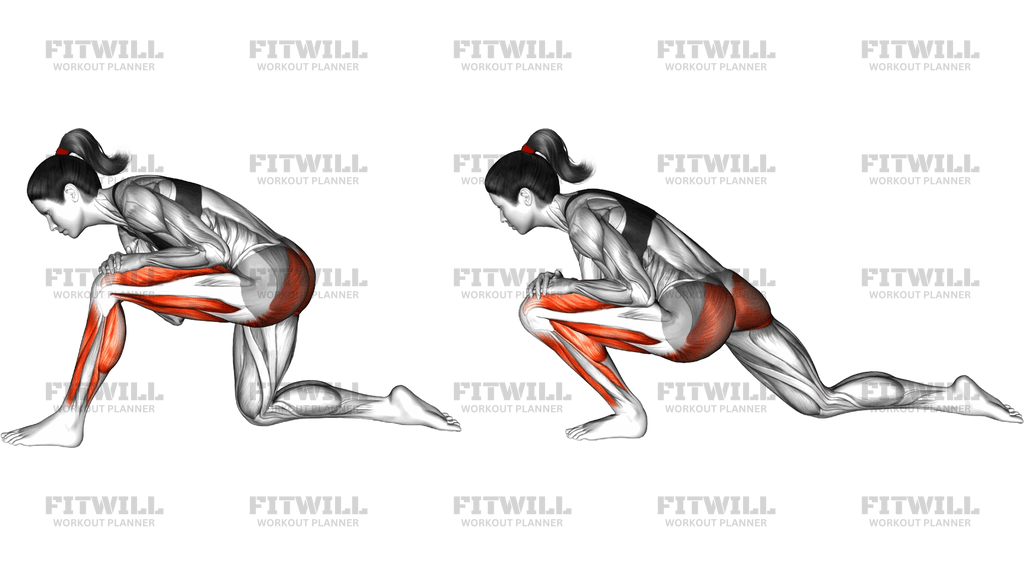
Instructions
- Kneel on one knee with the other foot flat on the floor in front of you, ankle roughly stacked over the knee so the shin is close to vertical.
- Place both hands on top of the front knee to support and guide it, and keep your torso upright with a slight forward lean over the front leg.
- Press the front heel firmly into the floor and keep it there for the entire set; the heel must not lift or roll.
- Brace your trunk lightly so your hips do the work, then slowly glide the knee forward and over the toes, past the pinky toe line if it stays comfortable.
- Stop when you feel tension in the calf or a stretch at the front of the ankle, and hold that end position for a one-second pause.
- Push back through the heel to return the knee to the starting position without letting the foot shift.
- Repeat for eight to twelve slow, controlled rocks, staying smooth rather than forcing deeper each rep.
- Breathe steadily throughout, exhaling as the knee travels forward to help relax the calf.
- After the set, stand up or step the rear leg forward, compare how each ankle feels, and repeat the full set on the other side.
Tips & Tricks
- A lifting heel is the most common error in the Self Ankle Mobilization; if the heel rises, the knee has traveled too far forward, so shorten the range until the heel stays down and rebuild depth gradually.
- Do not let the arch collapse inward as the knee moves; press the base of the big toe into the floor so the joint hinge, not the arch, produces the motion.
- If the front of your ankle pinches, back off slightly and add gentle ankle circles at mid-range before rocking again rather than pushing straight into the pinch.
- Vary the target: one set rocking the knee straight forward, another set aimed outside the pinky toe, and a third aimed inside can reach different angles of the joint.
- Keep the rear knee planted on the floor; if it slides back your hips drop and the drill turns into a hip stretch instead of an ankle drill.
- Move at a tempo of about two seconds forward and two seconds back; rushing turns the rocks into a bouncing stretch that the joint stiffens against.
- Placing a thin pad or folded towel under the kneeling knee makes longer sets comfortable enough to focus on the ankle instead of the floor contact.
- If one side is noticeably stiffer, do an extra set on that side but keep the depth pain-free rather than matching depth to the mobile side.
Frequently Asked Questions
What does the Self Ankle Mobilization actually improve?
It improves ankle dorsiflexion, the ability of the shin to travel over the foot, by repeatedly taking the joint into its end range while the heel stays planted. It also teaches you to keep the foot and arch stable while the ankle bends.
Which muscles and joints are involved?
The main target is the ankle joint itself, with a stretch felt in the gastrocnemius and soleus of the calf and the deeper tissues around the ankle. The front leg's stabilizers work to keep the foot flat and the knee tracking forward.
Is the Self Ankle Mobilization good before squats?
Yes, it is one of the most practical pre-squat drills because squat depth depends heavily on dorsiflexion. Two sets of ten rocks per side before training usually makes the heels stay down and the knees track better.
How close should my front knee be to my hands or a wall?
Start with the shin near vertical and the knee over the ankle, then rock the knee forward past the toes. If you want a test version, place the foot about a hand-width from a wall and try to touch the knee to the wall without the heel lifting.
Should I feel this as a stretch or as pressure?
A stretch in the calf or a mild stretching pressure at the front of the ankle is normal, but a sharp or pinching pain is not. If pinching occurs, reduce the depth, adjust the knee track slightly, and build range gradually over sessions.
How many reps and sets should I do?
Eight to twelve slow rocks per side works well, for one to three sets depending on how stiff the ankles feel. Because this is a mobility drill, consistent daily or near-daily practice beats one long weekly session.
Can I do this after an ankle sprain?
Regaining dorsiflexion is usually a key goal after a sprain, and this drill fits well into that process. Clear it with a healthcare professional first, and work only within a pain-free range while the ligaments heal.
What can I use instead if kneeling hurts my knee?
A knee-to-wall version standing with both feet on the floor works the same joint action, as does a standing calf stretch performed with a slow forward knee drive. A folded towel under the kneeling knee is often enough to make the original setup comfortable.
Why does my heel keep lifting during the Self Ankle Mobilization?
That usually means you are pushing past your current range or letting your weight shift toward the toes. Shorten the forward glide, keep more weight over the whole foot, and progress depth only when the heel stays planted through the full set.