Side Lying Chest Stretch
The Side Lying Chest Stretch is a floor-based flexibility exercise that targets the pectoral muscles by using body rotation instead of an active arm position. You lie on one side with your knees bent and your lower arm extended, then press into the floor with your top hand and slowly rotate your torso backward so the chest on the underside of your body opens up toward the ceiling. Because gravity and your own body weight create the stretch, it is easy to regulate and comfortable to hold for longer periods than many standing chest stretches.
This movement is especially useful for people who spend a lot of time pressing in the gym, sitting at a desk, or hunched forward over a phone. Those habits keep the chest in a shortened position, which can pull the shoulders forward and limit overhead mobility. The Side Lying Chest Stretch places the pec major, and to a lesser degree the pec minor and front of the shoulder, into a lengthened position in a supported way, making it a good fit for lifters after bench or push-up sessions and for anyone working on shoulder posture.
The side-lying setup is what makes this stretch distinct. With your hips and knees stacked and your head supported, your spine stays neutral while the rotation happens through the upper back and chest rather than through a strained low back or an overloaded shoulder. The extended bottom arm sets the line of the stretch, and small changes in that arm's height shift the emphasis between the upper and lower fibers of the chest.
Execution is simple but slow. Press your top palm into the floor, rotate your chest back toward the open side, and stop at a moderate pull across the stretched pec, not a sharp pain. Hold the end position while breathing steadily, then return under control. The second half of the movement matters just as much as the stretch itself: lowering yourself back down slowly keeps the tissue from being yanked and lets you notice exactly where the tension begins.
Because it requires no equipment and very little space, this stretch works well as part of a cooldown, a morning mobility routine, or a desk-break sequence. Most people benefit from thirty seconds to a minute per side, and consistent use over weeks is what produces lasting improvements in chest flexibility and shoulder positioning.
Fitwill
Log Workouts, Track Progress & Build Strength.
Achieve more with Fitwill: explore over 9600 exercises with images and videos, access built-in and custom workouts, perfect for both gym and home sessions, and see real results.
Start your journey. Download today!




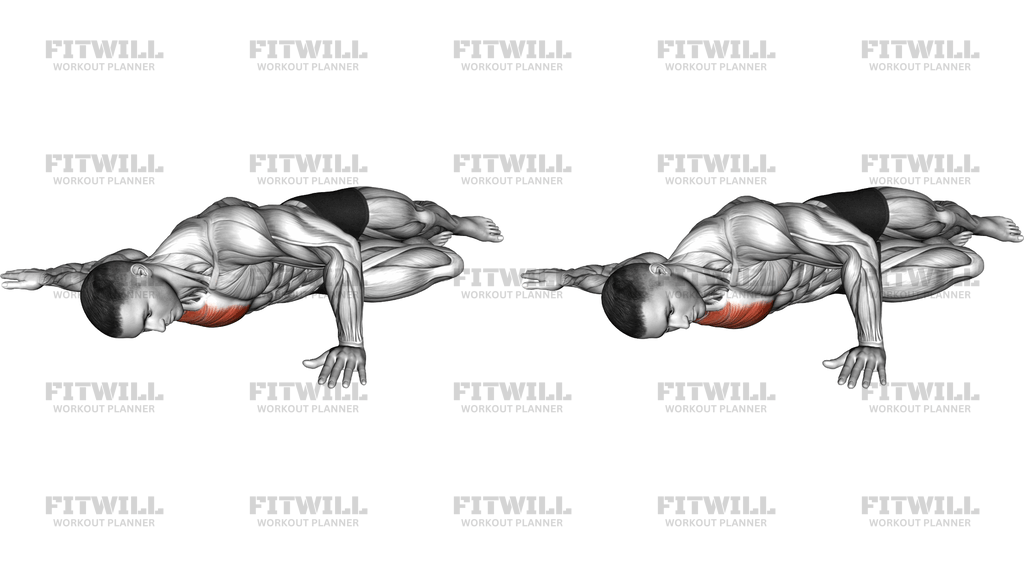
Instructions
- Lie on your right side on the floor with your legs stacked and knees bent, settling into a comfortable side-lying position.
- Extend your bottom (right) arm straight out in line with your shoulder, palm facing up, and rest your head against it or beside it so your neck stays neutral.
- Place your top (left) palm flat on the floor in front of your chest with fingers pointing away from you and the elbow slightly bent.
- Gently press into your top hand to brace yourself, keeping both hips stacked and knees together so the rotation comes from your torso, not your pelvis.
- Slowly rotate your chest and upper back backward toward the floor, letting the underside of your chest open toward the ceiling.
- Stop when you feel a moderate stretch across the right side of your chest and the front of your right shoulder, then hold that end position for 20 to 30 seconds.
- Breathe slowly and steadily while holding, and let each exhale soften the tension slightly so the rotation can deepen a little more.
- Return with control by easing the pressure off your top hand and rotating back down to the starting side-lying position.
- Repeat for your desired hold time or reps, then switch sides by lying on your left side and pressing with your right hand.
Tips & Tricks
- Keep your hips and knees stacked throughout the stretch; if your pelvis rotates back with you, the movement turns into a spine twist and the chest loses tension.
- Adjust the height of your extended bottom arm: a arm roughly at shoulder height targets the mid-chest, while raising it shifts the pull toward the upper chest fibers.
- Do not let your top arm do all the work by forcing a fast rotation; the floor press is only meant to guide you into the stretch, and momentum will make you overshoot.
- If your shoulder pinches at the end range, back off a few degrees and reduce how far you rotate rather than pushing into the discomfort.
- Keep your head resting on or beside your bottom arm; craning or lifting the head tightens the neck and steals range from the chest.
- Sink into the stretch slightly more on each exhale instead of trying to reach the full end range on the first rotation.
- If your top hand cannot comfortably reach the floor, place it slightly closer to your body or let a folded towel support it partway through the range.
- Use this stretch after pressing workouts like bench press, push-ups, or dips when the chest is warm and responds better to lengthening.
- Compare sides and give your tighter side extra hold time, since one chest is usually stiffer from sleeping posture or training imbalances.
Frequently Asked Questions
Which muscles does the Side Lying Chest Stretch target?
The primary target is the pectoralis major on the underside of your body, with the pectoralis minor and front of the shoulder also lengthened as the torso rotates back.
Why stretch the chest while lying on my side instead of using a doorway stretch?
The floor supports your spine and head, so the rotation is easier to control and the shoulder is not loaded by holding an arm position. This makes it a gentler option for stiff or cranky shoulders.
How long should I hold the Side Lying Chest Stretch?
Hold 20 to 30 seconds per repetition, or settle into one longer hold of 45 to 60 seconds per side. For lasting flexibility gains, consistency over several weeks matters more than a single long session.
Is the Side Lying Chest Stretch suitable for beginners?
Yes. There is no equipment and the intensity is fully self-regulated, so a beginner can rotate only a few degrees and still get a useful stretch.
Should I feel the stretch in both sides of my chest?
No. This is a unilateral stretch, meaning the chest on the underside of your body is the one being lengthened while the top side stays neutral.
My pelvis rotates back with me during the stretch. What am I doing wrong?
The rotation is traveling too far down your body. Keep your knees bent, legs stacked, and think of the movement happening only from your chest and upper back upward.
Can the Side Lying Chest Stretch help with rounded shoulders?
It can be a useful part of a posture routine because it lengthens tissue that is chronically shortened by forward-shoulder positions, but it works best alongside back-strengthening exercises rather than as a standalone fix.
What is the most common mistake in this stretch?
Rotating too far too fast with the top arm and ending up with a pinch at the front of the shoulder. Slow the rotation down and stop at a moderate pull across the chest, not pain.
When is the best time to do the Side Lying Chest Stretch?
After pressing workouts, at the end of a training session, or during a separate mobility block when your muscles are warm. It also works as a low-effort morning mobility drill.
Is this stretch safe if I have a shoulder injury?
It is generally low load, but if you have a current or recent shoulder injury, reduce the rotation range, keep the stretch shallow, and check with a qualified professional before working into the end range.