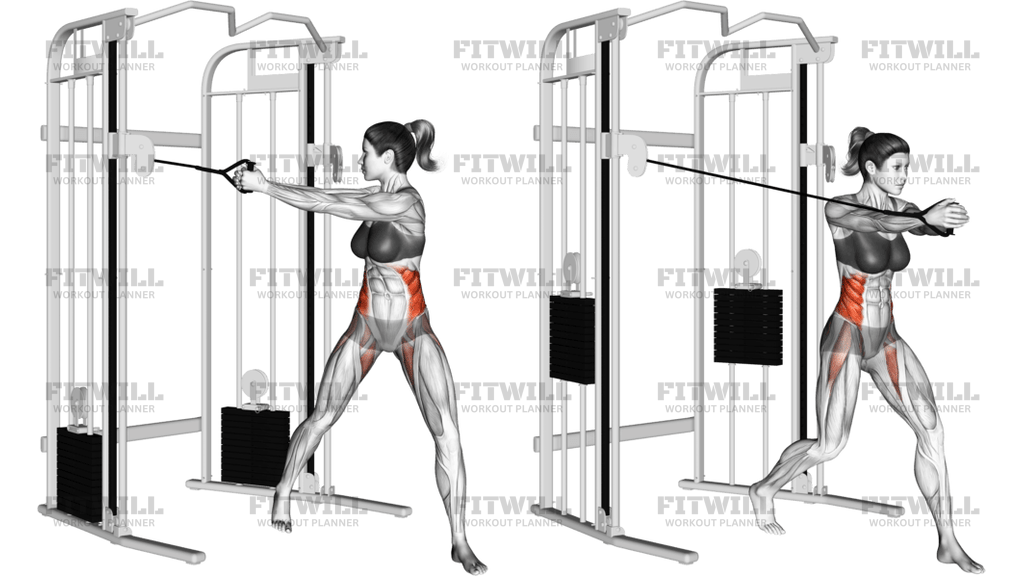
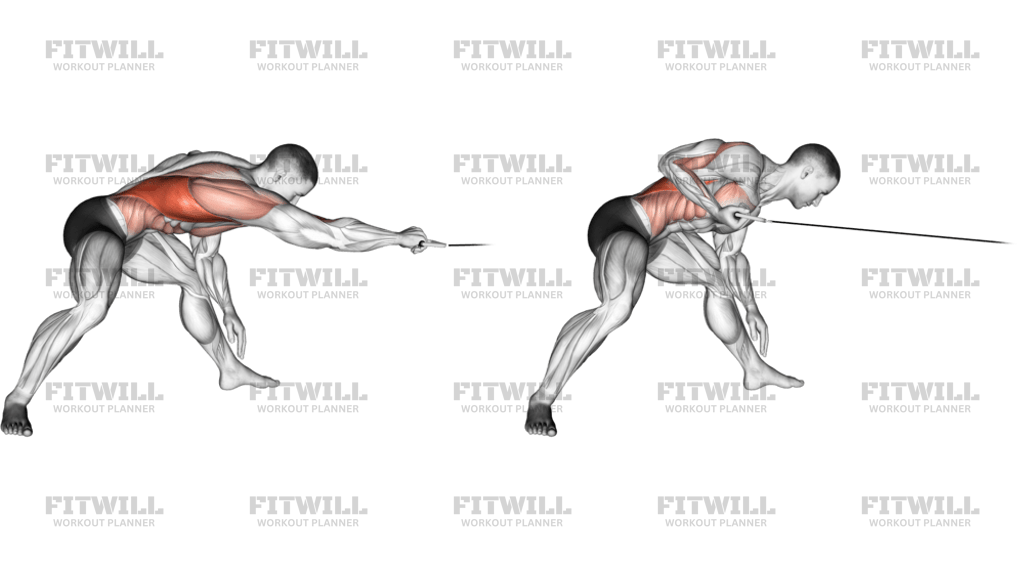
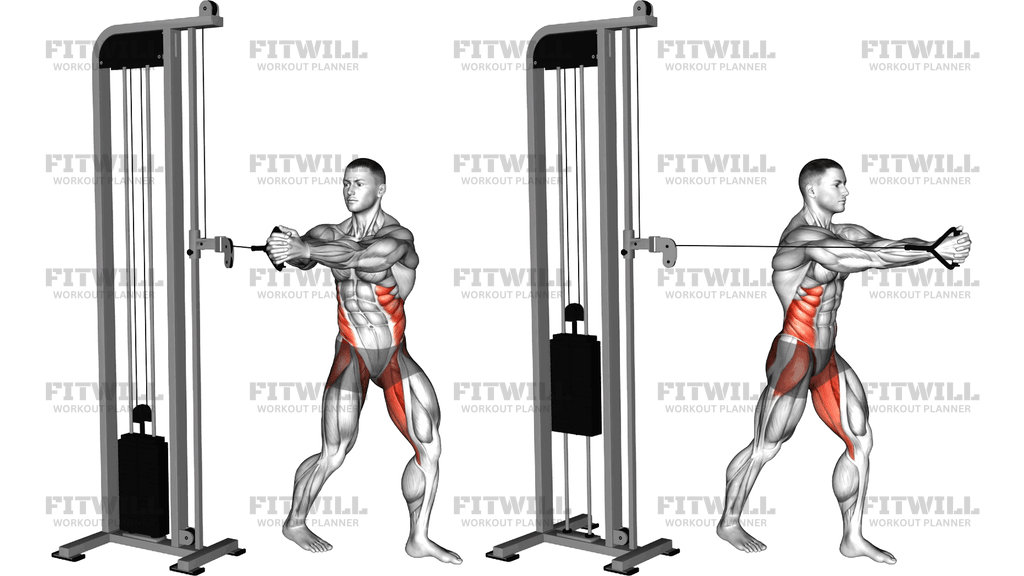
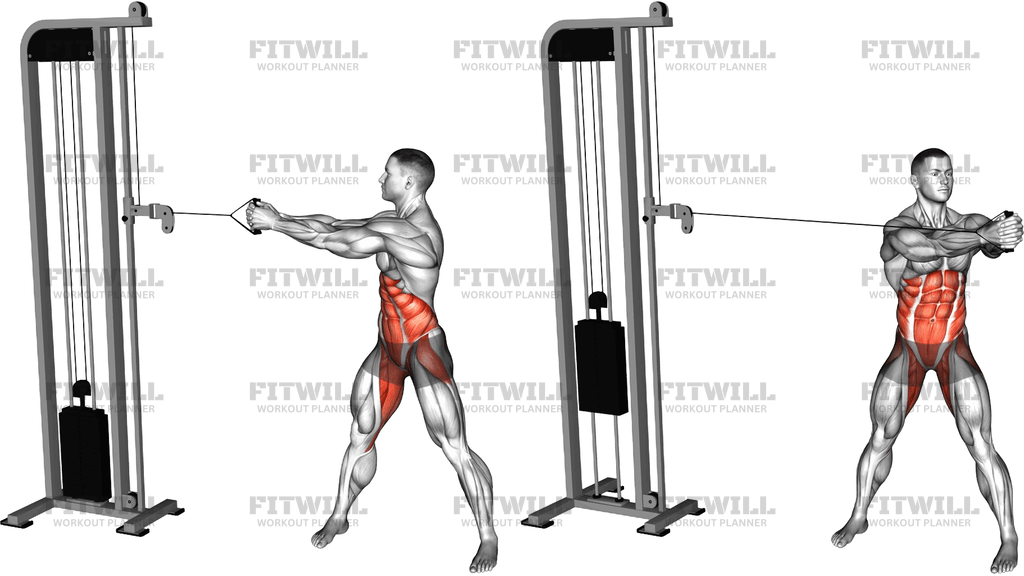
Cable High To Low Woodchopper
The Cable High To Low Woodchopper is a rotational core exercise performed on a cable machine with the pulley set at its highest position. You stand sideways to the stack, grip a single handle with both hands, and pull it diagonally down across your body toward your opposite hip, mimicking the motion of chopping wood from an overhead start. Because the cable provides continuous resistance through the entire arc, the obliques and deep trunk stabilizers stay loaded from the first inch to the last.
This movement earns its place in most programs because rotation in daily life and sport almost always travels diagonally. Swinging a bat, racket, or golf club, throwing, and even carrying a heavy bag up stairs all rely on the same high-to-low cross-body pattern the woodchopper trains. It is especially valuable for athletes who need to transfer force from the upper body through the trunk to the legs, and for anyone whose core work has been limited to crunches and planks that never challenge rotation.
The primary work comes from the obliques on the side you are rotating toward, supported by the rectus abdominis, the lats and shoulders on the pulling arm, and the hips and glutes, which anchor the lower body so the rotation happens at the trunk rather than by drifting at the feet. Setup matters more than it looks: standing too close or too far from the pulley changes the resistance angle, and a soft brace lets the low back take load the core should be handling.
Execution is about rotating as one connected unit. Arms stay relatively long with a firm grip, the pull initiates from the trunk, and the handle travels a smooth diagonal path from above one shoulder down to the outside of the opposite hip. The return should be just as controlled as the pull, resisting the cable back to the start instead of letting it yank the arms upward.
You will see this exercise used as a core finisher, a warm-up activation drill before throwing or swinging sports, and as a main rotation movement in athletic strength blocks. Keep the weight honest; this is a pattern exercise first, and a load you can own through a full controlled arc will build far more usable rotational strength than a heavy weight that turns the chop into a sideways crunch.
[ Workout Log & Planner ]
Put your next workout in Fitwill
Keep your plan and training log ready when you are.


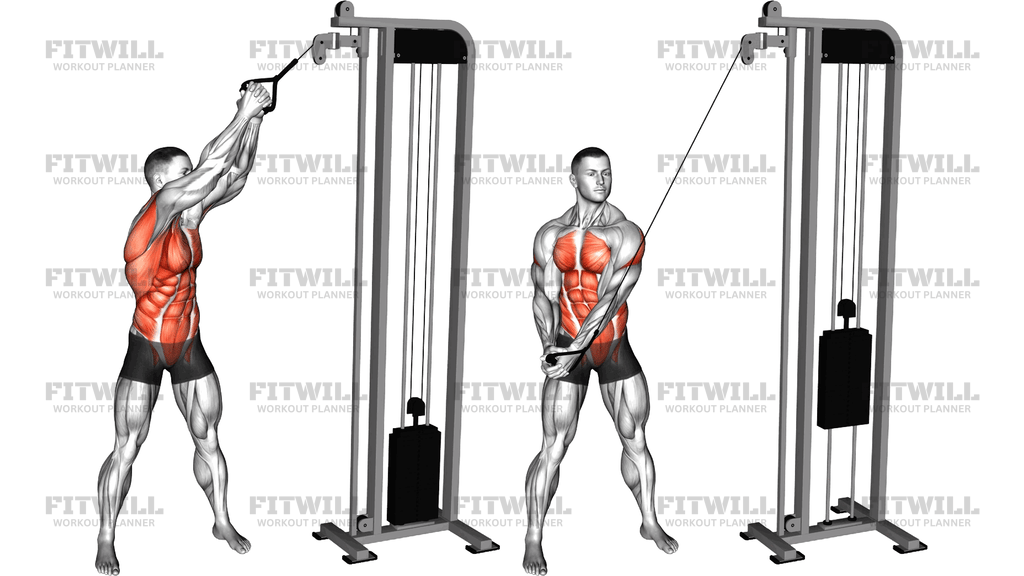
Instructions
- Set the cable pulley to its highest position on the machine and attach a single handle.
- Stand sideways to the cable machine with the pulley on your upper-working side, feet roughly shoulder-width apart or slightly wider, and reach up to grip the handle with both hands, one over the other.
- Step far enough from the machine that the cable is taut at the start and your arms are extended up and out toward the pulley, above and slightly in front of your lead shoulder.
- Brace your core, soften your knees slightly, and square your hips toward the direction you will be pulling.
- Pull the handle down and across your body in a smooth diagonal, rotating your trunk and letting your hips turn a little with it until the handle ends just outside your opposite hip with arms nearly straight.
- Pause briefly at the bottom, squeezing the abs and obliques rather than locking out hard.
- Resist the cable and slowly return the handle along the same diagonal path until your arms are extended back above the starting shoulder.
- Exhale as you pull down and inhale as you control the weight back up.
- Complete all reps on one side, then re-grip and switch your stance to work the opposite side.
Tips & Tricks
- If you feel the strain in your low back instead of your obliques, the weight is likely too heavy or your brace is too loose; reduce the load and tighten your abs before each rep.
- Keep your arms long rather than bending the elbows to row the handle in. Elbow flexion turns the woodchopper into a pull-down and steals the work from your trunk.
- Do not let the handle drift toward the machine or wide of your hip. A straight diagonal line from high shoulder to low hip keeps the obliques doing the work.
- Allow a small, controlled hip rotation, but avoid pivoting so far that your feet twist off the floor; drive the movement from the trunk while the legs stay planted.
- Stand at a distance where the weight stack cannot rest between reps. If the cable goes slack at the top, step back until there is steady tension through the full arc.
- Keep shoulders down and away from your ears at the start; shrugging as you reach up shifts tension to the upper traps.
- Lower the weight if you catch yourself using momentum or leaning backward to finish the pull. A three-second return is a good self-test for control.
- Match reps and effort on both sides even if your non-dominant side feels weaker, so you do not build further asymmetry.
- Exhale forcefully through the chopping portion, as if bracing for a light impact; this reinforces core engagement at the hardest point of the rep.
Frequently Asked Questions
Which muscles does the Cable High To Low Woodchopper work?
The obliques are the primary movers, with strong support from the rectus abdominis and deep core. The lats and front delts drive the arm path, and the glutes and hips stabilize as you rotate.
How is the Cable High To Low Woodchopper different from the Low To High version?
The high-to-low version starts with the pulley above your shoulder and pulls down toward the opposite hip, emphasizing a downward diagonal pattern. The low-to-high version reverses that path and tends to feel slightly harder on hip and trunk control on the way up.
Is this exercise suitable for beginners?
Yes, as long as the weight starts light. Beginners should spend the first few sessions learning the diagonal path and keeping the arms long before adding meaningful load.
How far should I stand from the cable machine?
Stand far enough that the cable stays taut with your arms extended up toward the pulley at the start. If the stack rests or the cable goes slack between reps, take one step farther away.
Should my hips rotate during the Cable High To Low Woodchopper?
A modest hip turn is natural and helps the pattern stay athletic, but the feet stay planted and the rotation should come mainly from the trunk. Excessive spinning usually means the weight is too heavy.
Why do my shoulders and arms fatigue before my abs?
This usually means you are pulling with the arms and bending the elbows. Keep the elbows nearly straight and think of the hands as hooks while the trunk performs the chopping motion.
What can I use if my gym has no cable machine?
A resistance band anchored overhead can replicate the same high-to-low diagonal, though tension peaks differently. A medicine ball slam with a rotational step is a reasonable athletic substitute.
How many reps and sets should I do?
For rotational strength and control, 2 to 4 sets of 8 to 12 reps per side works well. Use lighter loads and higher reps if you are warming up for a sport session.
Is it safe for people with lower back sensitivity?
Many people tolerate it well because the cable guides the path and the trunk rotates under control, but keep the range modest, avoid jerky pulls, and stop if you feel sharp or radiating discomfort.
Should I pause at the bottom of the chop?
A short pause with the abs squeezed helps you own the end position and prevents using a bounce off the rotation to return the weight. One second is enough.