Kettlebell Half Kneeling Halo
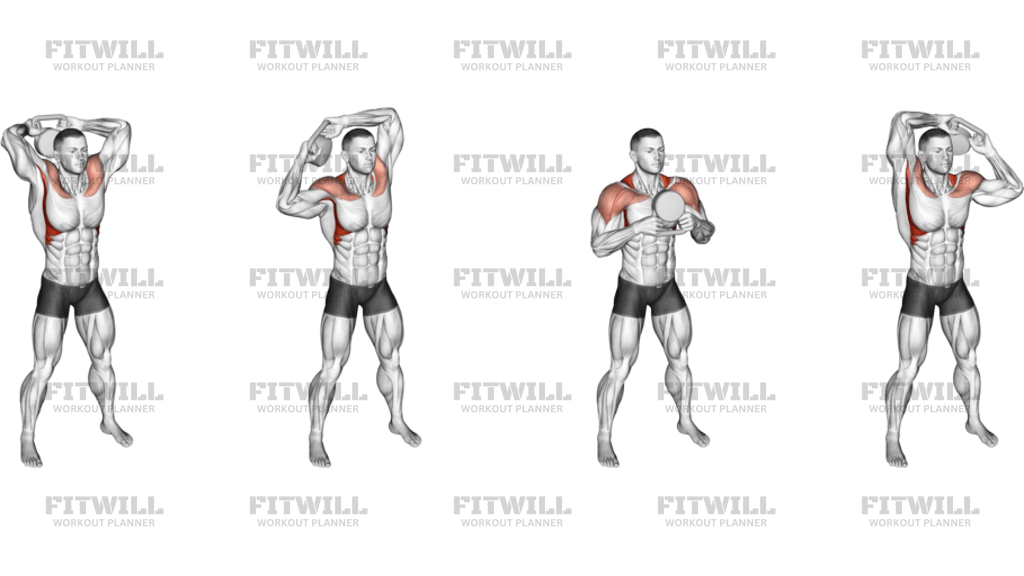
The Kettlebell Half Kneeling Halo is a shoulder mobility and core stability drill where you circle a kettlebell around your head while holding a half-kneeling stance — one knee down, the opposite foot planted in front. The kneeling base removes your legs from the equation, so any wobble in the weight has to be handled by your trunk rather than absorbed by your hips and ankles. It is a controlled, deliberate movement, not a speed drill.
This exercise is especially useful for people who press overhead, throw, or play racket sports, because it trains the shoulders to move smoothly through a full circular path while the core resists rotation. It is also a low-load option for lifters whose shoulders feel stiff at the start of a session — a light kettlebell halo before pressing often does more for overhead comfort than static stretching.
The half-kneeling position is what separates this from a standing halo. With your rear knee on the floor and front shin vertical, your pelvis has to stay level and square forward. If your torso twists or your hips sway as the kettlebell travels behind your head, the drill stops training what it is meant to train. That is why the setup — tall spine, front foot flat, rear knee anchored — matters as much as the circling itself.
To execute it well, hold the kettlebell by the horns close to your chest, then raise it and circle it around your head at roughly eye level, keeping the weight tight to the body and your elbows staying reasonably bent. Your head stays still; the kettlebell moves, not your neck. Complete all repetitions in one direction, then repeat on the other side, and switch kneeling legs so both halves of your body get the same work.
Common use cases include overhead pressing warm-ups, shoulder rehab progressions under supervision, and trunk stability work for people who find standing anti-rotation drills too easy or too hard on their balance. Because the load stays close to the head, a light to moderate kettlebell is all you need — this is one exercise where going heavier almost always makes the form worse.
For safety, start lighter than you think you need. The kettlebell passes near your face and the back of your head on every rep, so a grip that fatigues or a range you cannot smoothly control turns a good drill into a risky one. Keep the movement slow enough that you could pause the kettlebell at any point in the circle.
[ Workout Log & Planner ]
Put your next workout in Fitwill
Keep your plan and training log ready when you are.


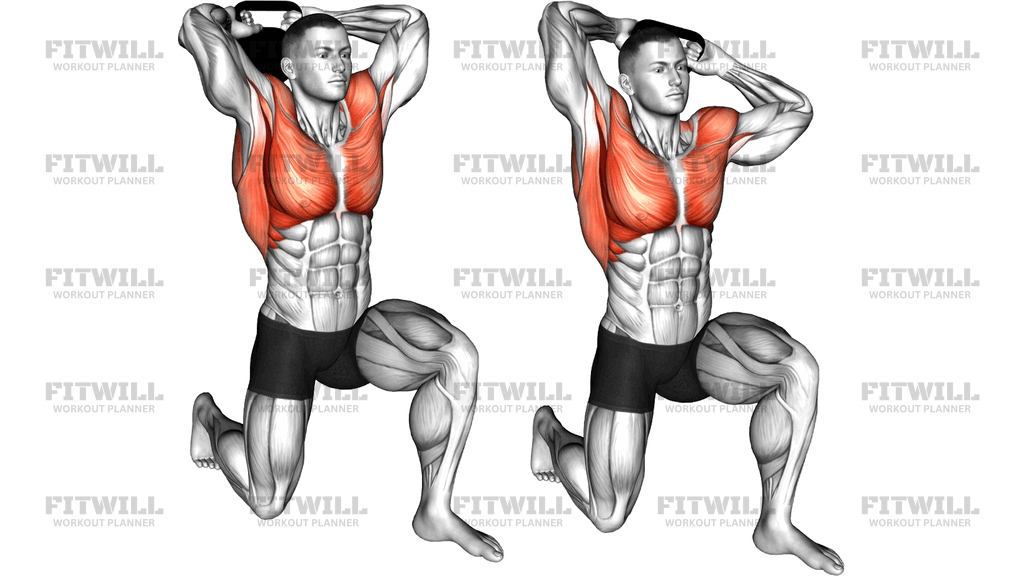
Instructions
- Kneel on your right knee with your left foot planted flat on the floor in front of you, left shin vertical and left knee bent roughly 90 degrees.
- Squeeze your rear glute and tuck your pelvis slightly so both hips face straight ahead and your torso sits tall over your front foot.
- Grip the kettlebell by the horns with both hands at chest height, elbows tucked, and brace your abs as if preparing for a light push to the chest.
- Raise the kettlebell so your hands are just above shoulder height in front of your chest, keeping your shoulders relaxed and away from your ears.
- Circle the kettlebell around the left side of your head, guiding it past your ear, behind your head, and around the right ear in a smooth oval path at eye level.
- Keep your head, chest, and hips completely still throughout the circle — the kettlebell travels around you, not the other way around.
- Complete the circle back to the starting position in front of your chest, then repeat for your target reps in that direction.
- Reverse the direction and perform the same number of circles clockwise and counterclockwise.
- Exhale slowly as the kettlebell travels behind your head; avoid holding your breath at the back of the circle where the lever arm is longest.
- After finishing one set, switch so your left knee is down and right foot is forward, and repeat to keep both sides even.
Tips & Tricks
- If your torso rotates as the kettlebell passes behind your head, your hips are doing the work your core should be doing — lighten the kettlebell and imagine a cup of water balanced on your pelvis that you cannot spill.
- The most common fault in this exercise is flaring the front knee inward as fatigue builds; actively press the outside of your front foot into the floor to keep the knee tracking over it.
- Keep the kettlebell close to your head, about an inch or two of clearance at the ears. A wide halo circle is easier to balance but trains far less shoulder control.
- If your shoulders shrug toward your ears at the back of the circle, the weight is too heavy or your upper traps are dominating — consciously pull your shoulder blades down before starting each rep.
- Rushing the rep is the fastest way to lose the benefit; take two to three seconds per full circle so the shoulders actually work through the path instead of swinging the bell.
- Your rear knee should feel anchored, not floating. Placing a folded mat or towel under the knee makes longer sets comfortable and stops you from shifting weight off the kneeling side.
- If your grip fails before your shoulders do, switch to a lighter bell or hold it by the handle body with both hands higher on the horns — the halo should challenge your trunk and shoulders first.
- Alternate which side you circle first each session; most people favor one direction and the weaker path is where shoulder stiffness actually shows up.
Frequently Asked Questions
What muscles does the Kettlebell Half Kneeling Halo work?
The shoulders and rotator cuff drive the circular path, while the core — especially the obliques and deep trunk stabilizers — works to keep your torso from rotating. The upper traps and hip stabilizers assist as you hold the half-kneeling position.
Is the Kettlebell Half Kneeling Halo good for beginners?
Yes, it is a beginner-friendly drill as long as the kettlebell is light. Beginners should focus on moving slowly and keeping the hips square, which matters more than the weight used.
How heavy should the kettlebell be for Halos?
Most people do well with a very light bell, roughly 4 to 12 kg depending on experience. If you cannot pause the kettlebell at the back of your head without wobbling, the weight is too heavy.
Why do the Halos in a half-kneeling stance instead of standing?
The half-kneeling base locks out your legs and hips, forcing the trunk and shoulders to control the kettlebell without help from a wide stance. It also trains hip and pelvis control that carries over to pressing and lunging.
Should my head move during the Kettlebell Half Kneeling Halo?
No — your head stays still and eyes forward while the kettlebell circles around it. Moving your head with the bell usually means the weight is too heavy or the circle path has drifted too wide.
Where exactly should the kettlebell travel during the halo?
It should trace a tight oval around your head at eye level, passing close to each ear and just behind the crown of your head. Keep enough clearance that the bell never touches you.
Can I use a dumbbell instead of a kettlebell for this exercise?
Yes, a small dumbbell held horizontally with both hands works, though the kettlebell's horn grip keeps the weight closer to your body and is generally more comfortable circling near your head.
Should I do the Kettlebell Half Kneeling Halo before or after pressing?
It works best as a warm-up before overhead pressing, when a few light circles can improve shoulder comfort and readiness. Doing heavy halos after pressing when your grip is fatigued is less effective and riskier.
My lower back arches when the kettlebell goes behind my head — is that a problem?
Yes, that arch usually means your abs have stopped bracing. Squeeze your rear glute, tuck the pelvis slightly, and lighten the load; the movement should never strain your lower back.