Standing Knee Raise Back Kick
The Standing Knee Raise Back Kick is a body weight movement that combines two opposing hip actions into one flowing rep. From a tall stance with both arms reaching overhead, you drive one knee up in front of your body, then immediately swing that same leg back into a controlled rear kick before returning it to the floor. Because the leg travels from full hip flexion into full hip extension without ever touching down, the working hip moves through a wide arc while the standing side has to handle balance and load all on its own.
This combination trains the glutes and hamstrings on the back kick, the hip flexors and lower abs on the knee raise, and the core throughout, since the arms stay overhead the entire time. That overhead position raises your center of gravity and removes any arm swing you would normally use for balance, which makes the deep core and the stabilizers around the standing hip work much harder than they would in a standard standing leg swing.
The exercise suits warm-ups, glute activation work, and low-impact conditioning circuits. It is a good choice for people who want to open up the front of the hip and wake up the backside after long periods of sitting, and it fits well into body weight leg days or core-focused sessions where no equipment is available. Because each rep is performed on one leg, it also exposes and helps correct side-to-side differences in hip mobility and stability.
Setup matters more than it looks. Stand tall with feet hip-width apart, interlace your fingers and press your palms toward the ceiling so your arms stay long and stacked over your shoulders. Brace your trunk lightly, as if bracing for a nudge, and keep your ribs stacked over your pelvis. If you start with a slack torso or flared ribs, the knee raise will pull you into an arch and the back kick will dump you forward, and you lose the core benefit of the overhead position.
To execute well, lift one knee to roughly hip height with a tall spine, then sweep the same leg back, squeezing the glute and letting the leg extend behind you with only a soft bend in the knee. The kick should feel like a controlled swing driven by the glute, not a fling that yanks your lower back into an arch. Return the leg forward and down to the floor with control, complete your reps on one side or alternate legs, and keep breathing steadily rather than holding your breath as the leg travels.
The most common errors are rushing the kick, arching the lower back as the leg goes behind, and letting the arms drift forward for balance. Keep the reach overhead, move at a pace you can steer, and reduce the height of the knee or the reach of the kick until you can stay upright on the standing leg.
[ Workout Log & Planner ]
Put your next workout in Fitwill
Keep your plan and training log ready when you are.


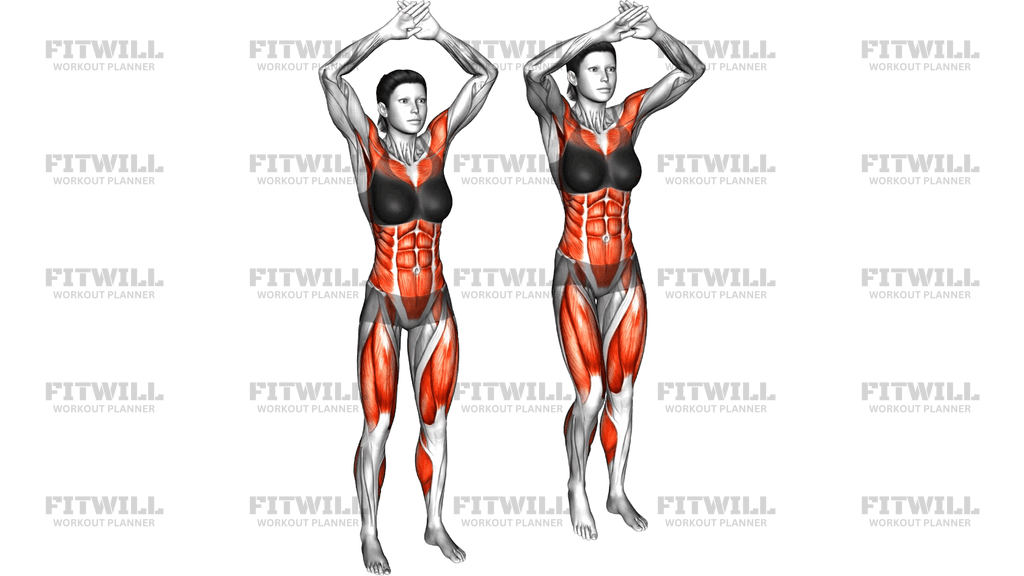
Instructions
- Stand with your feet hip-width apart and your weight spread evenly across both feet.
- Interlace your fingers and press your palms upward so both arms are fully extended overhead, stacked over your shoulders.
- Brace your abdominal wall lightly and keep your ribs down over your pelvis before you start moving.
- Shift your weight onto one leg and lift the opposite knee up in front of you to about hip height, keeping your torso tall.
- Without letting the foot touch down, swing the same leg behind you into a back kick, squeezing the glute and extending the hip while the knee stays softly bent.
- Pause briefly at the end of the kick, feeling the contraction in the glute rather than forcing extra height with your lower back.
- Bring the leg forward and lower it back to the floor under control, then either repeat on the same side or switch legs.
- Exhale as the knee lifts and the leg kicks back, and inhale as the leg returns to the standing position.
- Keep both arms reaching overhead for every rep; do not let them drop forward as the leg moves.
- Reset your stance and brace between sets if you notice yourself wobbling or arching your back.
Tips & Tricks
- If you fall forward during the back kick, your torso is probably leaning instead of the hip extending; think of pushing the heel back rather than tipping the chest down.
- Rushing the transition from knee raise to kick is the most common fault. Slow the swing down until you can keep the standing knee soft and still.
- Watch for rib flare during the knee raise. If your lower back arches as the knee lifts, lift the knee slightly lower and re-brace your trunk.
- Keep the standing leg knee slightly bent rather than locked so the hip stabilizers can do their job and your balance improves.
- Spread your toes and grip the floor with the standing foot. This alone often fixes side-to-side wobble in the back kick.
- If your shoulders tire from holding the arms overhead, check that your hands are actually stacked over your shoulders and not drifting behind your head.
- Alternate legs rep for rep if one side is noticeably steadier, and finish with extra reps on the weaker side rather than always starting with the strong one.
- Add a two-second hold at the top of the kick once the basic pattern feels easy to increase the glute demand without adding equipment.
- Perform the movement near a wall with a fingertip on it for the first few sessions if balance is the limiting factor, then progress to free standing.
Frequently Asked Questions
What muscles does the Standing Knee Raise Back Kick work?
The back kick targets the glutes and hamstrings, while the knee raise recruits the hip flexors and lower abs. The overhead arm position keeps the core and standing-leg hip stabilizers engaged throughout.
Why are the arms held overhead during the Standing Knee Raise Back Kick?
Keeping the arms overhead raises your center of gravity and removes arm swing for balance, which forces the trunk and standing hip to stabilize more. It also keeps the torso tall so the leg can move freely at the hip.
Is the Standing Knee Raise Back Kick suitable for beginners?
Yes, as long as the range is matched to your balance. Start with a lower knee lift and a shorter kick, and keep a fingertip on a wall until you can stay upright without support.
Should I alternate legs or complete all reps on one side?
Both work. Alternating keeps the heart rate up and suits warm-ups, while completing all reps on one side before switching makes it easier to notice and correct side-to-side imbalances.
How high should the knee come up in the Standing Knee Raise Back Kick?
About hip height is a good target, but only as high as you can lift while keeping your ribs down and torso tall. Height that costs you posture is not worth it.
Why does my lower back arch when I kick my leg back?
That usually means the glute is not driving the extension, so the spine is substituting. Squeeze the glute deliberately, slightly reduce how far the leg travels back, and keep the abs braced.
Can I use the Standing Knee Raise Back Kick as a warm-up?
Yes, it works well as a dynamic warm-up because it takes the hip through both flexion and extension while raising your temperature and activating the glutes before squats, lunges, or running.
What can I substitute if balancing on one leg is too difficult?
Hold a wall or sturdy chair with one hand and keep the free arm reaching overhead, or perform the knee raise and back kick with a smaller range. You can also do standing rear leg raises without the knee raise phase first.
How many reps of the Standing Knee Raise Back Kick should I do?
For warm-up or activation, 8 to 12 controlled reps per side is typical. For conditioning circuits, go by time, such as 20 to 30 seconds, while keeping the same control.
Is it safe to do this exercise every day?
As a low-load body weight movement, it can be done frequently, including in daily warm-ups. If you notice persistent pinching at the front of the hip, reduce the knee height and check your posture rather than pushing through.