Seated Cross Body Punch On A Chair
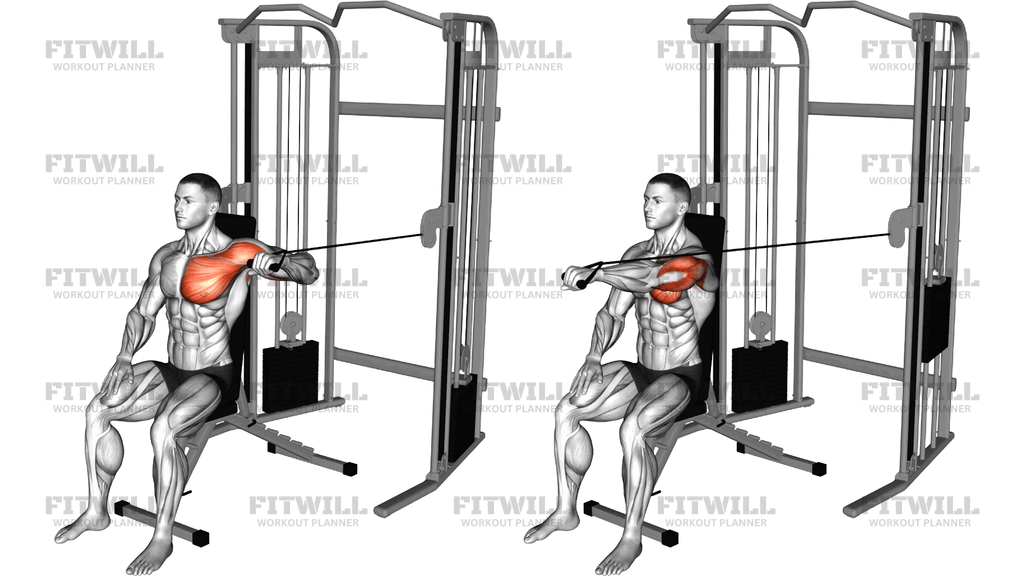
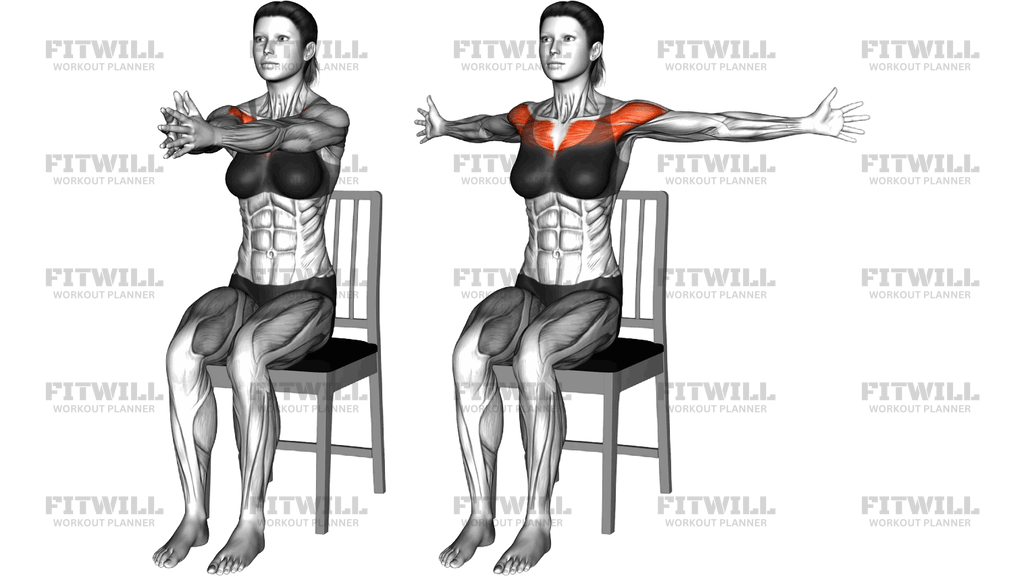
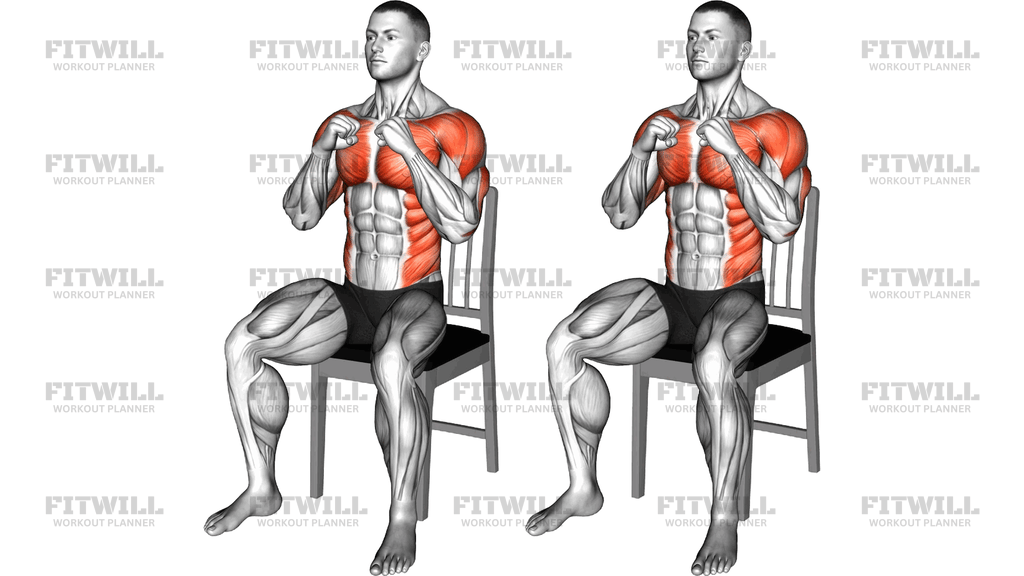
The Seated Cross Body Punch On A Chair is a bodyweight striking drill performed from an upright seat. You sit tall with your feet planted, raise both fists to chest height in a guard position, and punch one arm across the midline of your body toward the opposite side, alternating hands in a controlled rhythm. Because the chair removes your legs from the equation, all of the work shifts into your chest, front shoulders, triceps, and the trunk muscles that rotate and stabilize as each fist travels across your body.
This movement is especially useful for anyone who needs upper-body conditioning without standing or loading the joints. Older adults rebuilding confidence with pressing and reaching patterns, office workers breaking up long sitting periods, and people recovering general fitness who want a low-impact striking drill all fit well here. It also works as a warm-up before bench or pressing work, since it raises the heart rate while grooving scapular and shoulder movement without any external load.
The main muscles driving each punch are the pectorals, which horizontally adduct the arm across the chest, and the front deltoids, which lift and drive the arm forward. The triceps extend the elbow at the end of the punch, and the obliques plus deep core muscles control the slight trunk rotation that happens naturally when the arm crosses the midline. Even seated, your hip and torso stabilizers stay active to keep you from rocking side to side with each rep.
Setup matters more than it looks. Sit at the front half of the chair with your feet flat and about hip-width apart, keep your spine tall rather than slumped into the backrest, and hold your fists at chest height with elbows tucked slightly below shoulder level. If your posture collapses, the punch turns into a sloppy arm swing and you lose the chest involvement you are chasing. A stable base lets the rotation come from your ribcage and core instead of your lower back sagging.
To execute well, extend one fist across your body toward the opposite shoulder or side of the ribcage, keeping the moving arm roughly parallel to the floor. Reach to a point where your shoulder stays comfortable, then pull the fist straight back to guard and immediately punch with the other hand. The tempo should be deliberate on the way out and controlled on the way back, not a flailing speed test. Breathing works best in a steady pattern: exhale as you punch, inhale as the hand returns.
A common use case is performing this for time, such as 30 to 60 seconds of continuous alternating punches, or for reps in sets of 20 to 40 total punches. Keep the range shorter if your shoulders complain at full cross-body reach, and stop if you feel any pinching at the front of the shoulder. Because the resistance is only your own arm weight, progress comes from longer sets, tighter form, and slightly faster controlled reps rather than added load.
[ Workout Log & Planner ]
Put your next workout in Fitwill
Keep your plan and training log ready when you are.


Instructions
- Sit on a sturdy chair with your feet flat on the floor about hip-width apart and your weight on the front half of the seat.
- Sit tall through your spine, relax your shoulders down, and raise both fists to chest height with elbows bent and tucked close to your ribs.
- Brace your core lightly as if bracing for a light nudge, and keep your head level with your eyes forward.
- Exhale and extend your right fist across the midline of your body toward the left side of your chest, keeping the arm at chest height.
- Stop the punch at a point where your shoulder feels comfortable, with your palm facing down or inward and no shrugging of the shoulder.
- Pull the fist back along the same path to the guard position at your chest, keeping the elbow close to your body.
- Immediately punch with your left fist across toward the right side, alternating hands in a steady, controlled rhythm.
- Inhale as each hand returns to guard and exhale on each punch to keep your breathing even.
- Keep your torso mostly upright and let only a small, controlled rotation come from your ribcage with each cross-body punch.
- Complete your set, lower your hands to your lap, and reset your posture before starting the next set.
Tips & Tricks
- If your lower back starts to sway or your torso whips side to side, slow the tempo down and think of punching with your ribcage still facing forward.
- Avoid letting the punching shoulder hike up toward your ear; keep it pressed down and let the chest and front shoulder do the driving.
- Do not lock out the elbow sharply at the end of the punch; finish with the arm extended but soft so the joint stays protected.
- Keep both fists up between punches. Letting the resting hand drop to your lap breaks the guard position and reduces the continuous shoulder work.
- If your chair slides or feels unstable, place it against a wall so the backrest cannot tip during the rhythm.
- Aim the punch across at chest height rather than downward; punches that drift low pull your torso into a slump.
- Start with a slower pace for the first set to check that your shoulders tolerate the cross-body angle before speeding up.
- If full cross-body reach pinches the front of your shoulder, shorten the arc and punch only to the midline of your body.
- Keep your feet planted throughout; shifting or lifting your feet usually means the trunk rotation has gotten too aggressive.
Frequently Asked Questions
What muscles does the Seated Cross Body Punch On A Chair work?
The primary drivers are the pecs and front shoulders, which pull and press the arm across your chest. The triceps straighten the elbow, and the obliques and deep core stabilize the slight trunk rotation each punch creates.
Is the Seated Cross Body Punch On A Chair suitable for beginners?
Yes. It requires no equipment beyond a stable chair, has no external load, and the range and speed are fully self-controlled. Beginners should start with slow punches for 20 to 30 seconds and build up from there.
Why is this punch done seated instead of standing?
Sitting removes balance and leg fatigue from the drill so you can focus on chest, shoulder, and core engagement with a consistent angle. It also makes the movement accessible for people who have trouble standing for long periods.
How far across my body should each punch travel?
Punch toward the opposite side of your chest or shoulder, but stop short if you feel pinching at the front of the shoulder. Reaching roughly to the midline or slightly past it is enough to involve the pecs fully.
How do I stop my torso from swinging during the Seated Cross Body Punch On A Chair?
Brace your core, sit tall on the front half of the chair, and keep your ribcage facing forward with only a small controlled rotation. Slowing the tempo usually fixes excessive swinging immediately.
Can I use this exercise as a warm-up?
Yes, it works well as an upper-body warm-up before pressing or striking workouts because it raises your heart rate and takes the shoulders through a horizontal adduction pattern without load. One or two light sets of 30 seconds is plenty.
What kind of chair should I use?
Use a sturdy chair without wheels that will not tip or slide, ideally with a backrest you are not leaning on. Sit on the front half of the seat so your posture stays upright and your hips stay stable.
How many reps or how long should I perform the exercise?
A practical starting point is 30 seconds of continuous alternating punches or 20 to 30 total reps per set. Build toward 60-second sets or add sets as your shoulder endurance improves.
What can I substitute if I do not have a suitable chair?
Any firm seat works, including a bench, an exercise bench, or even sitting on the edge of a bed as long as your hips are stable and your feet reach the floor. Standing cross-body punches are a harder progression once seated reps feel easy.
Is it safe for my shoulders?
For most people yes, since the load is only your arm weight, but the cross-body angle can bother anyone with existing shoulder impingement. Keep the range comfortable, avoid sharp elbow lockout, and stop if you feel pinching rather than muscle effort.