Seated Lumbar Extension Flexion On Stability Ball
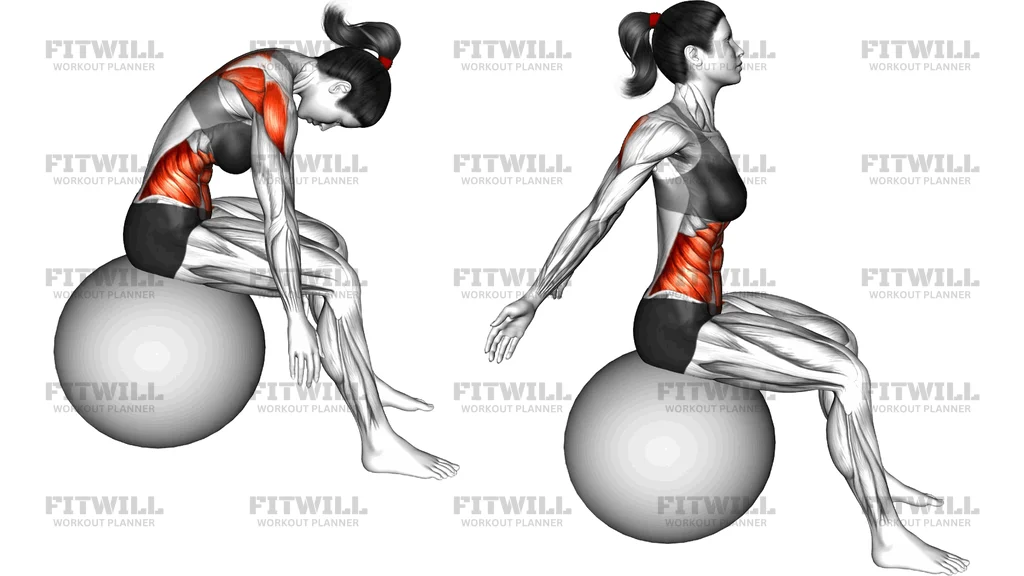
Seated Lumbar Extension Flexion On Stability Ball is a spinal mobility drill performed sitting upright on a stability ball with your feet flat on the floor. From a tall seated posture, you round your lower back and let the ball roll slightly underneath you as you slump forward, then reverse the motion by arching your lumbar spine and lifting your chest until you reach a gentle backbend. The ball's unstable surface makes your trunk work continuously to stay centered, so you get both a controlled stretch of the lower back and abdominal muscles and active practice of segmental spinal movement.
This movement is especially useful for people who sit for long hours and have lost the ability to move their lumbar spine through its full range. Desk workers, drivers, and anyone with a stiff or achy lower back from prolonged sitting often benefit from it, as do lifters who want to warm up their spinal erectors and deep core before squats, deadlifts, or overhead work. Because it is bodyweight and low load, it fits easily into warm-ups, cool-downs, or short movement breaks during the workday.
The setup matters more than it looks. Sitting on the ball with knees bent roughly ninety degrees, feet planted about hip-width apart, and your sit bones centered on top of the ball gives you a stable base while still allowing the ball to travel forward and back a few inches beneath you. If the ball is too small or your feet are too far forward, you will spend more effort balancing than moving your spine. Choose a ball height that lets your thighs slope slightly downward or stay level.
To execute it well, think of your pelvis as the driver. Tucking your tailbone under rounds the lumbar spine and lets the ball drift forward under your hips; tilting your tailbone back and stacking your ribs over your pelvis extends the spine and rolls the ball slightly behind you. Your arms can hang relaxed at your sides or drift behind your body as you extend, as a natural counterbalance. Keep the movement smooth and continuous rather than jerking between the two positions, and let your head follow your spine — chin dropping toward your chest as you round, gaze lifting as you arch.
A few practical points keep this safe and effective. Move within a range that feels like gentle stretching and muscle work, never into sharp or radiating pain, and keep the motion primarily in the lower back rather than hinging heavily from the hips. Start with slow repetitions of eight to ten and see how your back responds. If balancing on the ball feels shaky at first, position yourself near a wall or sturdy chair so you can steady yourself with a hand until your trunk control improves.
[ Workout Log & Planner ]
Put your next workout in Fitwill
Keep your plan and training log ready when you are.


Instructions
- Sit on top of a stability ball with your feet flat on the floor about hip-width apart and your knees bent close to ninety degrees, so your thighs are level or sloping slightly down.
- Center your sit bones directly on the crown of the ball and rest your hands lightly on your thighs or let your arms hang at your sides.
- Sit tall at the start: stack your ribs over your pelvis, lengthen the back of your neck, and look straight ahead.
- Inhale, then slowly tuck your tailbone under and round your lower back, letting the ball roll a few inches forward under your hips as your chin drops toward your chest.
- Pause briefly at the rounded end position and feel a gentle stretch across your lower back.
- Exhale and reverse the motion: tilt your tailbone back, arch your lumbar spine, lift your chest, and let the ball roll slightly behind you, allowing your arms to drift behind your body for balance.
- Pause at the extended end position with your gaze lifted slightly, keeping the arch in your lower back rather than pushing your ribs forward.
- Continue flowing between the two positions at a slow, even tempo, keeping your feet planted and your hips centered on the ball the whole time.
- Breathe steadily throughout — inhale as you round, exhale as you extend — and avoid holding your breath.
- After your final repetition, return to the tall neutral seated position, steady yourself for a moment, then stand up carefully before stepping away from the ball.
Tips & Tricks
- Move from the pelvis, not the shoulders. If your upper body is just pitching forward and back, tuck and untuck your tailbone deliberately until you feel each vertebra of the lower back contributing.
- Keep the ball travel small. If the ball rolls far forward or backward, your hips are sliding on the ball instead of the spine articulating over it — reset your sit bones on top and shorten the range.
- If you slump by collapsing your chest instead of rounding your lower back, imagine curling your tailbone toward your heels to isolate the lumbar flexion.
- Do not force the extension end range by craning your neck back; lift the sternum and let the head follow the spine last.
- Place the ball near a wall or stable chair when starting out so one hand can catch you if the ball shifts — losing balance mid-extension is the most common beginner problem.
- Check your ball height: if your knees end up above your hips, the ball is too low and your pelvis will tuck passively, making extension harder to reach.
- Keep both heels down throughout. Lifting your toes or heels means the ball has wandered off center under your hips.
- If your hamstrings grip or your hips rock side to side, slow the tempo down further — this drill rewards control far more than speed.
- Skip deep rounding if you feel any sharp or shooting sensation; a mild stretch is fine, but nerve-like symptoms mean you should reduce the range or stop.
Frequently Asked Questions
Which muscles does Seated Lumbar Extension Flexion On Stability Ball work?
It primarily mobilizes the lower back, with the erector spinae controlling the extension phase and the abdominals and obliques controlling the rounded position. Because the ball is unstable, your deep core also works the entire time just to keep you centered.
Is this exercise safe if I have lower back pain?
Gentle, pain-free spinal movement is generally well tolerated, but you should move within a comfortable range and stop if you feel sharp or radiating symptoms. If you have a diagnosed back condition, get clearance from a healthcare professional before adding it to your routine.
What size stability ball should I use for Seated Lumbar Extension Flexion On Stability Ball?
Pick a height that puts your knees at or slightly below hip level when seated, which usually means a 55 to 65 cm ball for most adults. Your feet should rest flat on the floor with thighs level or sloping gently downward.
Why does the ball roll forward and backward during the movement?
That small roll is intentional: as your pelvis tucks and tilts, the ball shifts a few inches beneath your hips, allowing your lumbar spine to articulate fully. If the ball travels much farther than that, you are sliding your hips rather than moving your spine.
Can beginners do this exercise?
Yes, it is one of the more accessible stability ball drills because you stay seated and load-free. Beginners should position the ball near a wall for support and start with a smaller range until balancing feels comfortable.
How is this different from doing lumbar flexion and extension standing or on the floor?
The ball lets your pelvis move freely with the rolling surface, so you can achieve a cleaner, less restricted lumbar arc than when standing, where tight hamstrings and hips often limit the motion. The unstable seat also forces your trunk to control the movement actively.
How many repetitions should I perform?
Eight to ten slow, continuous cycles is a good starting dose, either as a warm-up before lifting or as a movement break during long sitting. You can repeat it two or three times a day if your back feels stiff.
What can I substitute if I do not have a stability ball?
You can perform the same pelvic tuck and arch while seated on the edge of a sturdy chair or bench, though you lose the rolling feedback and balance challenge. Cat-cow on all fours is another way to train the same flexion-extension pattern.
Should my arms move during Seated Lumbar Extension Flexion On Stability Ball?
Keep them relaxed and mostly passive; letting them drift behind you as you extend is a natural counterbalance. Do not push off your thighs or swing your arms to force a bigger range.
Can I use this as a warm-up before heavy lifting?
Yes, a set of slow cycles is a useful way to rehearse spinal movement and wake up the trunk muscles before squats or deadlifts. Keep it gentle and controlled — the goal is mobility and readiness, not fatigue.