Standing Up Raise Side Open Arms
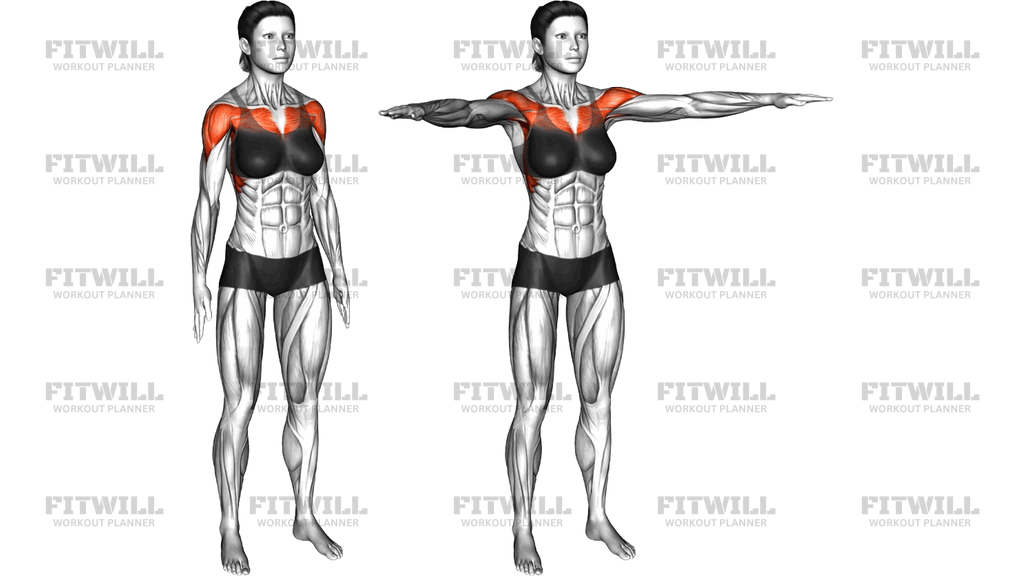
Standing Up Raise Side Open Arms is a bodyweight movement where you stand tall and sweep both arms out to the sides until they reach shoulder height, forming a wide T shape with your body. Because no external load is involved, the exercise relies entirely on deliberate muscle tension and controlled motion, making the side deltoids work harder than you might expect from an unweighted movement. The shoulders are the primary target, with the upper traps and the muscles around the shoulder blades assisting as the arms travel up and back down.
This is an accessible exercise for almost anyone. Beginners use it to learn what a proper arm raise feels like before adding dumbbells, and people recovering shoulder mobility or coming back from time away from training use it to reintroduce overhead-side motion gently. It also works well as a warm-up activation drill before pressing or lateral raise work, since it wakes up the deltoids and scapular stabilizers without fatigue.
The setup matters more than it looks. Standing with feet about hip-width apart, a tall spine, and relaxed shoulders down away from the ears gives the arms a clean path to travel. If the torso leans back, the neck creeps up, or the shoulders shrug early, the traps take over and the side delts lose the work. Keeping the arms softly bent at the elbow rather than locked straight also protects the elbow joints and keeps tension on the shoulder muscles.
Execution is simple but demands control. Start with arms hanging at your sides, palms facing your thighs or turned slightly forward. Raise both arms out to the sides in a smooth arc, leading with the elbows, until they are level with your shoulders. Pause briefly at the top, then lower the arms slowly back to your sides rather than letting them drop. The lowering phase is where much of the muscle work happens, so give it at least two to three seconds.
A common use case is high-repetition shoulder endurance work, often for 15 to 25 controlled reps per set, or as part of a bodyweight circuit. Because there is no equipment, it fits easily into home workouts, hotel-room sessions, or group warm-ups. You can add light hand weights later, but master the bodyweight version first so the movement pattern is solid.
For safety, stay within a pain-free range of motion and stop at shoulder height rather than forcing the arms higher. If you feel pinching at the front of the shoulder, angle your palms slightly forward or reduce the height of the raise. Slow, steady reps with honest muscle engagement will do more for your shoulders than fast, sloppy swings.
Fitwill
Log Workouts, Track Progress & Build Strength.
Achieve more with Fitwill: explore over 9600 exercises with images and videos, access built-in and custom workouts, perfect for both gym and home sessions, and see real results.
Start your journey. Download today!




Instructions
- Stand upright with your feet about hip-width apart, weight evenly distributed across both feet, and your arms hanging naturally at your sides.
- Let your palms face your thighs, or rotate them slightly forward so the fingers point out to the sides.
- Draw your shoulders down away from your ears, lift your chest, and brace your core lightly to keep your torso still.
- Keep a small, soft bend in both elbows so the joints are not locked straight.
- Raise both arms out to the sides at the same time, leading with the elbows, in a smooth arc away from your body.
- Stop when your arms are level with your shoulders, forming a straight line from fingertip to fingertip, and hold for a brief pause.
- Lower your arms slowly back down along the same path, taking two to three seconds, until they rest at your sides.
- Exhale as you raise the arms and inhale as you lower them, keeping your breathing steady throughout the set.
- Reset your posture between reps: check that your shoulders stay down, your ribs are not flaring, and your torso has not leaned backward.
Tips & Tricks
- If your shoulders creep up toward your ears as the arms rise, the upper traps are doing the deltoids' job. Lower the arms a few degrees and consciously press your shoulder blades down before continuing.
- Leading with the hands instead of the elbows turns the raise into a swing. Think about pushing your elbows outward and let the hands follow.
- Avoid leaning your torso backward as the arms reach shoulder height. If you catch yourself arching, stand with your back near a wall and keep light contact with your head, upper back, and hips.
- Do not lock the elbows. A stiff, straight arm shifts stress into the elbow joint and reduces the shoulder's involvement.
- The lowering phase is easy to rush. Count two to three seconds on the way down so the side delts stay under tension instead of resting between reps.
- A tiny pause at shoulder height, even one second, makes the exercise noticeably harder without any added weight.
- If you feel a pinch at the front of the shoulder, turn your palms slightly forward or stop the raise just below shoulder level rather than forcing the full height.
- Keep the movement in the frontal plane, straight out to the sides. If your arms drift forward, the front delts take over and the exercise becomes a different movement.
- Start with 15 to 20 slow reps. With no external load, volume and tempo, not heavy resistance, are what make this exercise effective.
Frequently Asked Questions
Which muscles does Standing Up Raise Side Open Arms work?
The side deltoids of the shoulders are the main movers, with the front and rear deltoids assisting as the arms travel through the arc. The upper traps and the muscles that control the shoulder blades also contribute, especially near the top of the raise.
Is Standing Up Raise Side Open Arms good for beginners?
Yes, it is one of the best starting points for shoulder training because there is no load to manage and the range is easy to control. Beginners can use it to learn the arm-raise pattern before progressing to dumbbell lateral raises.
How high should I raise my arms in Standing Up Raise Side Open Arms?
Raise the arms to shoulder height so they form a straight line across your body. Going higher tends to shift the work into the traps and can cause shoulder discomfort in some people.
Can I add weights to Standing Up Raise Side Open Arms?
You can hold light dumbbells once you can perform 20 controlled bodyweight reps with clean form. Adding weight before the pattern is solid usually leads to shrugging and swinging.
Why do my shoulders shrug up when I perform Standing Up Raise Side Open Arms?
Shrugging means the upper traps are compensating for tired or underactive deltoids. Lower your arms slightly, consciously draw your shoulder blades down, and reduce your rep range until the delts can handle the work.
How many reps of Standing Up Raise Side Open Arms should I do?
Fifteen to twenty-five slow reps per set works well since the resistance is only your own arms. Focus on tempo, roughly one second up, a brief pause, and two to three seconds down, rather than chasing high numbers.
Can Standing Up Raise Side Open Arms be used as a warm-up?
Yes, it is an effective activation drill before overhead presses or lateral raise work. Perform one or two sets of 12 to 15 easy reps to bring blood into the deltoids and wake up the shoulder stabilizers.
What can I substitute for Standing Up Raise Side Open Arms?
Dumbbell lateral raises, cable lateral raises, or resistance band lateral raises all train the same side deltoid pattern with added load. Band pull-aparts are another option if you want more emphasis on the rear shoulders and upper back.
Is it safe to do Standing Up Raise Side Open Arms every day?
For most people, yes, because the unweighted load is gentle on the joints. If you notice persistent pinching or aching at the front of the shoulder, reduce the range of motion or take a rest day rather than pushing through.
Should my elbows be straight or bent during Standing Up Raise Side Open Arms?
Keep a small, soft bend in the elbows throughout. Fully locked elbows place unnecessary stress on the joint and reduce the control you have over the arm's path.