Side Glute Raise Chair Supported
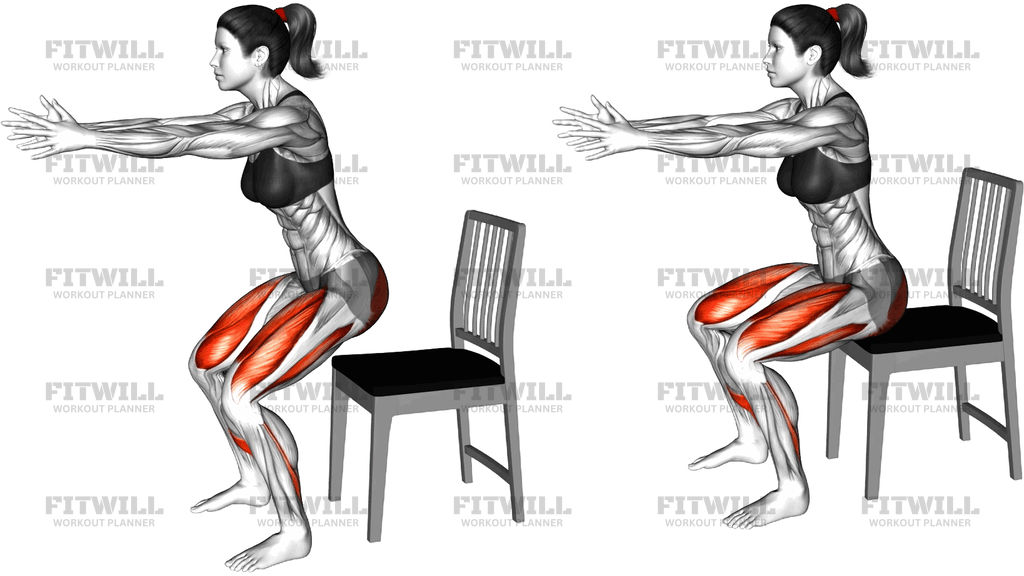
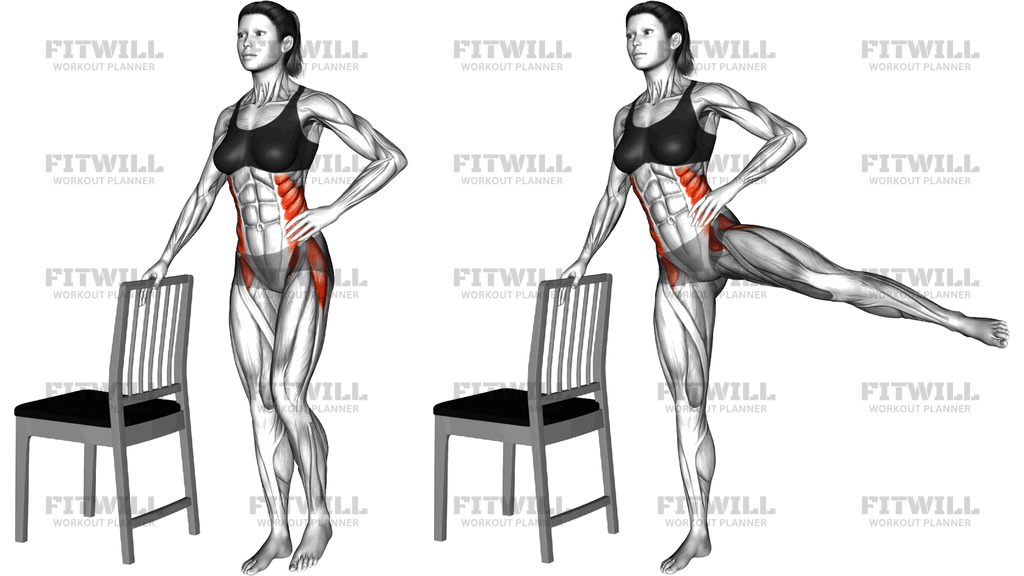
Side Glute Raise Chair Supported is a standing hip abduction exercise where you hold the back of a sturdy chair with one hand and lift your outer leg straight out to the side. The chair gives you just enough balance support to focus entirely on the hip doing the work, which makes this a great entry point into direct side-glute training. It requires no equipment beyond a stable chair, so it fits easily into a home routine, a warm-up, or a rehabilitation-style program.
The main target is the gluteus medius, the muscle that runs along the side of your hip and lifts your leg away from your body. The gluteus maximus and tensor fasciae latae assist, while the standing leg's hip works hard to keep you steady. Your obliques and deep core also stay engaged on the opposite side of your trunk to stop you from tipping sideways as the leg rises. This combination makes the movement useful for hip stability, not just for shaping the side of the glutes.
Strong, responsive side glutes matter for far more than appearance. They control the alignment of your pelvis every time you walk, climb stairs, or stand on one leg, and weakness in this area often shows up as hip dropping or knee valgus during squats and lunges. Because the lift is done one leg at a time with light support, this exercise also exposes and helps correct left-to-right imbalances that are hard to notice in bilateral movements.
Setup matters here because the chair is the only thing separating a clean hip movement from a wobbly, momentum-driven swing. Stand sideways to the chair with the near hand resting lightly on the chair back — resting, not gripping and leaning. Your weight foot should point straight ahead, your torso tall, and your free hand can sit on your hip to give you feedback about whether your pelvis starts to tilt.
To perform the lift well, keep the moving leg mostly straight and think about sweeping it out to the side in a slight arc rather than straight to the front or back. Raise it only as high as you can without letting your trunk lean away from the leg, pause briefly at the top, and lower it back down under control. Height is not the goal; a smooth, felt contraction along the side of the hip is. Most people do well with slow reps in the twelve to twenty range per side, or timed holds for a stability focus.
This movement suits beginners learning where their side glutes are, older adults who want safer single-leg balance, and lifters who use it as a pre-activation drill before squats, deadlifts, or running sessions. If you feel it mostly in the front of the hip or in your lower back, reduce the range and slow the tempo before adding anything else.
[ Workout Log & Planner ]
Put your next workout in Fitwill
Keep your plan and training log ready when you are.


Instructions
- Place a sturdy, non-slip chair on a flat surface and stand sideways to it, with the chair back on the side of your working leg.
- Rest one hand lightly on the top of the chair back and place your other hand on your hip; stand tall with your feet together and your weight foot pointing forward.
- Brace your core gently and pull your ribs down so your torso stays square to the front and does not twist.
- Shift your body weight fully onto the foot nearest the chair and keep a soft, unlocked knee on that standing leg.
- Keeping the outer leg nearly straight and the toes pointing forward, raise it out to the side in a smooth arc, leading with the heel.
- Stop at the highest point you can reach without your trunk leaning away or your pelvis rotating, and hold for a brief pause.
- Lower the leg back down with control until the feet are close together again, without letting it drop or swing.
- Exhale as you lift the leg and inhale as you lower it, keeping your breathing steady throughout the set.
- Complete all repetitions on one side, then turn around, switch your grip to the other hand on the chair back, and repeat on the opposite leg.
Tips & Tricks
- The most common fault is leaning your torso away from the lifting leg to gain height; if your upper body tilts, the lift is too high for your current control.
- Avoid letting the toes rotate up toward the ceiling, which turns the movement into an external rotation — keep the foot level and lead with the heel instead.
- Do not grip and lean on the chair; the hand is there for balance only, and pressing hard into it steals work away from the standing hip.
- If you feel the front of the hip doing most of the work, take the leg slightly behind your midline at the start, which puts the gluteus medius in a stronger line of pull.
- A slow three-second lowering phase will do far more for the side glutes than fast, bouncy reps that use momentum.
- Keep the knee of the lifting leg soft but not bent — a strongly bent knee shortens the lever and shifts the feel away from the hip.
- Watch that the standing foot does not roll outward as the leg rises; press through the big-toe side of the foot to keep it stable.
- If your lower back aches during the set, you are likely arching to lift higher — flatten the range and keep the pelvis level throughout.
Frequently Asked Questions
Which muscles does Side Glute Raise Chair Supported work the most?
The gluteus medius on the side of the moving hip is the primary muscle, with assistance from the gluteus maximus and tensor fasciae latae. The obliques and deep core work to keep your trunk upright, and the standing hip stabilizes your whole body.
Is a chair stable enough to use for this exercise, or should I use something else?
A solid dining-style chair without wheels is fine, as long as it does not slide on the floor. You can substitute a countertop, railing, or the back of a sturdy seat, but avoid anything lightweight that could tip.
Can beginners do Side Glute Raise Chair Supported?
Yes, it is one of the most beginner-friendly ways to train the side glutes because the chair removes most of the balance demand. Start with a modest range and focus on feeling the contraction along the side of the hip.
How high should I lift my leg during Side Glute Raise Chair Supported?
Lift only as high as you can while keeping your torso vertical and your pelvis level — for most people that is around 30 to 45 degrees. Height gained by leaning or rotating comes from the back and trunk, not the glutes.
Why do I feel this more in the front of my hip than in the side of my glutes?
That usually means the hip flexors are taking over because the leg has drifted forward or the range is too aggressive. Keep the leg slightly behind your body, lead with the heel, and shorten the range until the side-hip contraction is clear.
How many reps should I do on each side?
Twelve to twenty slow reps per side works well for endurance and control, and beginners can start with ten. Because the resistance is only your leg, higher rep ranges with strict form are more productive than adding speed.
Can I make Side Glute Raise Chair Supported harder without adding weights?
Yes — pause two to three seconds at the top of each lift, slow the lowering phase to four seconds, or remove your hand from the chair once your balance allows. Ankle weights can be added later when body weight feels easy.
Should my toes point forward or outward when I lift the leg?
Keep the toes pointing forward or only slightly outward. Rotating the foot up toward the ceiling changes the movement into a hip rotation and reduces the work going to the gluteus medius.
Is Side Glute Raise Chair Supported safe if I have hip or knee discomfort?
The supported stance and controlled range make it gentle for most people, but you should stay within a pain-free range and stop if discomfort appears. If symptoms persist, check with a qualified professional before continuing.