Bodyweight Standing W Pose
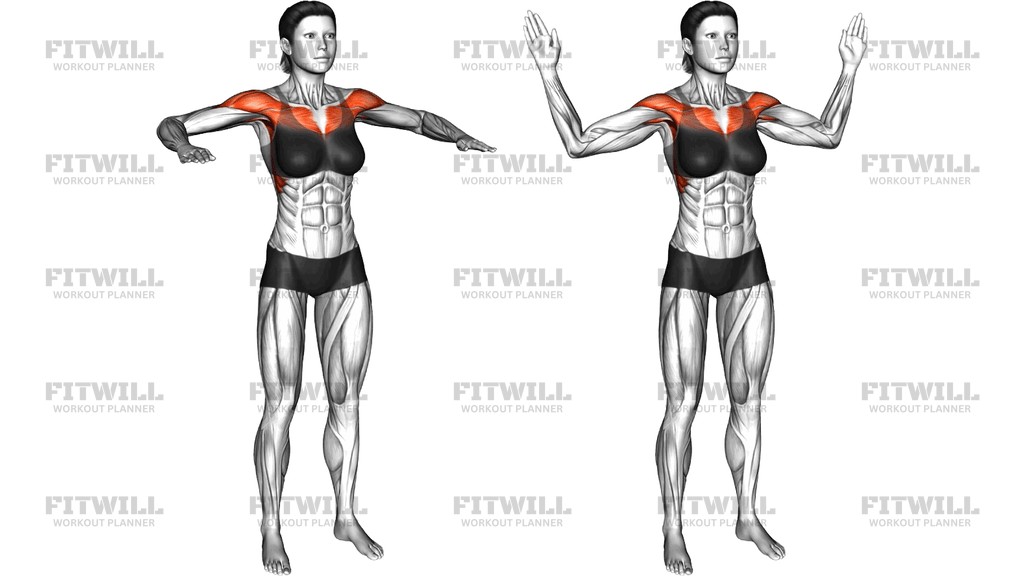
The Bodyweight Standing W Pose is a shoulder-strengthening movement performed from an upright stance with no equipment at all. You set your upper arms out to the sides at roughly shoulder height, bend your elbows to about 90 degrees, and rotate and lift your forearms until your body traces the shape of a W, with palms facing forward. From there, you lower the forearms back down under control and repeat. Because the arms work away from the midline while the elbows stay pinned at your sides, the demand lands squarely on the middle and rear deltoids along with the small rotator cuff muscles that steer the upper arm.
This drill is especially useful for anyone whose shoulder training leans heavily on pressing. Bench presses, push-ups, and overhead work all emphasize the front of the shoulder, while the side and rear delts and the external rotators tend to get neglected. The Bodyweight Standing W Pose fills that gap with nothing but your own arm weight, which makes it easy to fit in as a warm-up primer before pressing, as a finishing movement after heavier lifts, or as a low-load option on recovery days.
Setup matters more than it might seem. Standing tall with feet about hip-width apart, ribs stacked over the pelvis, and shoulders pulled gently down away from the ears gives the deltoids a stable base to work from. If the torso leans back or the shoulders shrug toward the neck, the upper traps take over and the intended muscles lose tension. Keeping the elbows fixed at or slightly below shoulder height throughout each rep is what separates a quality repetition from a sloppy one.
To execute the movement well, think of rotating the forearms up and back from the elbow rather than swinging the hands forward. The path is a smooth arc: forearms drop toward the floor or hang slightly below horizontal, then rotate upward until the palms face forward and the upper arms and forearms form right angles. Pause briefly at the top, then lower with the same control. The return is where most people rush, and slowing it down roughly doubles the value of every rep.
Common use cases include rehab-style shoulder conditioning, warm-up activation for overhead athletes and lifters, posture work for people who sit at a desk all day, and as a teaching tool for learning external rotation before progressing to band or cable versions. Since the only load is the weight of the arms, higher repetitions in the 12 to 20 range tend to work best, and the exercise can be performed just about anywhere with enough room to spread your arms.
From a safety standpoint, keep the range within what your shoulders allow without pain or pinching at the front of the joint. If you feel impingement-style discomfort, reduce how high you lift the upper arms or slightly narrow the angle of the elbows. The movement should feel like a focused burn across the outer shoulder and upper back, never a strain in the neck or a sharp catch in the shoulder itself.
[ Workout Log & Planner ]
Put your next workout in Fitwill
Keep your plan and training log ready when you are.


Instructions
- Stand upright with your feet about hip-width apart, weight spread evenly across both feet, and your gaze forward.
- Raise your upper arms out to the sides until they are at or just below shoulder height, then bend your elbows to about 90 degrees so your forearms point forward or hang slightly down.
- Draw your shoulder blades gently down and together, and brace your core so your ribs stay stacked over your hips.
- Exhale as you rotate your forearms up and back from the elbows until your palms face forward and your arms form a W shape.
- Hold the top position for one to two seconds, keeping your elbows pinned at shoulder height and your shoulders pulled away from your ears.
- Inhale as you slowly lower your forearms back down along the same arc until they hang below horizontal, without letting your elbows drop toward your torso.
- Pause briefly at the bottom to reset tension, then begin the next repetition.
- Keep your head neutral and avoid jutting your chin forward as your arms fatigue.
- Complete all repetitions with steady breathing, exhaling on the lift and inhaling on the lowering phase.
- After your final rep, lower your arms to your sides and roll your shoulders to release tension before moving on.
Tips & Tricks
- If your shoulders creep up toward your ears, which shifts work to the upper traps, consciously press your shoulder blades down before each rep and reduce your range until you can hold them there.
- A common mistake is swinging the hands up using momentum. Move slowly enough that you could stop at any point in the arc without losing control.
- If your elbows drift forward or down as you rotate, imagine squeezing a towel roll under each armpit to anchor the upper arm in place.
- When you feel a pinch at the front of the shoulder, lower your upper arms a few degrees and shorten the top range rather than pushing through discomfort.
- Arching the lower back as the arms lift is a sign the movement is too hard or too fast. Tighten your abs and slightly tuck your pelvis to keep the torso still.
- Squeezing your fists lightly can increase tension through the forearms and shoulders, but avoid white-knuckling, which tends to travel up into the neck.
- Perform this drill before pressing or overhead work as an activation set of 10 to 15 slow reps rather than grinding to failure.
- If one side rotates noticeably further than the other, pause an extra second on the stiffer side each rep rather than adding extra sets at the end.
- Face a mirror or film yourself from the front so you can confirm your arms actually form a W and not a shallow V with flared ribs.
Frequently Asked Questions
Which muscles does the Bodyweight Standing W Pose work?
The primary movers are the middle and rear deltoids on the outer and back of the shoulder, with strong support from the rotator cuff muscles that rotate the upper arm. The upper traps and the muscles between the shoulder blades work to keep the shoulder girdle stable.
Is the Bodyweight Standing W Pose good for beginners?
Yes. Because the only load is the weight of your own arms, it is a safe way for beginners to learn shoulder control and external rotation before adding bands or weights. Start with 2 sets of 10 to 12 slow repetitions.
Why do my elbows drop when I perform the Bodyweight Standing W Pose?
Dropping elbows usually means the rotator cuff and deltoids are fatiguing and the lats or chest are pulling the upper arm back toward the torso. Reduce your repetitions, slow the tempo, and focus on keeping the elbows fixed at shoulder height throughout each rep.
Should I feel the Bodyweight Standing W Pose in my neck?
No. Neck tension almost always comes from shrugging the shoulders toward the ears as the arms lift. Press your shoulder blades down and lengthen your neck before each set, and stop if the discomfort persists even with corrected form.
How is the Bodyweight Standing W Pose different from a lateral raise?
A lateral raise moves the whole arm up away from the body, while the W Pose keeps the upper arms fixed at shoulder height and rotates the forearms upward from the elbow. This places much more emphasis on external rotation and the rotator cuff rather than pure abduction.
Can I substitute the Bodyweight Standing W Pose with a band exercise?
You can progress to a band external rotation or a band pull-apart once bodyweight reps feel easy, but the standing W remains valuable because it trains the rotation and elevation pattern together. Use the band versions as a step up, not a full replacement.
How many repetitions of the Bodyweight Standing W Pose should I do?
Because the resistance is light, aim for 12 to 20 controlled repetitions per set for 2 to 3 sets. Prioritize a slow lowering phase and a brief pause at the top over adding volume.
Should I do the Bodyweight Standing W Pose before or after my workout?
It works best as a warm-up activation before pressing or overhead lifting, when fresh shoulders will move through the rotation pattern cleanly. It can also serve as a finishing pump on shoulder days, but avoid doing heavy volume in both slots.
My shoulders pinch at the top of the Bodyweight Standing W Pose. What should I change?
Lower your upper arms slightly below shoulder height and stop the forearm rotation a few degrees short of full elevation. If the pinching continues even in a shorter range, check with a qualified professional before continuing.