Seated Chest Press On A Chair
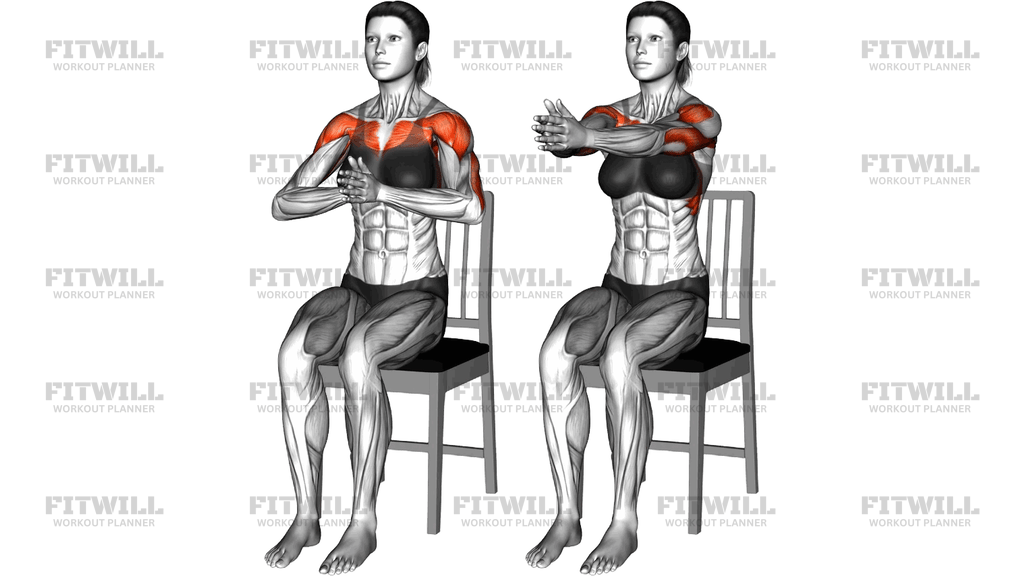
The Seated Chest Press On A Chair is a bodyweight pressing movement you can perform anywhere you have a sturdy chair. You sit upright on the seat with your back tall, raise your upper arms out to your sides at chest height, bend your elbows to about ninety degrees, and press your hands forward and inward until your arms extend in front of your chest, then return under control. Because the resistance comes from your own muscular tension rather than an external load, the exercise works best when you actively squeeze your palms toward each other or press your fists together throughout the movement.
This drill primarily targets the pectorals, with the front delts assisting on the press and the triceps engaging as the elbows extend. The seated position removes momentum from the lower body and forces your core to hold your torso still, which means the chest has to do the actual work of bringing the arms forward. It sits somewhere between a chest fly and a pressing motion: the arms travel forward at chest height while the hands converge, mimicking the top portion of a press.
The Seated Chest Press On A Chair is especially useful when you have no access to weights or machines. It suits beginners learning what a chest contraction feels like, older adults who want a joint-friendly upper-body movement, office workers taking short movement breaks, and travelers keeping a routine in a hotel room. More experienced lifters can use it as a warm-up to activate the chest before pressing, or as a high-rep finisher to squeeze out extra work without equipment.
Setup matters more than it looks. Sit well back on the chair with both feet flat on the floor, keep your ribs stacked over your pelvis, and avoid leaning forward as you press. If your back rounds or your shoulders creep up toward your ears, the chest loses tension and the movement loses its point. Keeping the elbows at or slightly below shoulder height protects the shoulder joints and keeps the emphasis on the pecs rather than the neck.
Execution should be slow and deliberate. Drive your hands forward as if pushing a heavy object away from your chest, squeeze hard at full extension for a beat, then pull the elbows back with control until your upper arms are roughly in line with your torso. Because there is no external resistance, tempo and intent create the training effect: pressing hard against your own hands, pausing at the front, and controlling the return will make this far more productive than rushing through the range.
The main practical point is to stay honest with the tension. If you let the hands drift apart or the shoulders round forward, you are moving your arms, not training your chest. Keep the chest lifted, the shoulder blades gently drawn back, and the pressing effort continuous from start to finish.
[ Workout Log & Planner ]
Put your next workout in Fitwill
Keep your plan and training log ready when you are.


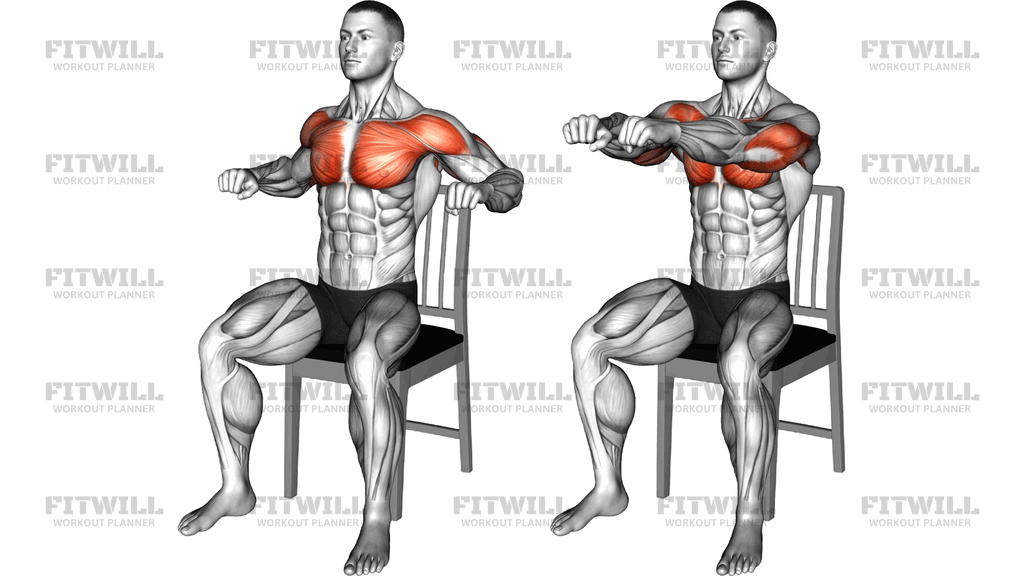
Instructions
- Sit on a sturdy chair with your feet flat on the floor about hip-width apart and your back upright, sitting tall on your sit bones.
- Raise both upper arms out to your sides at chest height and bend your elbows to roughly ninety degrees, forming a goalpost position with your fists facing forward.
- Lightly brace your abdominal muscles and draw your shoulder blades back and down so your chest stays lifted throughout the set.
- Press your hands forward and slightly toward each other as if pushing an invisible object away, keeping your wrists straight and your forearms parallel to the floor.
- Continue until your arms are fully extended in front of your chest at shoulder height, and squeeze your hands inward against each other for a one-second hold.
- Keep your torso still as you press — do not lean forward or let your lower back arch to gain range.
- Breathe out as you press forward, and breathe in as you bring the arms back.
- Return with control by bending the elbows and pulling your upper arms back until they are roughly in line with your torso, maintaining tension the entire way.
- Pause briefly in the goalpost position, then begin the next repetition.
- At the end of the set, lower your arms to your sides, shake out the shoulders, and reset your posture before the next round.
Tips & Tricks
- The most common mistake is pressing with the shoulders shrugged up near the ears. Drop the shoulders away from the neck before each rep and keep them there.
- Because there is no external weight, the squeeze is the load. Press your fists or palms firmly toward each other during the entire forward movement, or the chest gets almost nothing.
- If your elbows drift below chest height on the return, the movement turns into a shoulder exercise. Keep the elbows tracking at or just below shoulder level.
- Do not let your lower back arch as you reach full extension. Think about keeping your ribs down and your abs lightly engaged.
- Slow the tempo down — aim for about two seconds forward, a one-second squeeze, and two seconds back. Fast reps rely on momentum your chest cannot feel.
- If sitting tall feels unstable on a soft chair, place the chair against a wall or move to a firmer seat so your torso has a solid base.
- For a stronger contraction, clench your fists hard and imagine crushing something between your hands as they come forward.
- If you feel pinching at the front of the shoulders, reduce the range slightly and stop the press just short of full lockout rather than forcing the arms straight.
- Keep your gaze level and your neck relaxed; jutting the chin forward is a sign you are straining instead of pressing with the chest.
Frequently Asked Questions
Which muscles does the Seated Chest Press On A Chair work?
The primary muscles are the pectorals of the chest, with the front shoulders assisting the press and the triceps working as the elbows extend. The core also works to keep your torso upright and still on the chair.
How does the Seated Chest Press On A Chair provide resistance without weights?
The resistance comes from your own muscular effort — you press your hands firmly toward each other as they travel forward, creating tension in the chest. Intentional squeezing and a slow tempo replace the external load.
Is the Seated Chest Press On A Chair good for beginners?
Yes. It is low-impact, requires no equipment beyond a chair, and helps beginners learn to feel their chest contracting before progressing to dumbbell or machine presses.
Why should I sit tall instead of leaning forward when I press?
Leaning forward shifts the work toward the shoulders and reduces chest involvement, and it also rounds the lower back. Sitting tall keeps the pressing angle at chest height and protects your spine.
How many reps of the Seated Chest Press On A Chair should I do?
Because the load is self-generated, higher volumes work well — aim for 12 to 20 slow reps per set, or 2 to 3 sets. Focus on continuous tension rather than counting to a low number quickly.
What is the most common mistake in this exercise?
Shrugging the shoulders toward the ears and letting the hands drift apart, which removes chest tension. Keep the shoulder blades drawn back and press the hands inward against each other for the whole rep.
Can I use the Seated Chest Press On A Chair as a warm-up?
Yes, it is an effective activation drill before bench pressing, push-ups, or machine chest presses. One or two sets of 10 to 15 controlled reps preps the chest and front delts without fatiguing them.
What can I substitute if I do not have a chair?
Any firm seat works, including a bench or an exercise ball, and the same goalpost arm position can be used standing. The key elements are an upright torso and pressing the hands forward at chest height.
Is it safe for people with shoulder discomfort?
The movement is generally gentle because there is no external load, but anyone with a shoulder issue should keep the range pain-free, stop short of full lockout, and consult a professional if symptoms persist.
Should my elbows be at shoulder height during the Seated Chest Press On A Chair?
Yes, keep the upper arms at chest height or just slightly below, forming a goalpost shape. Elbows raised above shoulder level can pinch the front of the shoulder and shift emphasis away from the chest.