Seated Arm Crossover On A Chair
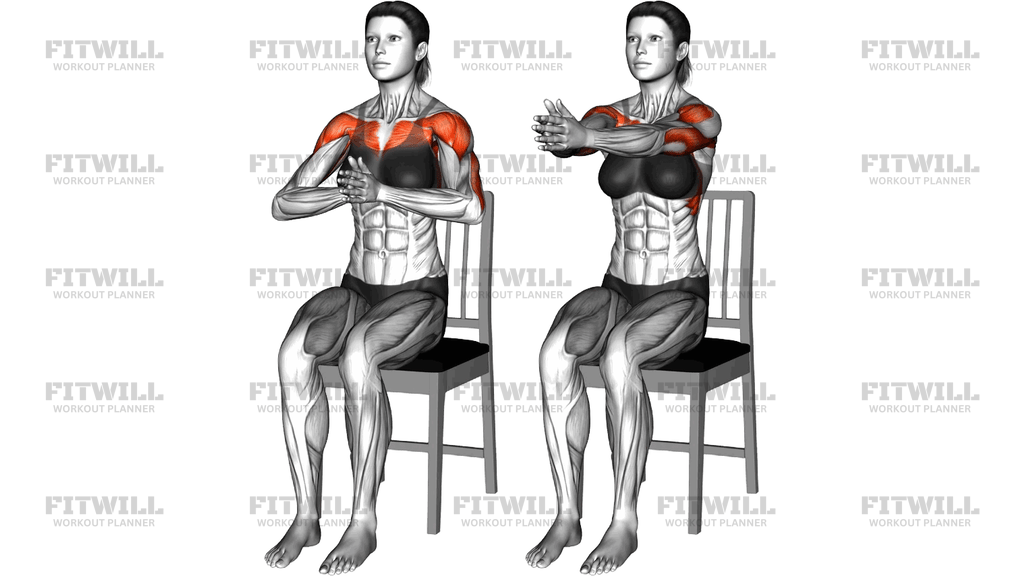
The Seated Arm Crossover On A Chair is a bodyweight chest movement performed from an upright seated position. You sit tall on a sturdy chair with your feet flat on the floor, raise both arms straight out to the sides at shoulder height, and sweep them forward so they cross over each other in front of your chest before returning them wide. The muscles highlighted most in this movement are the pectorals, which work to bring the arms across the midline of the body, with the front shoulders assisting throughout the arc.
Because the exercise uses only your arms against gravity and their own momentum, the resistance is modest. That makes it a practical choice for warming up the chest before pressing work, for beginners learning to feel their chest muscles working, and for anyone training at a desk, at home, or in rehabilitation settings where no equipment is available. Office workers can use it as a movement break to counteract the rounded, hunched posture that comes from long periods of typing, since the wide-arm return gently opens the chest.
The seated setup is what separates this from a standing arm crossover. Sitting on a chair locks your hips and legs in place, which removes the tendency to lean, sway, or use trunk momentum to fling the arms forward. With your back tall and core lightly engaged, the chest and shoulders have to do the work on their own. Keep the seat stable and your spine upright; if you can only use a chair with a backrest, sit forward on the seat so your shoulder blades stay free to move.
To execute it well, think of the arms as moving through a wide, controlled horizontal arc at shoulder height. As they come forward, one hand passes over the other and the arms reach past each other so the chest visibly compresses at the front of the body. On the way back, open the arms until you feel a comfortable stretch across the chest, then reverse. The crossing alternates naturally repetition to repetition, but you can also deliberately lead with the same arm for a set to keep the movement symmetric in feel.
A few practical points will keep this exercise productive. Move deliberately rather than quickly, because the value is in the controlled squeeze at the crossover and the stretch at the wide position, not in speed. Keep the arms at or just below shoulder height throughout; letting them drift up turns it into a shoulder shrug exercise. If you feel pinching at the front of the shoulders, lower the arc slightly and reduce how far you reach. Since there is no external load, this movement pairs well with more demanding chest work rather than replacing it entirely, though it can stand alone on light-activity days.
[ Workout Log & Planner ]
Put your next workout in Fitwill
Keep your plan and training log ready when you are.


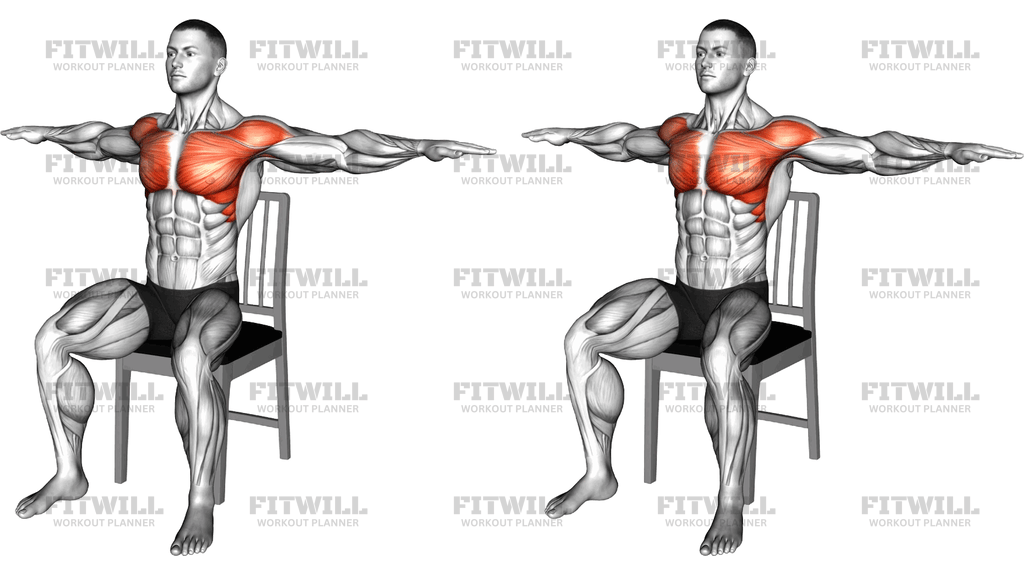
Instructions
- Sit upright on a sturdy chair with your feet flat on the floor about hip-width apart and your back tall, sitting forward enough that your shoulder blades are not pressed against a backrest.
- Raise both arms straight out to your sides until they are level with your shoulders, palms facing forward or down, with a soft bend in the elbows.
- Brace your core lightly and keep your neck relaxed so your shoulders stay down away from your ears.
- Sweep both arms forward through a wide horizontal arc at shoulder height, keeping the elbows nearly straight the whole way.
- Cross one arm over the other in front of your chest and reach slightly past it so you feel the chest muscles squeeze together.
- Reverse the arc smoothly, opening your arms back out to the sides until you feel a gentle stretch across your chest, without letting them drop or drift upward.
- Continue crossing so the arms alternate which one is on top from repetition to repetition, or lead with the same arm for a set if you prefer.
- Exhale as the arms cross forward and inhale as they open back out to the sides.
- Finish your set, lower your arms to your lap, and shake out the shoulders before resting or moving to the next exercise.
Tips & Tricks
- A common mistake is shrugging the shoulders up toward the ears as the arms tire; drop the shoulder blades down and back before each set to keep the tension in the chest.
- Keep the arc exactly at shoulder height. If the hands rise above the shoulders, the front shoulders take over and the chest loses its stretch at the wide position.
- Do not lock the elbows completely. A small bend protects the elbow joints and lets you keep steady tension through the whole sweep.
- The crossing point should feel like a deliberate squeeze, not a clap. Reach a few inches past the opposite hand so the pecs fully shorten at the front.
- Resist the urge to lean the torso forward as the arms cross. The chair is there to pin your hips down, so stay tall and let the arms do all the moving.
- Slow the return phase down. Most people rush the opening portion and miss the chest stretch that makes this seated variation worthwhile.
- If your shoulders pinch at the front, reduce how far the arms travel behind shoulder line on the wide position rather than forcing a bigger range.
- Use this as a warm-up before bench presses, push-ups, or cable crossovers, doing higher repetitions with a brisk but controlled tempo to bring blood into the chest.
- Because there is no load, judge progress by control and range, not by burning effort; add tension later with light resistance bands looped behind your back if the movement feels too easy.
Frequently Asked Questions
What muscles does the Seated Arm Crossover On A Chair work?
The primary muscles are the chest, which pulls the arms across the midline of the body. The front shoulders assist throughout the arc, and the arms stay lightly engaged to hold them straight.
Is the Seated Arm Crossover On A Chair good for beginners?
Yes. It requires no load and minimal coordination, making it a low-risk way to learn what a chest contraction feels like before progressing to push-ups or pressing exercises.
Why is this done seated on a chair instead of standing?
Sitting locks your hips and legs in place, which prevents you from leaning or swinging the trunk to generate momentum. The chest and shoulders are then forced to control the entire arc on their own.
Can I do the Seated Arm Crossover On A Chair at my desk during the workday?
Absolutely. It needs only a stable chair and about an arm's width of space on each side, so it works well as a short movement break that opens the chest after long periods of sitting.
How many repetitions should I perform?
Since the resistance is light, higher ranges work well, typically 15 to 25 controlled repetitions per set. For a warm-up, one or two sets are usually enough.
Should the same arm cross on top every repetition?
Letting the arms alternate naturally keeps the work even on both sides, but deliberately leading with the same arm for a set is fine if you want a consistent feel. Just balance it with a set leading with the other arm.
What is the most common mistake with this exercise?
Shrugging the shoulders up toward the ears and letting the hands drift above shoulder height. Both shift the work away from the chest and can create tension in the neck and upper traps.
Can I make the Seated Arm Crossover On A Chair harder?
Yes. Loop a light resistance band around your back and hold an end in each hand, or hold very light objects in your hands, so the crossing phase works against added resistance.
Is this exercise safe if I have shoulder discomfort?
The range is small and arm-weight only, but if you feel pinching at the front of the shoulder, narrow the arc, keep the hands slightly below shoulder height, and stop if discomfort persists.