Standing Single Side Leg Raise Chair Supported
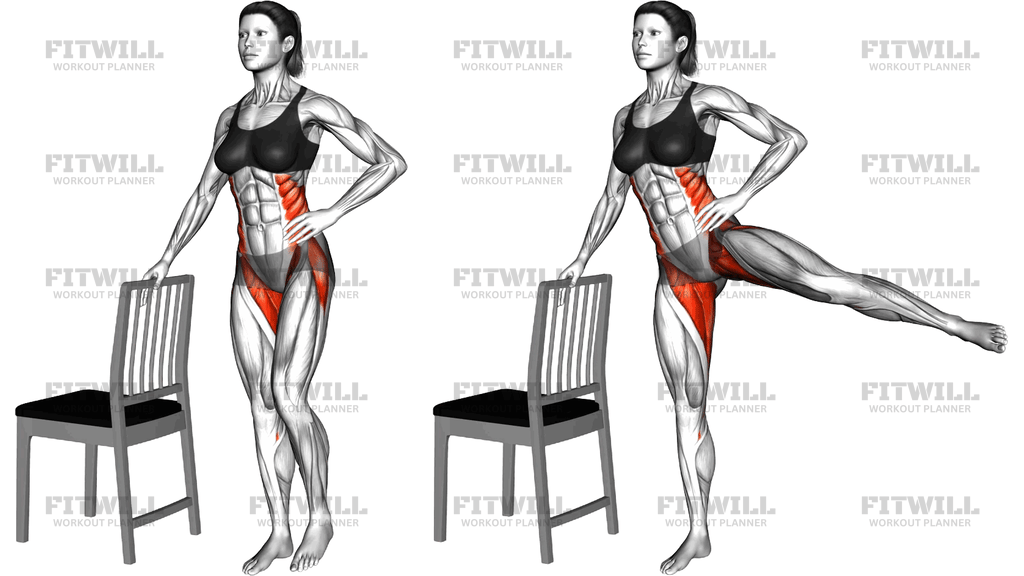
Standing Single Side Leg Raise Chair Supported is a simple standing abduction exercise where you hold the back of a sturdy chair with one hand, keep the other hand on your hip, and lift one straight leg out to the side before lowering it back down with control. The chair acts as a balance point rather than a crutch, so you can focus on moving the leg from the hip instead of wobbling around trying not to fall over. Because the working knee stays straight, the movement comes entirely from the hip joint, which makes it easy to feel exactly where the work should be happening.
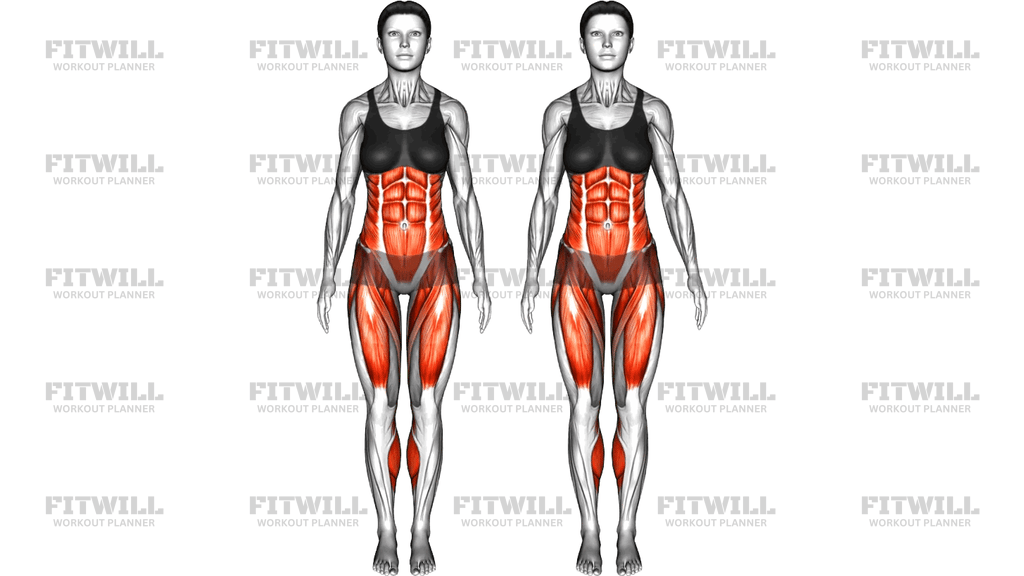
The main muscles at work are the gluteus medius and gluteus minimus on the outer side of the moving hip, with the gluteus maximus assisting as the leg travels higher. The standing leg is doing quiet but important work too, since the same outer-hip muscles on that side must keep your pelvis level while the other leg swings up. Your obliques and deep core brace to stop your torso from tipping sideways, which is why you will often feel this exercise along the waistline of the support-side body.
This version is especially useful for people who find floor-lying side leg raises uncomfortable, whether because of hip tightness, back sensitivity, or simply getting down and up off the floor. It is a common inclusion in warm-ups before squats and lunges, in rehabilitation-style routines for hip stability, and in balance training for older adults, since single-leg standing with a controlled lift challenges the same stability systems we use when walking.
Setup matters more than it looks. Stand close enough to the chair that your support hand rests lightly on the backrest rather than gripping hard, position yourself slightly behind it so the leg has a clear path, and keep your working hand on your hip as a cue to keep the torso tall. If you lean heavily on the chair, the exercise loses most of its value, so treat the contact as a fingertip reference point.
To perform it well, shift your weight onto the leg nearest the chair, brace your core, and sweep the far leg out to the side with the knee straight and the toes pointing forward or slightly outward. Lift only as high as you can without your torso tilting or your hip hiking up, pause briefly at the top, then lower the leg back to the start over two to three seconds. Keep the movement smooth and quiet; if you hear your foot slap down or need to swing the leg to lift it, the weight is too much for control and the range should be reduced.
As for safety, this is a low-load exercise, but the balance element deserves respect. Use a chair that will not slide, stand on a non-slip surface, and keep the support hand within easy reach throughout the set. Stop and reset if you find yourself rotating the torso, rolling the standing ankle outward, or compensating with a hip hitch, since those habits reinforce poor hip mechanics rather than improving them.
[ Workout Log & Planner ]
Put your next workout in Fitwill
Keep your plan and training log ready when you are.


Instructions
- Place a sturdy, non-slip chair on a flat surface and stand beside it with the chair back on the side of your support hand.
- Rest one hand lightly on top of the chair back and place your other hand on your hip; stand tall with your feet together.
- Shift your weight onto the leg closest to the chair and softly bend that knee a few degrees to find your balance.
- Brace your core and pull your ribs down so your torso stays upright and your waist does not collapse to one side.
- Keeping the far leg straight, raise it out to the side in a smooth arc, leading with the heel and keeping the toes pointing forward.
- Stop the lift at the highest point where your torso stays square to the front and your hip has not hiked up toward your ribs.
- Hold the top position for one breath, squeezing the outer hip of the moving leg.
- Lower the leg back down slowly over two to three seconds until it lightly touches or hovers just above the floor.
- Exhale as you lift the leg and inhale as you lower it, keeping the breath steady instead of holding it.
- Complete all reps on one side, then switch so the opposite hand rests on the chair and the other leg works.
Tips & Tricks
- Touch the chair with fingertips, not a death grip; if you are loading your arm, you are stealing the balance work from the standing hip.
- Watch for hip hitching, where the standing-side hip creeps up toward the ribs to fake a higher leg lift. Fix it by lifting lower and imagining the pelvis stays level like a bowl of water.
- If your torso tips away from the working leg as you raise it, that is usually the obliques failing to hold you square. Reduce the range until you can lift without leaning.
- Turn the toes of the working leg slightly toward the ceiling rather than rotating the leg open; this keeps the gluteus medius doing the work instead of the front of the hip.
- A straight knee is part of the design, but do not lock it hard; a soft, active knee keeps the leg feeling long without straining the joint.
- If the standing ankle rolls outward or wobbles, spread your big toe into the floor and shorten the lift height before adding reps.
- Slow the lowering phase before adding height or reps; the descent is where most people quietly lose control of the movement.
- Standing on a thin exercise mat or firm floor is fine, but avoid a thick, squishy surface, which makes the balance job unnecessarily hard.
- Expect the second side to feel different; many people have one weaker outer hip, so start your set with that side while you are fresh.
Frequently Asked Questions
Which muscles does the Standing Single Side Leg Raise Chair Supported target?
The primary work comes from the gluteus medius and gluteus minimus on the outer hip of the lifting leg, with the gluteus maximus assisting. The obliques and standing-leg hip stabilizers work isometrically to keep your pelvis and torso level.
Why use a chair for support instead of doing this freestanding?
The chair gives a light balance reference so you can move the leg with control instead of compensating with torso sway. As your stability improves, progress to a fingertip touch and eventually no contact.
Is the Standing Single Side Leg Raise Chair Supported good for beginners?
Yes, it is one of the most beginner-friendly hip abduction exercises because the chair removes the balance barrier and the body weight load is gentle. Beginners should focus on a small, clean range before chasing height.
How high should I lift my leg during the Standing Single Side Leg Raise Chair Supported?
Lift only to the height where your torso stays upright and your pelvis stays level, which for most people is around 30 to 45 degrees. A lower lift done correctly trains the outer hip better than a high lift that leans and hikes.
Why does my waist feel sore after doing the Standing Single Side Leg Raise Chair Supported?
The obliques on your support side are working hard to stop your torso from tipping sideways every time the leg lifts. That is a normal part of the exercise, but if it dominates, your lifting range may be too large for your current core control.
What is the most common mistake in this exercise?
Hip hiking, where the standing-side hip rides up to make the leg look like it is lifting higher. Watch yourself in a mirror and keep both hip bones at the same height throughout the rep.
Can I do this exercise if lying side leg raises hurt my hip?
Often yes, because the standing position changes the hip angle and removes floor pressure, and many people tolerate it better. Move within a pain-free range and consult a professional if discomfort persists.
What can I use if I do not have a suitable chair?
Any stable hip-height support works, such as a countertop, sturdy railing, or the upright of a squat rack. Avoid wheeled furniture or anything light enough to tip.
How many reps and sets should I do?
Two to three sets of 10 to 15 controlled reps per side is a solid starting point. Since the load is low, prioritize slow lowering and clean hip position over higher rep numbers.
How is this different from a cable side leg raise?
The cable version adds continuous resistance through an ankle attachment, making it harder and better for building strength, while the chair-supported body weight version is gentler and better suited for learning the pattern, warming up, or rehab-style training.