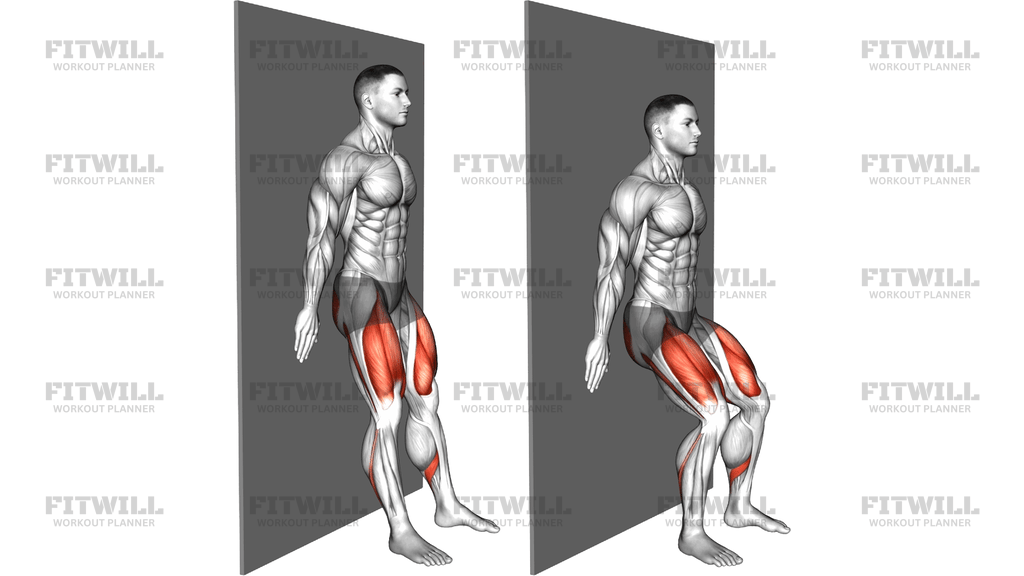
Standing Glute Back Lift Against Wall
Standing Glute Back Lift Against Wall is a single-leg body weight exercise where you stand facing a wall, place both hands flat against it at head height or above, and lift one leg straight back behind you while balancing on the other. The wall acts as a steady point of contact for your hands, which lets you focus entirely on driving the movement from your hip instead of fighting to stay upright.
The main muscle at work is the glute of the lifting leg, with the hamstrings assisting as the leg travels back. Because you are standing on one leg, the glute and hip stabilizers of the standing leg also work hard to keep your pelvis level, and your core stays engaged to stop your torso from twisting. This combination makes it a good exercise for building hip extension control rather than just raw strength.
The wall setup is what separates this from a free-standing rear leg lift. Many people arch their lower back or tip their chest toward the floor when they kick a leg behind them, which shifts work away from the glutes and irritates the lower back. With your hands anchored on the wall and your arms overhead, you get immediate feedback: if your chest collapses or your hips rotate, you feel it right away and can correct it.
This movement suits beginners learning what a glute-driven hip extension feels like, people returning from time off who want a low-load reintroduction to hip work, and more experienced lifters using it as a warm-up or activation drill before squats, deadlifts, or lunges. It also fits well into home routines because it needs nothing but a patch of clear wall.
Keep the lift modest and controlled. The goal is a clean squeeze at the top of the movement, not height. If you feel the lift coming from your lower back rather than your glute, reduce the range until the glute does the work.
[ Workout Log & Planner ]
Put your next workout in Fitwill
Keep your plan and training log ready when you are.


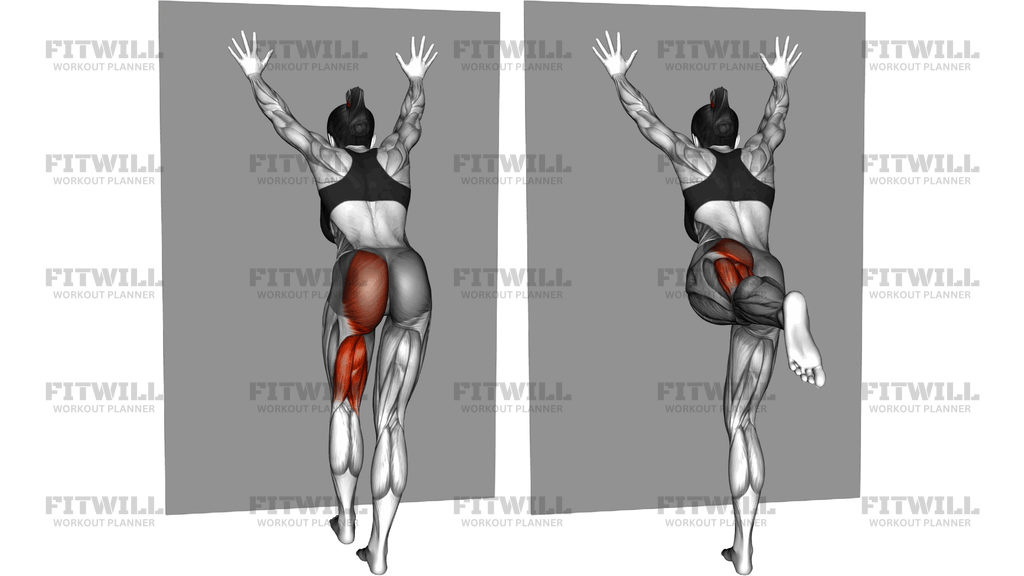
Instructions
- Stand facing a clear wall about arm's length away, feet hip-width apart.
- Place both palms flat on the wall at around head height or slightly above, fingers spread, and step back until your arms are nearly straight so you are leaning slightly into the wall.
- Shift your weight onto one leg, soften the standing knee slightly, and brace your core as if bracing for a light nudge to the ribs.
- Keep your hips square to the wall and your back flat rather than arched.
- Squeeze the glute of your free leg and lift that leg straight back behind you, letting it rise to wherever you can go without arching your lower back — usually a small to moderate height.
- Pause for a beat at the top with the glute fully squeezed and your torso still tall against the wall.
- Lower the leg with control until your toes touch the floor again; do not let it drop.
- Exhale as you lift the leg back and inhale as you lower it, keeping your breathing steady throughout.
- Complete all repetitions on one side, then reset your stance and switch legs.
- If your balance or form slips, place both feet down, re-brace, and start the next rep fresh.
Tips & Tricks
- A common mistake is arching the lower back to make the leg travel higher — this usually means the hamstring or lower back is taking over. Cut the range down until you feel the work in the glute itself.
- Watch that your hips do not open to the side as the leg lifts. Press both palms evenly into the wall and imagine your hip bones pointing straight at it for the whole set.
- Keep a soft bend in the standing knee. Locking it out makes balance harder and reduces the stability work in the standing-side hip.
- Point the toes of the lifting leg down slightly and think about pushing the heel back and up toward the ceiling rather than just swinging the foot.
- Press your chest gently toward the wall through your palms. This keeps your upper body from collapsing backward as the leg rises.
- If you feel this only in the front of your hip or thigh, you are likely lifting with hip flexor momentum on the return or letting the leg swing. Slow the tempo to about two seconds up, one pause, two seconds down.
- The standing leg should do quiet work — if you find yourself wobbling heavily, widen your hands on the wall or shorten the lift height before abandoning the exercise.
- Use this as a pre-workout activation pair: 10–12 reps per side before squats or deadlifts to wake up the glutes.
Frequently Asked Questions
Which muscles does the Standing Glute Back Lift Against Wall work?
The glutes of the lifting leg are the primary movers, with the hamstrings assisting the back lift. The standing leg's glute and hip stabilizers plus your core work to keep you level and steady.
Why do my hands go on the wall for this exercise?
The wall gives your upper body a fixed point of contact so you can concentrate on hip extension without losing balance. It also gives you instant feedback — if your chest or hips twist, you feel the pressure shift through your hands.
Is the Standing Glute Back Lift Against Wall good for beginners?
Yes. The wall support makes single-leg balance much more manageable, and the light load lets beginners learn to feel their glutes extending the hip before moving to harder variations.
How high should I lift my leg behind me?
Only as high as you can go while keeping your lower back neutral and your hips square to the wall. For most people that is a modest height; chasing range by arching the back defeats the purpose.
I feel this in my lower back instead of my glutes. What am I doing wrong?
You are probably arching your lumbar spine to gain height, which shifts work from the glutes to the lower back. Lower the lift height, re-brace your core, and think about squeezing the glute to start the movement.
How many reps and sets should I do?
For activation or learning the pattern, 2–3 sets of 10–15 controlled reps per side works well. Move slowly enough that each rep is deliberate rather than a swing.
What can I use if I do not have a clear wall space?
A sturdy countertop, the back of a stable chair, or a squat rack upright can substitute for the wall. The key is having a fixed surface at roughly chest-to-head height for your hands.
Can I add ankle weights to the Standing Glute Back Lift Against Wall?
Yes, once you can complete all reps with clean form and no lower back arch. A light ankle weight adds resistance without changing the movement pattern.
How is this different from a standing kickback on a cable machine?
Both train hip extension, but the wall version is fully body weight and relies on your own stabilizers for control. The cable version adds constant resistance, so the wall lift is better for learning the pattern and the cable kickback for loading it.