Weighted Bag Walking Lunge
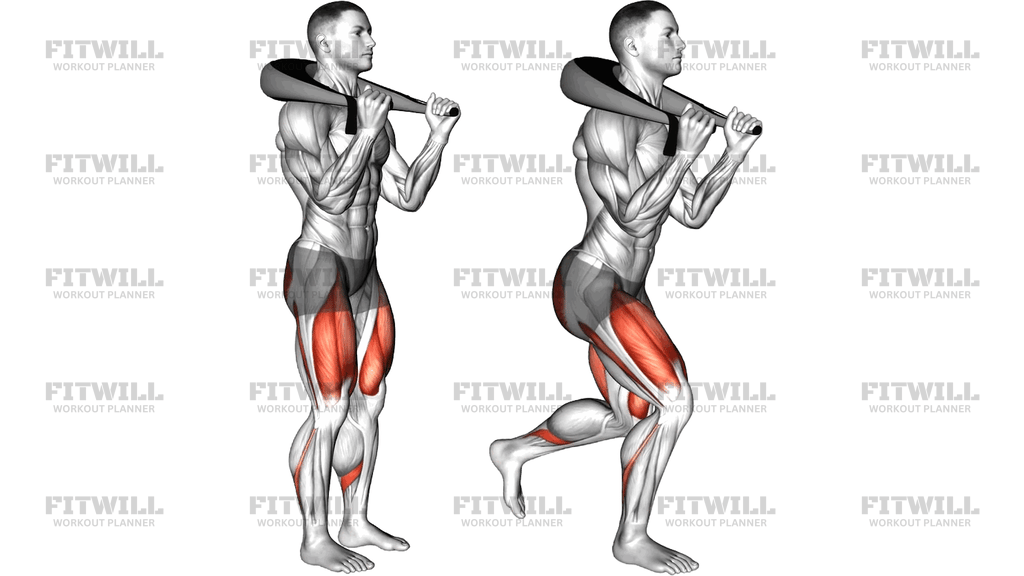
The Weighted Bag Walking Lunge is a traveling lunge performed with a weighted bag resting across the back of your shoulders, held by the ends or straps in both hands. Unlike a barbell, the bag sits softly on the trapezius area and shifts slightly as you move, which forces you to stay braced and balanced through every step. It is a practical way to load the lunge pattern when you do not have access to barbells, dumbbells heavy enough for your legs, or a rack.
This movement primarily builds the quadriceps of the front leg, with strong contributions from the glutes and hamstrings as you drive out of each step and push the hips forward. The rear leg works through a long stretch at the hip flexor, and the calves and ankle stabilizers manage the constant forward-and-down motion. Because you are walking rather than lunging in place, each transition demands controlled deceleration, which is where most of the strength and stability benefit comes from.
Setup matters more than most people expect. The bag should sit centered across the upper back and shoulders, not hanging off one side, and your hands should grip firmly enough to keep it from sliding forward or backward. An off-center load is one of the fastest ways to develop a side-to-side lean, which changes the exercise from a leg builder into a compensation pattern. Stand tall, brace the trunk, and set your feet before the first step.
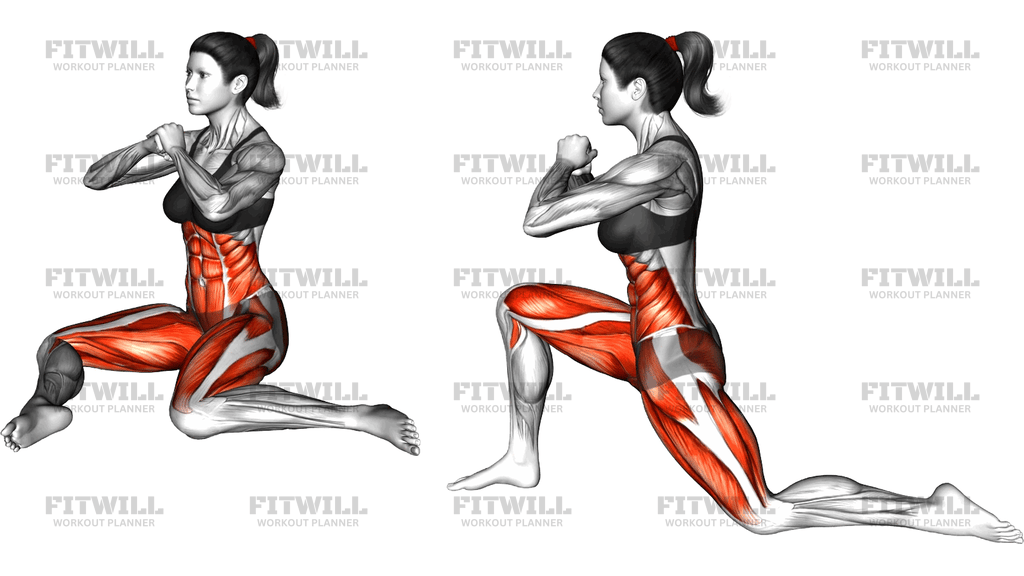
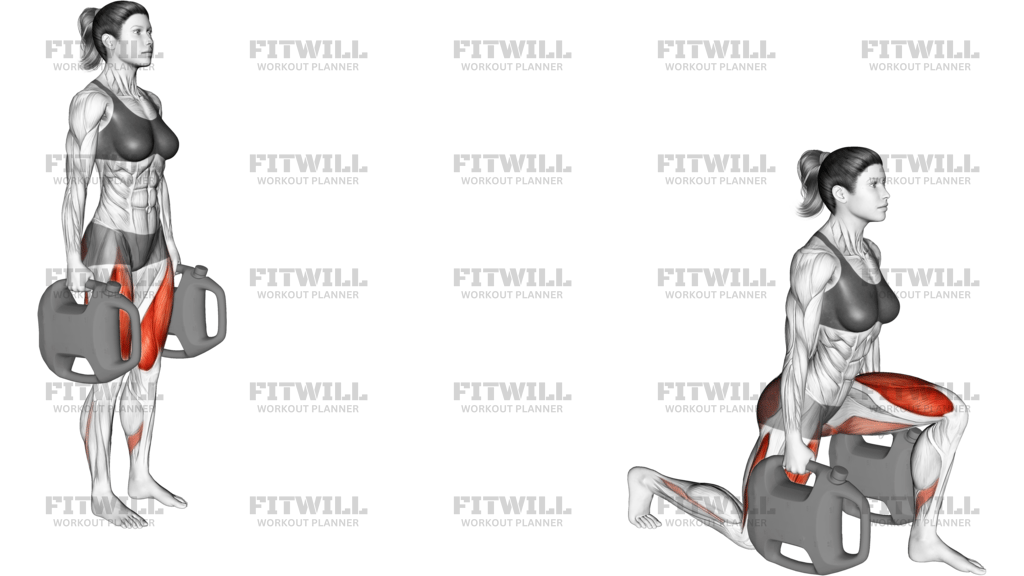
To execute well, step forward into a lunge with a long enough stride that your front shin stays close to vertical and your front knee tracks over the foot without collapsing inward. Lower until the back knee approaches the floor, then drive through the front foot to rise and bring the rear leg through into the next step. Keep your torso upright but not arched, and let the bag stay quiet on your shoulders. Two to four sets of 10-20 total steps is a common working range.
This exercise suits lifters who want unilateral leg strength without a rack, athletes looking for a loaded carry-lunge hybrid, and anyone training in a minimal gym or at home where a sandbag or loaded duffel is the heaviest tool available. If balance or grip becomes the limiting factor before your legs do, shorten the distance, lighten the load, or pause between steps until your stability catches up.
[ Workout Log & Planner ]
Put your next workout in Fitwill
Keep your plan and training log ready when you are.


Instructions
- Fill or select a weighted bag with an even load and drape it across the backs of your shoulders so it rests centered on the upper traps.
- Grip the ends or straps of the bag firmly with both hands, elbows pointing down, and pull it slightly toward your chest so it cannot slide during the walk.
- Stand tall with feet hip-width apart, brace your core as if bracing for a light push, and pick a clear walking path of several meters.
- Take a long step forward with your right foot, planting the whole foot flat before descending.
- Lower straight down until your right thigh is roughly parallel to the floor and your left knee approaches the ground, keeping your torso upright.
- Check that your front knee stays stacked over or slightly behind your toes and does not cave inward as you sink.
- Drive through the heel and midfoot of the front leg to stand up, bringing your left foot through to meet or pass the right as you step into the next lunge with the left leg.
- Exhale as you drive up out of each lunge, and inhale at the top while you reset your brace for the next step.
- Continue alternating legs for the planned number of steps, then stop walking, turn carefully with the bag still held, and set it down under control before resting.
Tips & Tricks
- If the bag slides toward your neck or off one shoulder, the grip is too loose or the load is uneven; re-center it and squeeze the ends in toward your chest before continuing.
- Shorten your stride if you feel your lower back arching at the bottom, since an overly long step with a loaded bag often turns into a torso lean instead of a deeper hip stretch.
- Watch for the rear knee swinging outward or the front knee caving inward mid-walk; both usually appear when fatigue sets in, so end the set rather than grind sloppy steps.
- Keep the bag from bouncing by stepping softly; heavy, slapping footfalls mean you are dropping into each lunge instead of lowering under control.
- Pause for one full breath at the top of each step if your balance wobbles, rather than rushing the leg switch with a load on your shoulders.
- Set your walking distance and turn-around point before you start, because trying to pivot with a weighted bag on your shoulders mid-fatigue is a common stumble point.
- If your grip gives out before your legs, choke up on the straps or wrap the ends around your hands once instead of cutting the set short.
- Keep your gaze on a point a few meters ahead, not down at your feet, to help your torso stay tall through each step.
Frequently Asked Questions
What muscles does the Weighted Bag Walking Lunge work?
The quadriceps of the front leg do most of the work, with the glutes and hamstrings driving you up out of each step. Your core, calves, and grip also work continuously to control the bag and stabilize each stride.
How is the Weighted Bag Walking Lunge different from a barbell walking lunge?
The bag sits lower and softer on the shoulders and shifts slightly as you walk, which challenges balance and trunk control more than a rigid barbell. It also requires no rack, making it easier to set up in a home or minimal gym.
Is the Weighted Bag Walking Lunge suitable for beginners?
Yes, as long as you start with a light bag and master the bodyweight version first. If you can perform 10 controlled walking lunges per leg without weight, a lightly loaded bag is a sensible next step.
Where should the weighted bag sit on my body?
It should rest centered across the backs of your shoulders and upper traps, similar to a barbell position, with both hands gripping the ends to keep it from sliding. Never let it hang off one side or press on your neck.
Why do I wobble when switching legs during the Weighted Bag Walking Lunge?
Wobbling usually comes from rushing the step transition or carrying a load that is too heavy for your current balance. Slow the walk down, pause briefly at the top of each step, and reduce the weight until the wobble disappears.
How far and how many steps should I walk per set?
A common starting point is 10-14 total steps per set, counting both legs, over a clear path of several meters. Progress by adding steps or load gradually rather than both at once.
Can I use a backpack or duffel bag if I do not have a proper sandbag?
Yes, any sturdy bag with an even, stable load and something to grip will work. Make sure the contents cannot shift inside the bag, since moving weight across your shoulders makes balance much harder.
What should I do if my grip fatigues before my legs?
Choke up on the straps or wrap the ends around your hands to secure the bag, and shorten the set slightly. Grip endurance typically improves quickly with continued practice.
Are Weighted Bag Walking Lunges safe for the knees?
They are generally well tolerated when your front knee tracks over your foot, your stride is long enough to keep the shin near vertical, and the load is appropriate. Stop and reassess if you feel sharp knee pain rather than normal muscle effort.
Can I substitute a stationary lunge if I have limited space?
Yes, alternating split squats or reverse lunges in place train similar muscles with the same bag position. You lose some of the balance and deceleration demand of walking, but the strength work remains similar.