Step Up With Knee Drive
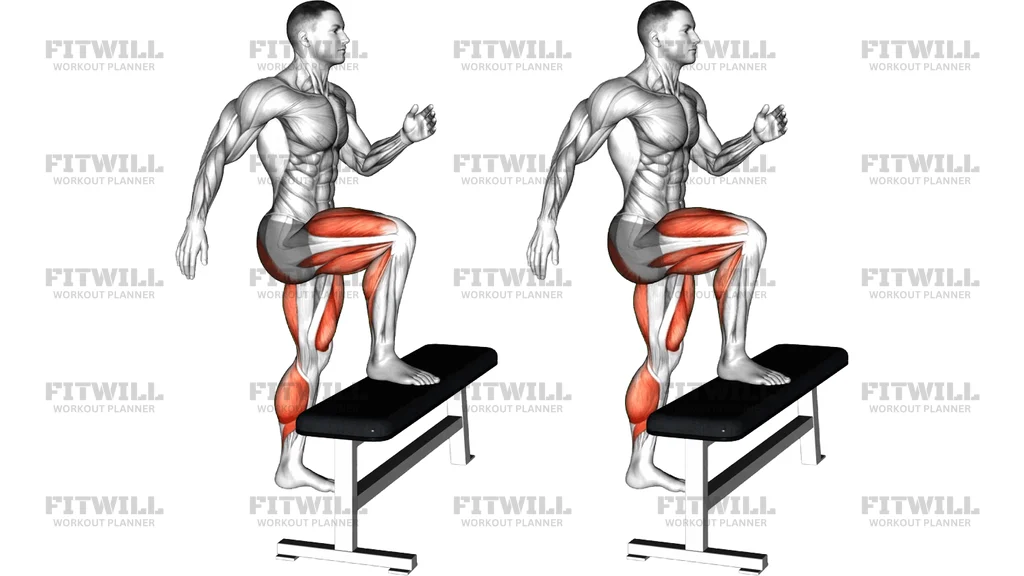
Step Up With Knee Drive is a single-leg strength exercise performed with one foot planted on a flat bench or step. Instead of simply stepping up and bringing the trailing foot alongside, you drive the back knee up toward hip height at the top of every rep. That knee lift turns a basic step-up into a more complete lower-body and hip-flexor movement that also demands balance and trunk control.
The working leg does most of the job here. Pressing through the bench leg challenges the quads and glutes through a full hip and knee extension, while the knee drive fires the hip flexors of the opposite leg and forces your core to keep your ribs stacked over your pelvis. Your calves and the small stabilizing muscles around the ankle and hip work continuously to stop you from wobbling side to side.
This version of the step-up carries over well to running, hiking, climbing, and field sports, all of which involve driving one knee up as the other leg pushes the body forward and up. It is a smart choice for athletes who want single-leg power without loading a barbell, and for anyone who has mastered a standard step-up and wants a harder, more dynamic variation.
Setup matters more than most people expect. Choose a bench height that lets you place your whole foot flat on top with the knee roughly at or just below hip height when your foot is planted. If you have to rise onto your toes or rock your torso to get up, the box is too tall. Stand facing the bench, close enough that your shin stays close to vertical as you step.
To perform it well, put one foot fully on the bench, brace your trunk, and shift your weight over that front foot before you move. Exhale and press through the whole foot to stand tall on the bench, letting the trailing knee drive up until the thigh is about parallel to the floor. Pause briefly at the top, then lower the knee-drive leg back to the floor under control and let it absorb your bodyweight softly before the next rep.
A few practical points will keep this safe and effective. Avoid pushing off the floor with the trailing leg, which quietly steals work from the target side. Keep your torso tall rather than leaning back as the knee comes up, and match your arm swing naturally, driving the opposite arm forward like you would when running. Complete all reps on one side before switching, and start with bodyweight only until your balance is solid on every rep.
[ Workout Log & Planner ]
Put your next workout in Fitwill
Keep your plan and training log ready when you are.


Instructions
- Stand facing a flat bench at a height that lets you place your entire foot on top with your knee at or slightly below hip level.
- Place your left foot fully on the bench so your heel and the ball of your foot are both supported, and let your right foot rest on the floor behind you.
- Brace your abdominal muscles, lift your chest, and shift your bodyweight completely over the bench leg so the floor foot is nearly unloaded.
- Exhale and press through the bench foot, extending the hip and knee to stand up onto the bench.
- As you reach the top, drive your right knee up toward your chest until the thigh is roughly parallel to the floor, swinging your left arm forward for balance.
- Pause for a beat at the top with your torso tall and your standing hip fully extended, not bent forward.
- Lower the right foot back to the floor with control, letting it land softly rather than dropping or stomping down.
- Inhale as you lower, then reset your weight over the bench leg before starting the next repetition.
- Complete all reps on one side, then switch legs so the right foot works on the bench and the left knee drives up.
Tips & Tricks
- If your floor foot slides forward or you bounce off it each rep, you are pushing with the back leg. Lift the toes of that foot slightly or hover it an inch off the floor to force the bench leg to do the work.
- A bench that is too tall is the most common setup mistake. If your heel lifts or you lean far forward to get up, switch to a lower bench or step.
- Do not let the standing knee cave inward as you press up. Think about spreading the floor with your foot so the knee tracks over the middle of the foot.
- Keep the knee drive controlled rather than whipping it up. A fast, loose drive usually pulls your torso backward and costs you balance.
- Squeeze the glute of the standing leg at the top. This stops the habit of leaning forward at the hips as the opposite knee rises.
- Look at a fixed point on the wall ahead of you instead of down at your feet. Fixing your gaze noticeably improves balance on this exercise.
- If you keep wobbling, hold the edge of a rack or wall lightly with one hand for support, and progress to freestanding reps once the wobble settles.
- Alternate arm swing each rep as if running. Swinging the same-side arm forward is an easy pattern error that throws off coordination.
Frequently Asked Questions
What muscles does Step Up With Knee Drive work?
The quads and glutes of the leg on the bench do the main work, with the hamstrings and calves assisting the press. The knee drive also recruits the hip flexors of the opposite leg, and your core stays active to keep you balanced on one foot.
How high should the bench be for Step Up With Knee Drive?
Pick a height where your whole foot sits flat on the bench and your knee is about at hip height when planted. For most people that means a bench between 12 and 18 inches, and a lower height is better while you are still building balance.
Is Step Up With Knee Drive good for beginners?
Yes, as long as you start with a low step and bodyweight only. If the knee drive feels unstable at first, master a regular step-up first, then add the knee lift once each rep feels steady.
Why should I drive the knee instead of just stepping up normally?
The knee drive adds work for the hip flexors, challenges your balance at the top, and trains the knee-up pattern used in running and climbing. It also makes the top position harder to cheat, since you cannot coast with both feet on the bench.
Can I push off my back foot to help get up?
No, pushing off the floor turns it into a two-leg movement and takes load away from the bench leg. Shift your weight fully over the front foot before pressing so the trailing leg only tracks up and down.
Should I hold dumbbells while doing Step Up With Knee Drive?
You can once your balance and form are consistent with bodyweight. Start light, hold the weights at your sides, and expect the knee drive to feel harder because your arms can no longer swing to help balance.
How many reps and sets should I do?
For strength and muscle, 3 sets of 8 to 12 reps per leg works well. Because the movement is done one side at a time, finish all reps on one leg before switching so each side gets the same work.
My knee hurts when I step up. What should I check?
Make sure your whole foot is on the bench, your knee tracks over the middle of your foot, and the bench is not so tall that your knee bends sharply at the start. Reduce the height and range first, and stop the exercise if discomfort continues.
What can I use instead of a bench?
Any stable, non-slip platform around knee height works, such as a low plyo box or a sturdy stair. Avoid anything that shifts or tips under your weight, since you are standing on one leg at the top of every rep.