Standing Lateral Raise (Bent Arms)
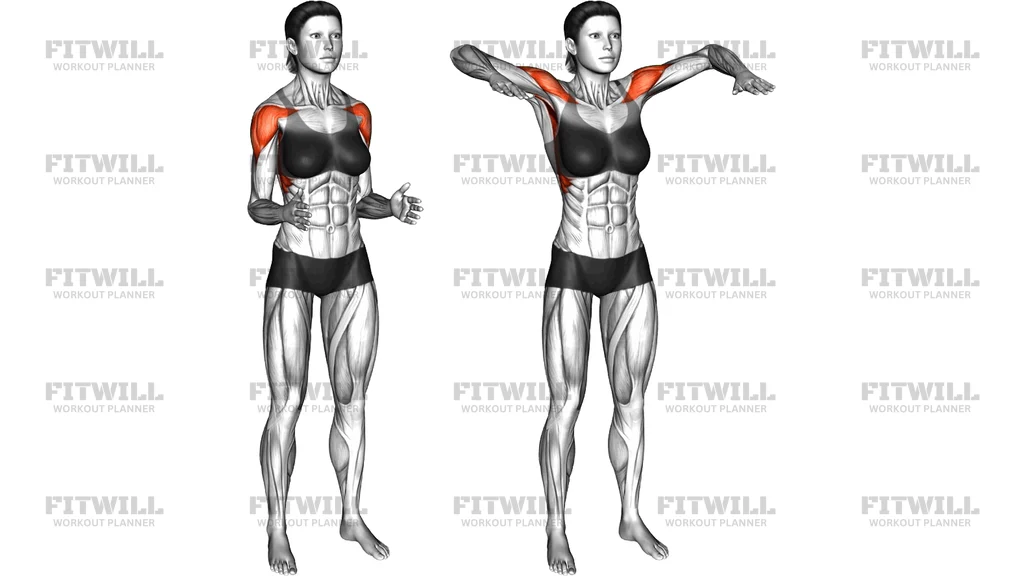
The Standing Lateral Raise (Bent Arms) is a bodyweight shoulder isolation movement performed with the elbows fixed at roughly a 90-degree bend throughout. From a tall standing position, you lift both arms out to the sides until they reach shoulder height, then lower them back down with control. Bending the arms shortens the lever, which makes the pattern easier to learn and to feel in the side of the shoulders than a straight-arm version, especially when no dumbbells are involved.
Because this version uses no external load, resistance comes entirely from your own limb weight and from how deliberately you move. That makes it a practical choice for beginners learning where the lateral raise should be felt, for warm-ups before pressing or dumbbell lateral raise work, and for higher-rep burnout sets at the end of a shoulder session. It is also useful for people rebuilding training habits at home, since it requires nothing but floor space to stand on.
The primary muscle at work is the lateral deltoid, the cap of muscle on the outer shoulder that gives the shoulder its width. The front delts and upper traps assist as the arms rise, and the rotator cuff and scapular stabilizers work isometrically to keep the shoulder joint centered as the arm travels overhead-height. The core contributes quietly by keeping the torso upright while the arms move.
Setup matters more than it seems in an unloaded raise. With no weight to mask it, small habits show up fast: shrugging the shoulders toward the ears, swinging the arms with momentum, or leaning the torso back to help the arms up. Standing tall with the ribs stacked over the hips and the shoulder blades relaxed down forces the deltoid, rather than momentum or the traps, to do the lifting.
Execution is straightforward but rewards precision. Keep the elbows bent at a consistent angle and lead with them, letting the forearms follow, until the upper arms are parallel to the floor or just slightly below. Pause briefly at the top, then lower over two to three seconds rather than dropping the arms. Move at a pace slow enough that you could stop the arms at any point; if you cannot, you are relying on momentum.
Common use cases include deltoid warm-ups, home shoulder training, technique practice before loading the pattern with dumbbells, and active recovery days. Keep the range pain-free and stop just short of any pinch at the top of the shoulder. Because the load is light, the exercise responds well to higher repetitions, slower tempos, and brief holds at the top rather than maximal effort.
[ Workout Log & Planner ]
Put your next workout in Fitwill
Keep your plan and training log ready when you are.


Instructions
- Stand with your feet about hip-width apart, weight spread evenly across both feet, and let your arms hang at your sides.
- Bend both elbows to roughly 90 degrees so your forearms point forward, and relax your shoulders down away from your ears.
- Brace your core lightly and keep your ribs stacked over your hips so your torso stays upright before you start moving.
- Exhale and raise both upper arms out to the sides, keeping the elbow angle fixed and leading the movement with the elbows rather than the hands.
- Stop when your upper arms reach shoulder height and are roughly parallel to the floor, with your forearms still pointing forward.
- Hold the top position for a brief moment without shrugging or letting the shoulders creep up toward your ears.
- Inhale and lower your arms slowly over two to three seconds back to the starting position at your sides.
- Reset your posture between reps: shoulders down, torso tall, elbows still bent at 90 degrees, then begin the next lift.
- Keep both sides moving evenly so one arm does not drift higher or faster than the other.
Tips & Tricks
- If you feel the work mostly in your neck or upper traps, lower the range slightly and consciously press your shoulders down before each rep.
- Swinging the forearms up is the most common fault here; fix it by pretending the elbows are the only joints moving and the forearms are just along for the ride.
- Avoid letting the elbow angle change mid-rep. If your arms straighten as you lift, the set turns into a different exercise and the lever lengthens.
- Do not raise the arms above shoulder height in search of more work; going higher shifts effort toward the traps and can pinch the top of the shoulder.
- Lean back slightly and the torso steals the job from the delts. If you catch yourself rocking, stand closer to a wall with your back lightly touching it.
- Make the unloaded version harder by pausing two to three seconds at the top or by lowering over a slow four-second count instead of adding speed.
- Your wrists should stay neutral and relaxed; flipping the palms up or curling the hands inward changes the shoulder rotation and the feel of the raise.
- If one side fatigues first, that asymmetry is worth noting. Slow down and match the weaker side's range rather than chasing the stronger arm.
Frequently Asked Questions
Which muscles does the Standing Lateral Raise (Bent Arms) work?
The lateral deltoids on the outer shoulders do most of the work. The front delts and upper traps assist, while the rotator cuff and shoulder blade stabilizers hold the joint steady as the arms travel.
Why are the arms kept bent at 90 degrees in this exercise?
Bending the elbows shortens the lever arm, which reduces how hard the shoulders have to work and makes it easier to isolate the deltoid without weight. It is a good way to learn the raise pattern before adding dumbbells.
Is the Standing Lateral Raise (Bent Arms) suitable for beginners?
Yes, it is one of the most accessible shoulder exercises because it requires no equipment and the bent-arm position keeps the demand low. Beginners should focus on slow reps and avoiding shoulder shrugging rather than speed or volume.
How high should I raise my arms in this movement?
Raise until your upper arms are about parallel to the floor at shoulder height. Lifting much higher adds little for the lateral delts and tends to shift the work to the upper traps.
What is the most common mistake with the bent-arm lateral raise?
Using momentum by swinging the forearms upward, often alongside a shrug. The fix is leading with the elbows, keeping the shoulder blades pressed down, and lowering the arms on a slow two-to-three-second count.
Can I make the Standing Lateral Raise (Bent Arms) harder without equipment?
Add a two-to-three-second hold at the top, slow the lowering phase to four seconds, or increase the reps substantially. Paused and slow-tempo reps create far more challenge than moving faster.
What can I use instead of this exercise?
Dumbbell or resistance band lateral raises train the same muscles with added load, and a cable lateral raise keeps constant tension on the side delts. The bent-arm bodyweight version is best treated as the entry point or warm-up for those.
Should I feel this exercise in my neck?
No, neck or upper-trap burning usually means the shoulders are riding up as you lift. Reduce your range of motion slightly, keep the shoulder blades pulled down, and reset your posture between reps.
How many reps should I do of this exercise?
Since the resistance is light, sets of 15 to 25 controlled reps work well, whether for warm-ups or home training. Stop the set when your form changes, not when the arms simply feel tired.