Weighted Bottle Hollow Rock
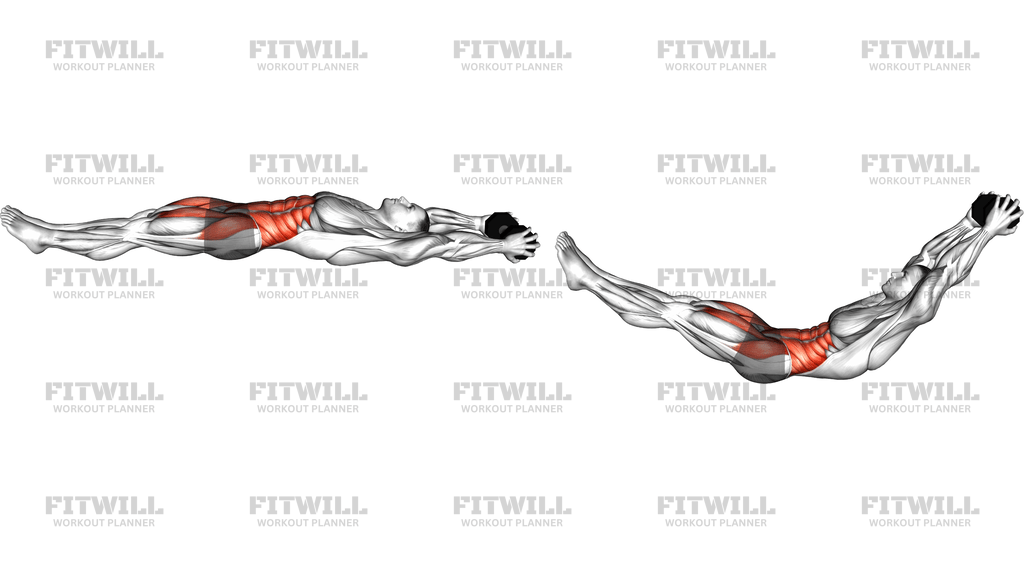
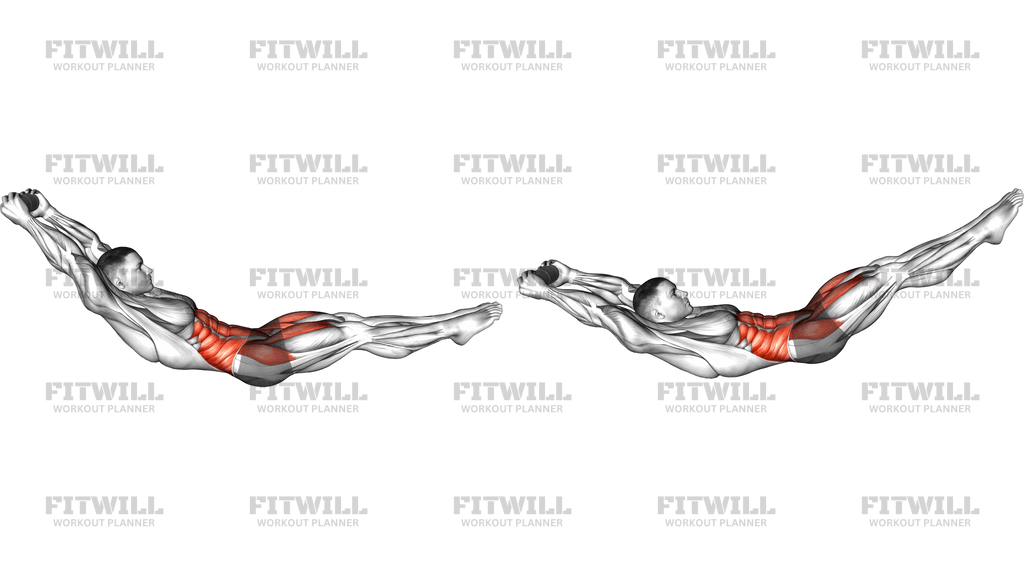
The Weighted Bottle Hollow Rock is a dynamic core exercise that takes the classic hollow rock and adds load overhead in the form of a weighted bottle held in both hands. You lie on your back, press the bottle toward the ceiling, then lift your straightened arms and legs off the floor so your body forms a shallow banana shape. From there, you rock back and forth like a rocker, keeping that rigid hollow position from shoulders to heels throughout the entire set.
This movement is primarily a deep abdominal and anterior chain builder. The hollow position itself demands constant contraction from the rectus abdominis and transverse abdominis to keep your lower back flattened toward the floor, while the hip flexors work hard to hold your straight legs up. Adding the weighted bottle lengthens the lever arm and pulls your center of mass toward your hands, which means your abs have to fight noticeably harder to hold the shape than they would with an unweighted hollow rock.
The setup matters more than most people expect. Because the weight sits above your head and slightly behind it at the back of the rock, any slack in your shoulders or lower back gets amplified as you swing. You want your ribs pulled down, your arms locked out tight by your ears, and your legs squeezed together before the first rock even starts. A loose setup turns the exercise into a lower-back swing with a weight hovering over your face, which is exactly what you want to avoid.
To execute it well, think of your body as one solid piece of wood rocking on the curve of your lower back, not as two separate halves flapping up and down. Initiate the rock by tipping slightly toward your feet, then let the momentum carry you over your glutes and back, keeping the amplitude small and the tempo steady. Breathe in short, controlled breaths through the nose while keeping the brace locked in.
This exercise suits intermediate to advanced trainees who can already hold a bodyweight hollow hold for thirty to forty-five seconds without their lower back arching. It shows up frequently in gymnastics strength work, calisthenics programming, and sports conditioning where midline stiffness under momentum is valuable. Because the load is a simple weighted bottle, it is also an accessible home-training option that scales easily by filling the bottle more or less.
For safety, keep the weight modest at first and make sure your grip on the bottle is secure before every set. If you feel your lower back lifting off the floor or your ribs flaring, shorten the range of the rock or reduce the load rather than pushing through a broken position. Stop the set the moment the shape collapses, because reps performed in a bad hollow position build habits you will have to undo later.
[ Workout Log & Planner ]
Put your next workout in Fitwill
Keep your plan and training log ready when you are.


Instructions
- Lie flat on your back on the floor with your legs straight and together, holding a weighted bottle in both hands with a firm overhand grip.
- Press the bottle straight up toward the ceiling so your arms are fully extended, then squeeze your arms in line with your ears and pull your ribs down toward your hips.
- Brace your core hard, flattening your lower back against the floor, and point your toes while squeezing your legs together.
- Lift your shoulder blades, arms, and legs off the floor at the same time so your body forms a shallow banana shape balanced on your glutes and lower back.
- Begin rocking by tipping slightly toward your feet, letting your bodyweight carry you back onto your glutes and then forward again.
- Keep the rock short and controlled, maintaining the same hollow shape at both ends of the swing with arms locked out overhead holding the bottle.
- Exhale in short, steady breaths through the rock without letting the brace soften or the lower back arch.
- Continue for the target number of seconds or repetitions, stopping as soon as the banana shape or the locked-out arm position starts to break down.
- To finish, stop the rock at the bottom, lower your legs and upper back to the floor one controlled motion at a time, then bring the bottle down to your chest before sitting up.
Tips & Tricks
- If the bottle feels unstable in your hands, grip it at its thickest point and squeeze it throughout the set; a slipping bottle over your face is a distraction you do not need mid-rock.
- The most common failure is the lower back arching when the legs swing low, which usually means the weight or the range is too aggressive; shrink the rock amplitude before you cut the load.
- Ribs flaring toward the ceiling are a sign the weighted overhead position is pulling your torso open; cue yourself to pull your belly button toward your spine and reach the bottle longer rather than higher.
- Rock with your whole body as one unit. If your legs and torso move out of sync, you are bending at the hips, so practice a few unweighted hollow rocks to relearn the connected shape.
- Keep your eyes on the bottle or on your feet at the top of the rock; letting your head drop back changes your neck angle and makes the hollow harder to hold.
- A slow, small rock trains more than a big, fast one. Momentum from a large swing lets your abs off the hook at the transition points.
- Place a thin mat under your spine if the rocking on a hard floor is uncomfortable on your vertebrae or shoulder blades, but keep it thin enough that you do not wobble side to side.
- If your grip fatigues before your abs do, the bottle is too heavy or too slippery; use a lighter bottle or one with a textured surface so the core stays the limiting factor.
Frequently Asked Questions
What muscles does the Weighted Bottle Hollow Rock work?
It primarily targets the abs, especially the rectus abdominis and deep transverse abdominis, while the hip flexors hold your straight legs up. The shoulders and arms work isometrically to keep the bottle locked out overhead.
Why use a weighted bottle instead of doing a regular hollow rock?
Holding the weight overhead lengthens your body's lever and shifts your center of mass toward your hands, which increases the demand on your abs to maintain the hollow. The bottle is also a convenient, easily adjustable load for home training.
How heavy should the bottle be for the Weighted Bottle Hollow Rock?
Start light, around one to two kilograms, and only add water or weight once you can rock for thirty seconds without your lower back arching. Your core and grip should fatigue together, with the abs giving out first.
Is the Weighted Bottle Hollow Rock safe for beginners?
Beginners should master an unweighted hollow hold and hollow rock first, since adding load overhead makes every positioning error harder to correct. Once you can hold a clean hollow for thirty to forty-five seconds, add a light bottle.
Why do my lower back and hips lift off the floor during the rock?
That usually means your core brace has softened or the load is pulling your arms and ribs too far overhead. Squeeze your ribs down, reduce the weight, and keep the rock amplitude small so your lower back stays pressed toward the floor at the bottom of the swing.
Should my arms stay locked out during the whole exercise?
Yes, the bottle should stay held straight overhead by your ears with elbows locked for the entire set. Bending the elbows turns it into a different, easier leverage position and reduces the abdominal challenge that defines this movement.
What can I use if I do not have a suitable weighted bottle?
Any compact, grippable object works, such as a small dumbbell, a medicine ball, or a plate held in both hands. Just make sure it is an object you can hold securely overhead while moving.
How long should I rock for on the Weighted Bottle Hollow Rock?
Work in timed sets of fifteen to thirty seconds, or count rocks and aim for ten to twenty quality repetitions. End the set the moment your shape breaks rather than grinding out sloppy reps.
Can I do this exercise every day?
Because the load is light and the movement is bodyweight-driven, frequent practice is reasonable, but treat it like any resisted core exercise and leave a rest day between harder weighted sessions so your abs and hip flexors recover.