Bodyweight Full Squat With Overhead Press (Version)
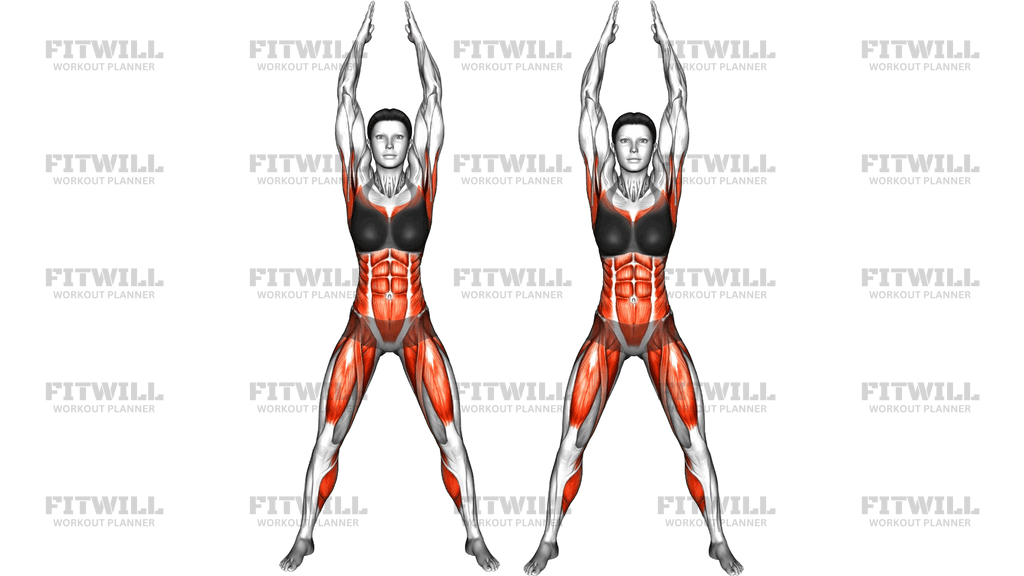
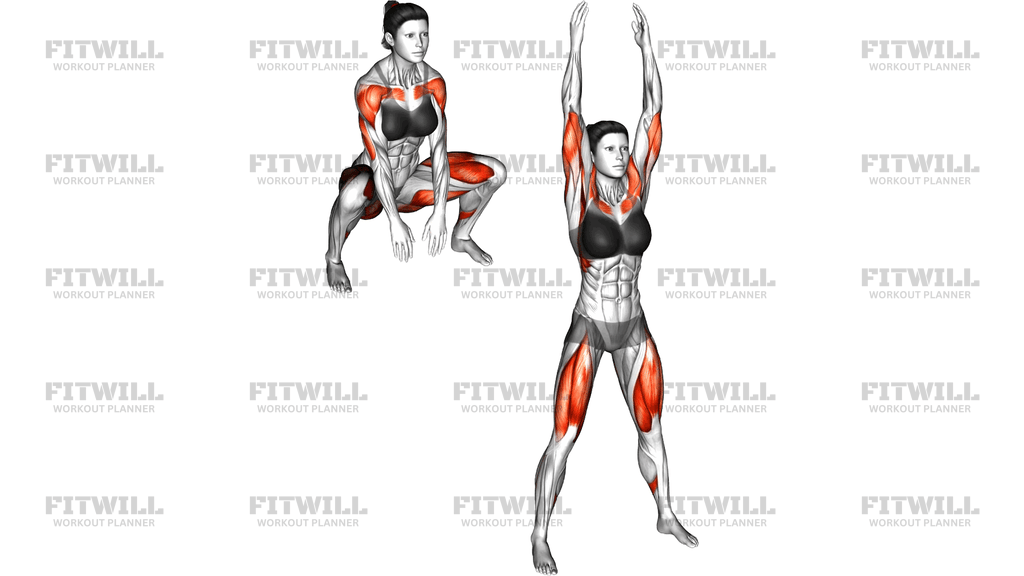
The Bodyweight Full Squat With Overhead Press is a compound bodyweight movement that links a deep, wide-stance squat with an overhead arm reach as you stand. From a standing position with your feet set noticeably wider than shoulder width and toes turned slightly out, you sink into a full-depth squat while your arms swing down and hang between your knees, then drive through the floor to stand tall as your arms press straight up overhead. It is essentially a squat and a shoulder raise blended into one continuous, flowing rep.
Because it ties the lower and upper body into a single pattern, this exercise is useful for warm-ups, general conditioning, and home workouts where no equipment is available. It raises your breathing rate quickly and teaches coordination between the hips, torso, and shoulders. Beginners can use it to groove a comfortable full-depth squat before adding load, while more experienced lifters often use it as a movement prep drill before barbell squats or pressing days.
The main work comes from the quads and glutes, which extend the hips and knees out of the bottom position. The adductors and hamstrings assist with control at the wide stance, and the core braces to transfer force from the ground to the arms. The shoulders, particularly the front delts, do the overhead lifting, with the upper back and traps supporting the arms at the top. None of these roles is maximal on its own, but the combination covers a lot of muscular ground in one rep.
Setup matters here because the wide stance changes how you must reach the bottom. Your knees need to track out over your toes, and your arms must clear your legs as they drop between your knees at the deepest point. If your stance is too narrow, the arms will collide with your thighs and pull your chest forward; too wide, and your hips may run out of range. Take a moment to find a foot position where you can sit fully upright at the bottom without your weight shifting to your toes.
Execution is about rhythm and sequencing, not speed. Sink down with control, let the arms fall naturally rather than forcing them, then coordinate the drive up so your knees, hips, and arms extend together and finish at the same moment. The most common error is letting the lower back round or the heels lift at the bottom, both of which are signs the descent is too fast or the stance is wrong for your mobility.
In practice, this movement works well as a first exercise in a warm-up, a higher-rep finisher, or a stand-alone drill in minimal-equipment routines. Stay within a depth you can reach with a neutral spine and flat feet, and add reps gradually. If deep squatting bothers your knees or hips, reduce the depth and keep the arm pattern, then build range over time.
[ Workout Log & Planner ]
Put your next workout in Fitwill
Keep your plan and training log ready when you are.


Instructions
- Stand with your feet set wider than shoulder width, toes turned out roughly 15 to 30 degrees, and your weight spread evenly across both feet.
- Let your arms hang relaxed at your sides and take a tall posture with your ribcage stacked over your pelvis.
- Brace your core lightly by tightening your midsection as if preparing for a light push to the stomach.
- Push your hips back and bend your knees out over your toes, sinking into a full squat while your arms swing down and hang between your knees.
- At the bottom, keep your heels flat, chest as upright as your mobility allows, and knees pressed outward in line with your toes.
- Drive through your whole foot to extend your knees and hips, swinging your arms up in front of your body as you rise.
- Finish standing fully upright with your arms pressed straight overhead, elbows extended and hands in line with your shoulders.
- Lower your arms back down with control as you immediately initiate the next squat, or reset your stance between reps if you are new to the pattern.
- Exhale as you drive up and press overhead; inhale as you descend into the next rep.
- Complete your set, then shake out your hips and shoulders before the next round.
Tips & Tricks
- If your arms collide with your thighs at the bottom, widen your stance slightly or turn your toes out a little more so your arms can drop between your knees.
- Heels lifting off the floor usually means the descent is too fast or your ankles are tight; slow the lowering phase and consider a slightly wider foot position.
- Keep the overhead press a straight vertical reach. Letting the hands drift forward as you stand shifts your weight onto your toes and rounds your upper back.
- Do not let your knees cave inward as you drive up from the deep squat; consciously push them out over your little toes, especially in the first half of the ascent.
- The arms should move as a result of your body rising, not as a separate shoulder shrug. Avoid hiking your traps toward your ears at the top.
- A rounded lower back at the bottom is a signal you have gone deeper than your hips currently allow. Squat to the depth where your spine stays neutral and build range gradually.
- Keep the movement fluid rather than pausing at the top or bottom, but never let momentum collapse you into the bottom position.
- If your hips feel pinched at full depth, narrow your stance slightly and reduce the toe-out angle, which often gives the hip sockets more room.
- Breathe in a steady rhythm rather than holding your breath through multiple reps, since the continuous flow can raise your heart rate quickly.
Frequently Asked Questions
Which muscles does the Bodyweight Full Squat With Overhead Press work?
The quads and glutes do the main work driving you out of the deep squat, while the front shoulders lift the arms overhead. Your core, adductors, and upper back stabilize and assist throughout the movement.
Why does this squat use a wide stance instead of a normal squat stance?
The wide stance with toes turned out creates space between your legs so your arms can hang down between your knees at the bottom. It also lets many people reach a deeper, more upright squat comfortably.
Is the Bodyweight Full Squat With Overhead Press good for beginners?
Yes, as long as you squat only as deep as you can keep your heels flat and your back neutral. It is a low-load way to learn the full squat pattern while also training shoulder mobility.
How deep should I squat if I cannot reach a full-depth position?
Squat to the deepest point where your feet stay flat and your spine stays neutral, even if your arms only hang toward your shins rather than the floor. Depth usually improves with consistent practice.
Should the arms actively press or just swing during the standing phase?
Treat it as a deliberate press: as your hips and knees extend, raise your arms straight up in front of your body until they finish overhead. Avoid passive flailing, which usually means the tempo is too fast.
Can I use this as a warm-up before barbell squats?
Yes, it works well because it opens the hips, raises your heart rate, and rehearses knee tracking and bracing before you add load. Two to three sets of eight to twelve smooth reps is a common warm-up dose.
My heels rise at the bottom of the squat. How do I fix that?
Slow down the descent, widen your stance slightly, and make sure your knees travel out over your toes rather than forward. Limited ankle mobility is often the cause, and reduced depth is a reasonable short-term fix.
What can I substitute if deep squatting is uncomfortable?
Use a partial-depth squat with the same overhead reach, or hold onto a sturdy support with one hand to help you sit taller at the bottom. Both preserve the pattern while you work on mobility.
How many reps should I do of the Bodyweight Full Squat With Overhead Press?
For warm-ups or conditioning, sets of 10 to 20 smooth reps work well. Because the load is your body weight, the goal is quality of movement and rhythm rather than working to failure.
Is it safe for my knees to squat this deep with a wide stance?
For most people with healthy knees, controlled deep squatting within a pain-free range is fine and the knees tracking over the toes is a natural position. If you feel sharp pain or have a knee injury history, reduce the depth and consult a qualified professional.