Weighted Plate Standing Front Raise Drive
The Weighted Plate Standing Front Raise Drive is a front raise variation where you hold a single weight plate with both hands and lift it straight out in front of your body until your arms reach shoulder height, then lower it back down under control. Because both hands share one plate held at its edges, the weight sits in front of your torso rather than split out to your sides, which changes the leverage compared to raising two separate dumbbells and keeps your arms working as a single unit.
The main work falls on the front delts, with the upper chest assisting on the lift and the traps and stabilizing muscles around the shoulder blade helping to keep everything steady at the top. Your core is quietly involved the whole time, since the plate is pulled forward away from your body and your trunk has to resist arching to stay upright. The grip also gets more work than you might expect, because pinching the edge of a plate challenges the forearms differently than holding a bar or handle.
This movement suits lifters who want to build front shoulder strength and size without needing dumbbells, and it is especially common in gyms where plates are the most accessible equipment. It also works well as a finisher at the end of a shoulder or pressing day, when the delts are already fatigued and a moderate, precisely held weight is more practical than a heavy press. Athletes who throw, press, or reach overhead benefit from the shoulder flexion pattern it trains.
Setup matters here because the plate position dictates everything else. Stand tall with feet about hip width, hold the plate by its sides at roughly 3 and 9 o'clock with arms hanging straight down in front of your thighs, and set your shoulders back before you start. If you begin rounded or with the plate drifting toward your body, the lift shortens and the shoulders stop doing the work.
To execute it well, keep your elbows nearly straight but not locked, raise the plate forward and slightly upward along a path in line with your shoulders, and stop when the plate is level with your eyes or the top of your head. Pause briefly, then lower it at half the speed of the lift rather than letting gravity take it back. Keep your torso still throughout; if you find yourself leaning back or swinging, the weight is too heavy or you are rushing the rep.
As for safety, the front raise loads the shoulder in flexion, so use a weight you can lift without shrugging or jerking, and keep the range in front of your body rather than overhead. If your shoulders feel pinched at the top, lower the end height slightly and focus on smooth reps.
[ Workout Log & Planner ]
Put your next workout in Fitwill
Keep your plan and training log ready when you are.


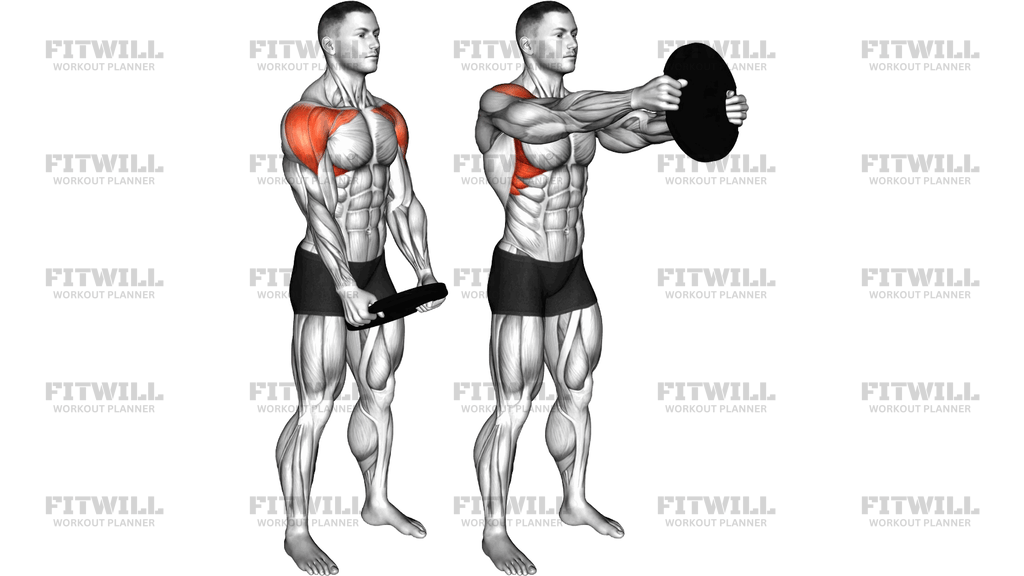
Instructions
- Stand upright with your feet about hip width apart and a weight plate held by its edges with both hands at roughly the 3 and 9 o'clock positions, one hand on each side.
- Let your arms hang straight down in front of your thighs so the plate rests against them, then draw your shoulders back and down so they sit level, not rounded forward.
- Brace your stomach lightly and keep your ribs stacked over your pelvis so your lower back is not already arched before you lift.
- Exhale and raise the plate forward and upward with straight but not locked elbows, keeping the plate facing forward as it travels.
- Follow a path directly in front of your body, in line with your shoulders, rather than letting the plate drift out to one side.
- Stop when the plate reaches shoulder to head height and your arms are parallel to the floor, then hold that top position for a beat without shrugging your shoulders up toward your ears.
- Inhale and lower the plate back down along the same path at a controlled speed, resisting the weight on the way down instead of dropping it.
- Let the plate settle briefly against your thighs at the bottom without fully relaxing your shoulders, then begin the next rep.
- Keep your torso upright from start to finish; do not rock backward to help the plate up, and reset your stance and posture if form slips.
Tips & Tricks
- If you feel the need to lean back as the plate rises, the weight is too heavy; a front raise should be driven by the shoulders, not by a trunk swing that turns it into a momentum lift.
- Hold the plate firmly by its edge with your fingers wrapped around the rim. Pinching it flat between your palms is a different, grip-limited version and will usually fail your hands before your shoulders.
- Keep a small bend in the elbows and hold it constant. Elbows that bend more as the set gets hard shorten the lever and quietly unload the front delts.
- Aim the plate at a spot on the wall directly in front of you. The most common drift with a two-handed plate raise is letting one side rise first, which twists the shoulders.
- Stop at shoulder height rather than lifting the plate overhead. Going beyond parallel shifts the work toward the traps and reduces the tension on the front delts.
- Lower the plate in two to three seconds. Because both hands share one load in front of the body, the negative is where most of the tension lives, and dropping it wastes that.
- Do not shrug at the top. If your shoulders creep toward your ears as the plate rises, consciously press them down and slightly back before your next rep.
- Start lighter than you would for a dumbbell front raise. Holding a plate in front of your body places a longer lever load on the shoulder, and the jump between plate sizes is steep.
- If your shoulders feel compressed at the very top, lower the end point an inch or two. A slightly shorter range with smooth, pain-free reps beats forcing full height.
Frequently Asked Questions
Which muscles does the Weighted Plate Standing Front Raise Drive work?
The front shoulders do most of the lifting, with the upper chest assisting during the drive upward. Your traps, grip, and core work to stabilize the plate and keep your torso upright.
How should I grip the plate for the Weighted Plate Standing Front Raise Drive?
Hold the plate by its sides with one hand at each edge, fingers wrapped around the rim, as if you were holding a steering wheel with a flat disc in front of you. This keeps the load balanced and lets your shoulders, not your grip, limit the set.
How high should I raise the plate?
Raise it to about shoulder height or eye level, so your arms are roughly parallel to the floor. Going higher than that shifts effort toward the traps and can compress the shoulder joint.
Is the Weighted Plate Standing Front Raise Drive good for beginners?
Yes, as long as a light plate is used. The two-handed grip keeps the movement symmetrical and easy to self-check, which makes it a simple way to learn the front raise pattern before progressing to heavier or single-arm variations.
Why does my lower back arch during this exercise?
Your trunk is compensating for a weight that is too heavy or reps moved too fast, using a backward lean to swing the plate up. Lighten the load, brace your stomach, and slow the lifting phase so the front delts do the work.
What can I use instead of a weight plate?
A single dumbbell held vertically with both hands under the top head works well and closely matches the plate's front-loaded position. A kettlebell held by the horns or a small sandbell are also reasonable substitutes.
How is the Weighted Plate Standing Front Raise Drive different from a dumbbell front raise?
With one plate held by both hands, the load sits centered in front of your body and your arms are forced to work together, whereas two dumbbells let each shoulder work independently. The plate version also demands more from your grip and makes side-to-side imbalances harder to hide.
Where should I put the Weighted Plate Standing Front Raise Drive in my workout?
It works best as an accessory or finisher after your main pressing or shoulder work, when the delts are warm and pre-fatigued. Two to four sets of 10 to 15 controlled reps covers it well.
Should my elbows be locked straight during the raise?
Keep them straight but with a small, constant bend. Fully locked elbows can be uncomfortable at the top, and letting the bend grow as you tire turns the raise into a partial front curl.
Is it safe to do this exercise if my shoulders click or ache at the top?
Stop at a height that feels comfortable and keep the reps slow and controlled, since reducing the top range usually removes the discomfort. If pain persists or is sharp, have a qualified professional assess your shoulder before continuing.