Cable Standing Jab
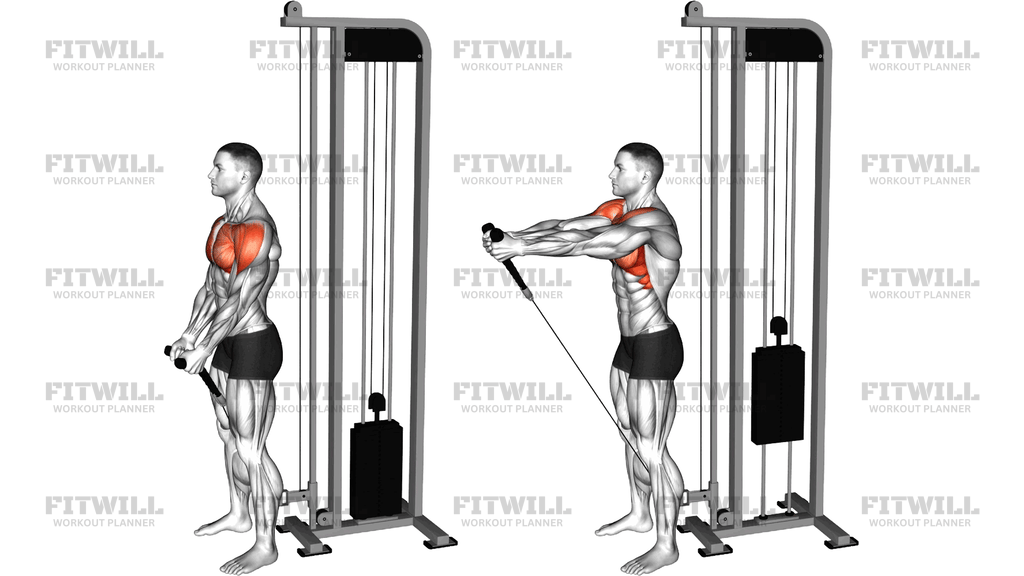
The Cable Standing Jab takes the first punch a boxer ever learns and loads it with cable resistance. You set the pulley at chest height, stand side-on to the machine in a staggered stance, hold the handle at your chin with your lead hand, and snap the arm out in a straight punching line while the cable pulls back toward the stack. Because the resistance comes horizontally from behind you, the tension stays constant through the entire punch rather than disappearing at the top the way a free-weight press does.
This movement is popular with combat sport athletes who want to build punching power and speed without a partner or heavy bag, and with general trainees who want a rotational, athletic core exercise that feels nothing like a plank. The front shoulders drive the punch, the chest and triceps assist the extension, and the obliques and deep core control the slight trunk rotation that transfers force from the floor to the fist. Your legs are quietly working the whole time, since the split stance and the pull of the cable demand balance and hip stability.
Setup matters more than it looks. The pulley height should match your chin so the punch travels on a level line, and your distance from the machine determines how much the cable drags you backward. Stand far enough away that the weight stack lifts fully and the handle floats at your guard without slack, but not so far that the cable yanks you off your stance.
Execution is about speed with control, not grinding. Exhale sharply as the fist extends, stop just short of locking the elbow, and bring the hand back to your chin under control instead of letting the cable windmill it home. The rep count stays moderate, usually eight to fifteen per side, and the emphasis stays crisp. Two or three sets per side fit well as a finisher on upper body days or as a power primer before boxing or sparring work.
A few practical points keep this safe and productive. Keep the non-working hand glued to your cheek the entire set, keep both feet planted, and never let your lower back arch backward as the cable pulls your torso. If you feel it in your shoulder joint rather than the shoulder muscle, the weight is too heavy or your elbow is drifting above shoulder line on the punch.
[ Workout Log & Planner ]
Put your next workout in Fitwill
Keep your plan and training log ready when you are.


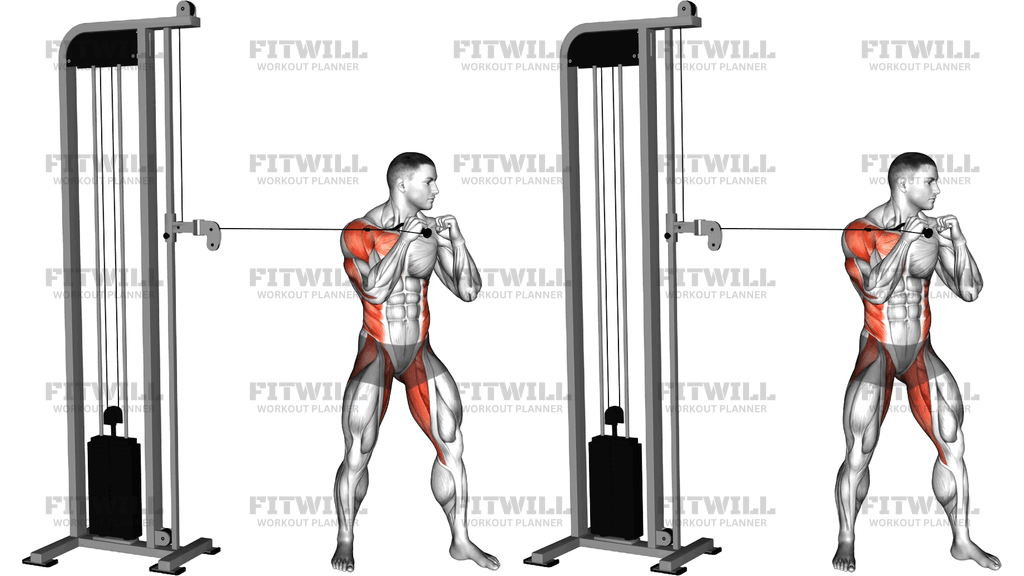
Instructions
- Set the cable pulley to chest height and attach a single handle to the carabiner.
- Stand side-on to the machine with your near side facing the stack, feet in a staggered boxing stance about shoulder-width apart and back heel raised slightly.
- Grip the handle with your lead hand and bring the fist up to your chin, elbow tucked close to your ribs.
- Raise the free hand to guard against the opposite side of your face and keep it there for every rep.
- Brace your core and pull your ribs down so the cable's backward pull does not arch your lower back.
- Exhale and punch the handle straight forward, rotating the fist so the palm turns down at full extension.
- Stop the punch just before the elbow locks, with the arm roughly level with your chin and shoulder.
- Inhale as you retract the fist back to your chin along the same straight path, resisting the cable's pull instead of letting it snap back.
- Complete all reps on one side, then switch your stance and repeat with the other arm.
- Step away from the machine before releasing the handle, and let the stack settle fully between sets.
Tips & Tricks
- The most common mistake is punching across the body in an arc. The cable line is your target line, so the fist should travel straight away from the machine, not diagonally inward.
- If the weight stack slams down between reps, you are standing too close. Take a half-step back until the handle floats at your guard with light tension.
- Do not let the retracting cable whip your arm back. Control the last third of the return, because that is where most shoulder strains on this exercise happen.
- Keep the elbow of the punching arm low and pointing at the floor on the way out. A flared elbow turns the jab into a sloppy side raise and stresses the shoulder.
- Your back heel should stay up and ready to pivot, exactly like a real jab. A flat back foot kills the hip rotation that gives the punch its drive.
- Power comes from the ground up: push slightly off the back foot, let the hip turn a few degrees, and let the arm finish the job. Arm-punching alone loads far less muscle.
- Keep the guard hand pressed to your cheek. If it drops while the other arm works, you are training a lopsided habit that carries over badly to bag work.
- Use a lighter weight than you think and prioritize snap. If you have to lean your torso forward to finish the punch, drop the load a plate or two.
- Warm the shoulders with a few unloaded shadow jabs before your first set so the socket is ready for the cable's constant pull.
Frequently Asked Questions
What muscles does the Cable Standing Jab work?
The front shoulders are the main driver, supported by the chest and triceps during the punch extension. The obliques and deep core stabilize the slight trunk rotation, and the legs work isometrically to hold the split stance against the cable's pull.
Is the Cable Standing Jab good for beginners?
Yes, as long as the weight is light. It is actually a good first loaded punching exercise because the cable guides the arm on a straight path and gives instant feedback when your stance or bracing breaks down.
How high should I set the pulley for the Cable Standing Jab?
Set it at chin height so the punch travels level with your guard. A pulley set too high turns the movement into a downward angle punch and shifts stress onto the top of the shoulder.
Why does my lower back ache after this exercise?
The cable pulls your torso backward from behind, and if your core is relaxed your lower back arches to compensate. Tighten your abs, tuck your ribs down, and slightly reduce the weight so you can hold that brace for every rep.
Should I do the Cable Standing Jab fast or slow?
Fast out, controlled back. The extension should be a crisp snap with an exhale, while the return resists the cable over one to two seconds so the muscles work in both directions.
How many reps and sets should I use?
Two to three sets of eight to fifteen reps per side works well. Heavier, grinding reps defeat the purpose, since this is a speed and power exercise rather than a max strength lift.
Can I replace a heavy bag workout with the Cable Standing Jab?
No, but it is a useful complement. The cable builds straight-line punching strength and control, while a bag develops timing, conditioning, and full combinations. Use the cable work as a builder, not a substitute.
What can I use instead if my gym has no cable machine?
A resistance band anchored behind you at chest height is the closest substitute, offering the same backward pull. Unloaded shadow jabs also train the pattern, though without the constant tension that makes the cable version distinctive.
Is it safe for my shoulders?
Generally yes when the weight is reasonable and the punch stays at chin height. Avoid locking the elbow hard at full extension and never let the cable snap your arm back on the return, as those are the two most common sources of shoulder and elbow irritation on this movement.