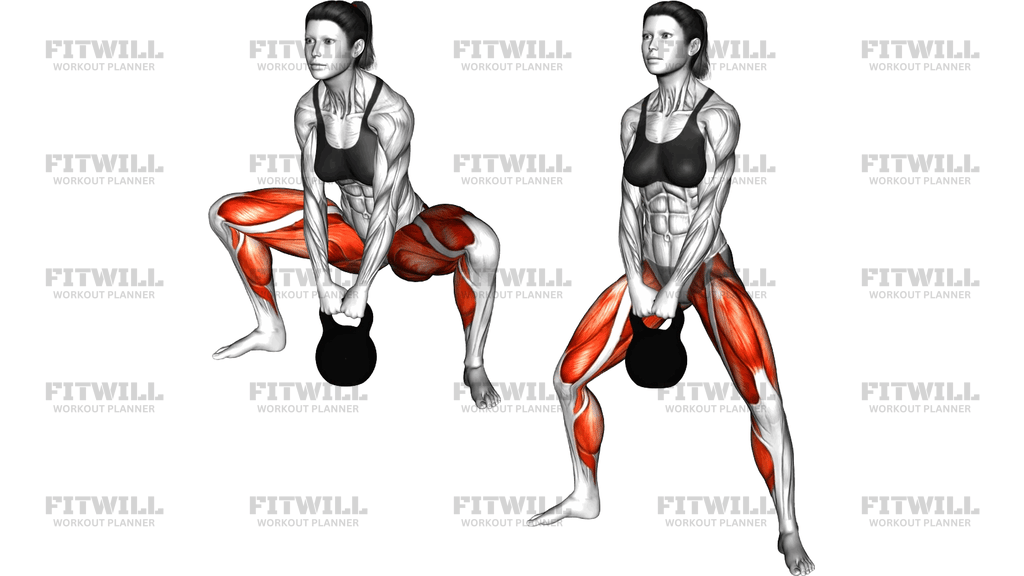
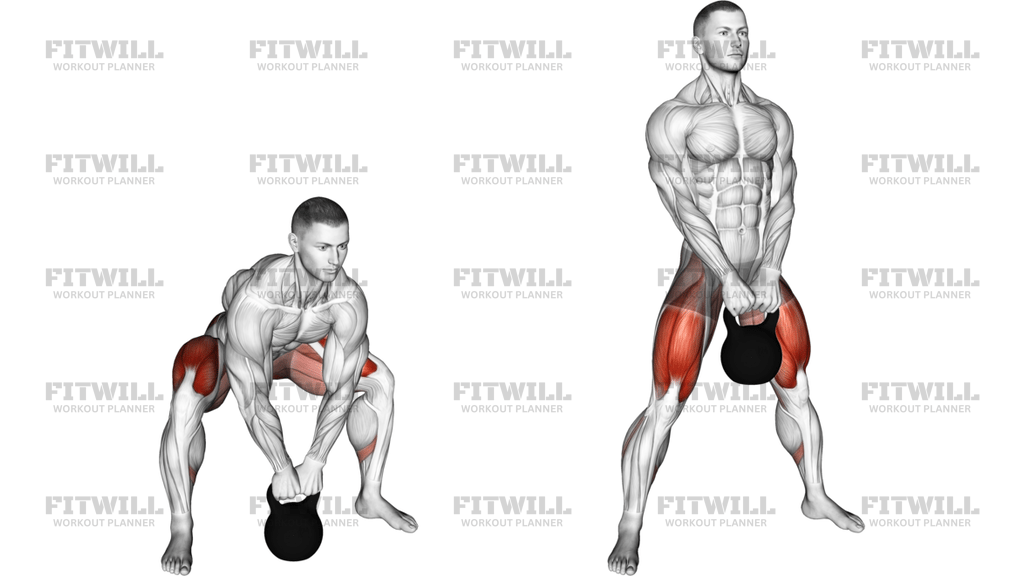
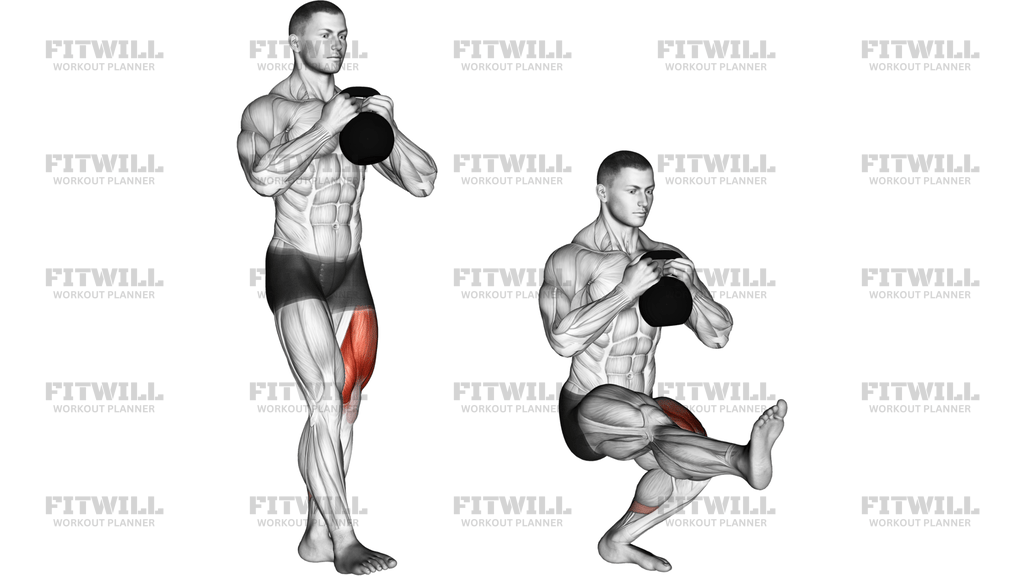
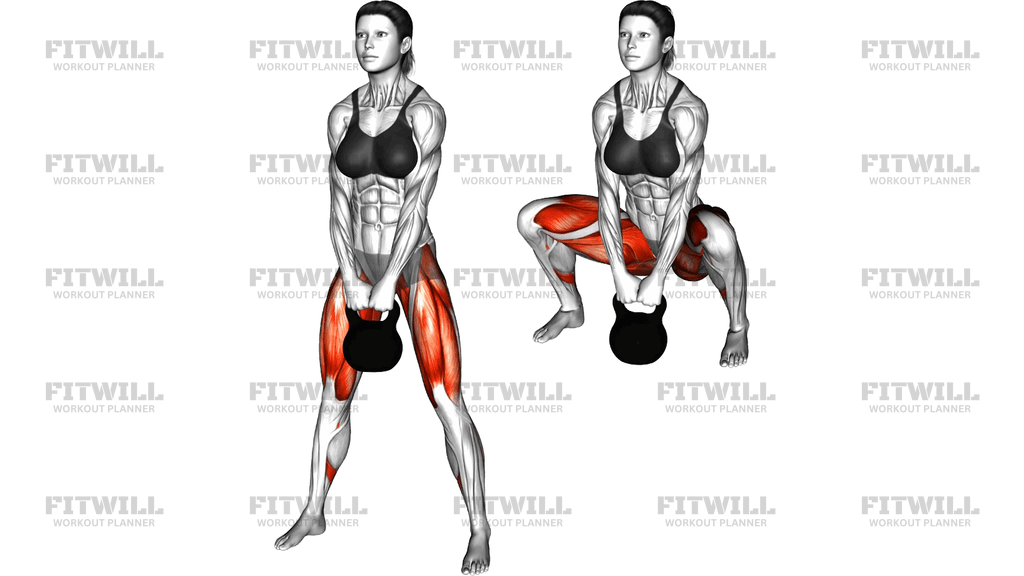
Kettlebell Split Squat
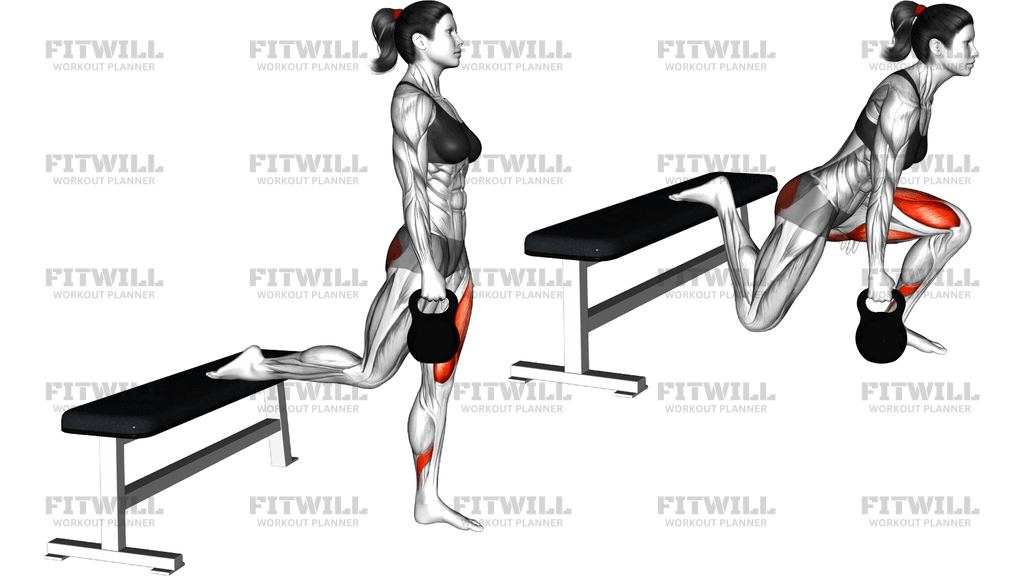
The Kettlebell Split Squat is a single-leg strength exercise performed with one foot elevated behind you on a flat bench and a kettlebell held at your side. Because the rear foot is only there for support, nearly all of the work falls on the front leg, which makes this one of the most demanding and productive lower-body movements you can do with a single kettlebell. The depth shown in the exercise places the front knee well forward over the foot while the rear hip sinks low, putting a strong stretch on the quad of the front leg and heavy loading through the glutes and hamstrings.
This movement is useful for almost anyone who trains with kettlebells. Lifters who want bigger, stronger legs without heavy barbells use it as a primary squat pattern, and it is especially valuable for people who feel back squats in their lower back. Because each leg works independently, it also exposes and gradually corrects side-to-side strength differences, and the split stance challenges balance and hip stability in a way that two-legged squats never will.
Setup matters more here than in most squat variations. The distance between your front foot and the bench determines whether the movement feels smooth or awkward: too close and your knee jam forward with your heel lifting, too far and you drift into a lunge and lose the vertical squat path. The kettlebell should hang relaxed from a straight arm, ribs down, torso tall with a slight forward lean as you descend. A braced trunk and a front foot fully planted, with weight spread across the whole foot, keep the knee tracking cleanly over the toes.
To execute it well, lower under control until your rear knee tracks down toward the floor and your front thigh reaches at least parallel, then drive through the floor to stand back up without pushing off the rear foot. Exhale on the way up, reset your stance if it shifted, and complete all reps on one side before switching. Common use cases include unilateral leg days, home training with limited equipment, and hypertrophy blocks where the front-leg quad and glute get direct, focused work.
A few practical points will keep this safe and productive. Start with a light kettlebell or body weight only until you can hit depth without wobbling, and use a wall or rack nearby for a fingertip balance assist if needed. Keep the front knee aligned with the second toe rather than caving inward, and never sacrifice depth or control just to add load. Because the bench behind you limits how far back you can stumble, give yourself a clear area and step away from the bench between sets rather than trying to turn around while fatigued.
[ Workout Log & Planner ]
Put your next workout in Fitwill
Keep your plan and training log ready when you are.


Instructions
- Place a flat bench behind you and stand about two feet in front of it, holding a kettlebell in one hand with your arm hanging straight down at your side.
- Reach one foot back and rest the top of that foot on the bench, laces down, so your rear knee can bend freely; your front foot stays flat and fully planted on the floor.
- Set your front foot far enough forward that when you lower, your shin stays roughly vertical and your knee travels over your toes without your heel lifting.
- Brace your core, pull your ribs down, and keep your chest tall with only a slight forward lean; let the kettlebell hang relaxed from your straight arm.
- Inhale, then bend your front knee and hip to lower your body until your rear knee nearly touches the floor and your front thigh is at or below parallel.
- Keep the front knee tracking in line with your toes and keep your weight distributed across the whole front foot, heel included.
- Exhale and press through the floor with your front leg to stand back up, resisting the urge to push off your rear foot or bounce off the bench.
- Complete all reps on one leg, then re-set your stance and switch the kettlebell to the other hand before training the opposite side.
Tips & Tricks
- If your front heel keeps lifting, your stance is too short; hop the front foot an inch or two farther from the bench until the bottom position feels stable.
- Most people push off the back foot without realizing it. Curl the rear toes under or consciously keep that leg passive so the front leg does the work.
- A wobbly torso usually means the kettlebell is too heavy or the brace is loose. Drop the weight and practice holding a tall chest with the ribs stacked over the hips.
- If the bench edge digs into your instep, point the rear foot more so the top of the foot and toes carry contact, not the ankle joint.
- Let the torso lean forward slightly as you descend; forcing a perfectly upright spine shifts stress away from the glutes and can pinch the front of the hip.
- Use your free hand to lightly touch a wall or rack for balance on your first few sets — the goal is stability, and it fades quickly once load goes up.
- Control the lowering phase for two to three seconds. This exercise rewards tempo, and dropping fast into the bottom is where knee position falls apart.
- Switch hands between sets rather than mid-set so grip fatigue on one side does not change your stance or depth.
Frequently Asked Questions
Which muscles does the Kettlebell Split Squat work hardest?
The quads of the front leg do most of the work, with the glutes and hamstrings contributing strongly as you drive up out of the bottom. The adductors and calves of the front leg help stabilize, and your core works to keep the torso from twisting under the single-sided kettlebell load.
Should the kettlebell be held on the same side as the front leg or the rear leg?
Holding it on the front-leg side, as shown in the standard setup, lets the load sit directly over the working leg. Holding it on the opposite side adds a mild balance and core challenge, so use it as a progression once your stance feels solid.
Can beginners do the Kettlebell Split Squat?
Yes, but start with body weight or a very light kettlebell until you can lower with control and no wobble. Because the rear foot is elevated, this version is harder than a standard split squat, so earn the bench height before adding load.
How far should my front foot be from the bench?
Roughly two feet, or about the length of your shin. Fine-tune it so your front shin stays close to vertical and your knee tracks over your toes without your heel lifting at the bottom.
Why does my front knee hurt when I do the Kettlebell Split Squat?
Knee discomfort usually comes from a stance that is too short, the knee caving inward, or descending too fast under too much load. Lengthen the stance, keep the knee aligned with the second toe, slow the tempo, and reduce the kettlebell weight.
Is the rear foot supposed to push during the movement?
No. The rear leg only anchors you to the bench; pushing off it steals work from the front leg and turns the rep into a partial lunge. Keep the rear leg relaxed and drive exclusively through the front foot.
What can I substitute if I don't have a bench?
Use any stable surface around knee height or slightly lower, such as a sturdy chair, a plyo box, or a second kettlebell placed on the floor. You can also do a standard split squat with both feet on the floor, which is a good stepping stone.
How deep should I go in the Kettlebell Split Squat?
Aim to lower until your rear knee is just above the floor and your front thigh reaches at least parallel. If you cannot reach that depth with a flat front foot and a stable knee, reduce the range and build up gradually.
How heavy should the kettlebell be?
Choose a weight you can control for all reps on your weaker leg while keeping your chest tall and your knee tracking cleanly. Grip fatigue is often the limiting factor with heavy kettlebells, so consider a two-kettlebell or doubled-up grip as your legs get stronger.