Reverse Plank With Leg Lift
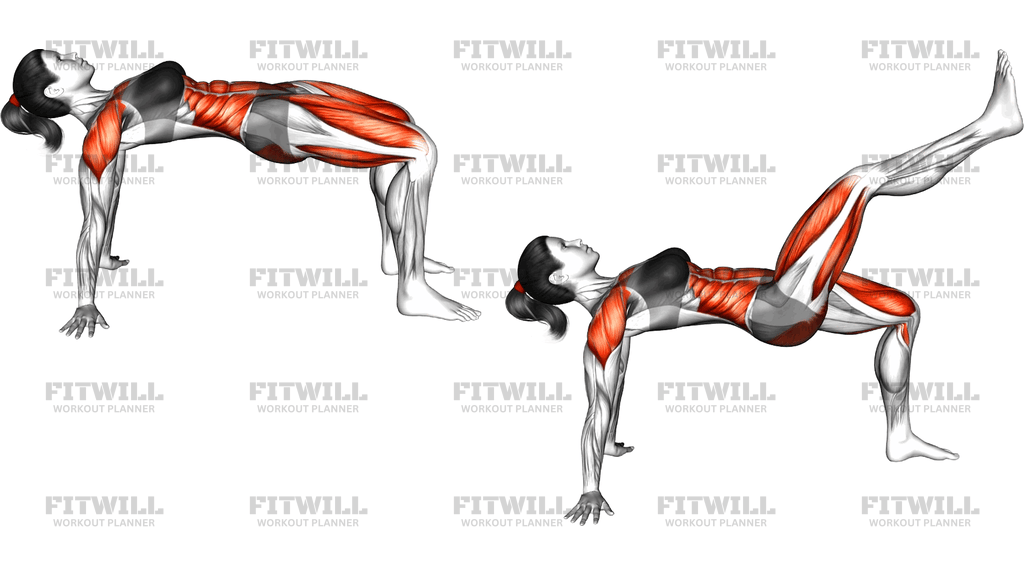
The Reverse Plank With Leg Lift is a bodyweight movement that combines a posterior-chain hold with a single-leg lift. You start seated on the floor with your hands planted behind your hips, press through your palms and heels to raise your hips into a straight line from shoulders to knees, and then extend one leg up while your body stays lifted. It is essentially a reverse tabletop position with a leg raise layered on top, which makes it far more demanding on the glutes and trunk than a standard reverse plank.
This exercise earns its place in a program because it trains the back side of the body in a way most floor work ignores. Where planks and crunches hammer the front, the reverse plank with leg lift loads the glutes, hamstrings, and lower back extensors while the shoulders and triceps hold you up. The added leg lift forces the standing glute to stabilize the pelvis against rotation, so you also get genuine work for the deep core and hip stabilizers rather than just a static hold.
It suits a wide range of trainees: lifters who want extra hip-extension volume without barbells, desk workers trying to wake up sleepy glutes and open tight hip flexors, and anyone building home or travel workouts with no equipment. Because the load is your own bodyweight and the range is easy to scale, it works equally well as a warm-up activation drill before squats or deadlifts and as a finishing burnout for glutes and hamstrings.
Setup details matter more here than in most floor moves. Your hand placement behind the shoulders sets how comfortable the wrist and shoulder positions are, and your foot placement determines how much the hips can rise. If your hips sag or your hands sit too far away, the shoulders take over and the glutes never get the intended stimulus. Keep the hands roughly under the shoulders with fingers pointing toward your feet or slightly out, and place the feet about hip-width apart so the bridge is stable.
To execute it well, drive the hips up until your torso and thighs form one straight line, squeeze the glutes hard, and only then lift one leg toward the ceiling. Move the leg with control rather than momentum, pause briefly at the top, lower it without letting the hips drop, and repeat before switching sides. The most common faults are a dropped pelvis, shrugged shoulders creeping toward the ears, and pushing the hips so high that the lower back arches excessively. Stay in the straight-line range, keep the neck relaxed, and stop the set when you can no longer hold the hips level.
Fitwill
Log Workouts, Track Progress & Build Strength.
Achieve more with Fitwill: explore over 9600 exercises with images and videos, access built-in and custom workouts, perfect for both gym and home sessions, and see real results.
Start your journey. Download today!




Instructions
- Sit on an exercise mat with your legs bent and feet flat on the floor about hip-width apart, roughly a foot in front of your hips.
- Place your palms on the floor directly behind your shoulders with fingers pointing toward your feet or slightly outward, and keep your arms straight but not locked.
- Pull your shoulder blades down and back so your chest stays open, and gently brace your abdominals as if preparing for a light push to the stomach.
- Press through your palms and heels to lift your hips until your shoulders, hips, and knees form one straight line, and squeeze your glutes at the top.
- Shift your weight slightly onto one leg, then raise the other leg up and slightly back toward the ceiling, keeping the knee soft or extending it fully for more challenge.
- Hold the lifted position for one to two seconds while keeping the hips level and high; do not let the pelvis dip toward the raised-leg side.
- Lower the leg under control back to the floor without letting your hips sag, then either repeat on the same leg or alternate sides.
- Exhale as you press the hips up and lift the leg, and inhale as you lower the leg back down, keeping the breathing steady throughout the hold.
- Complete all reps on one side or alternate left and right, then bend your knees and lower your hips back to the seated starting position to reset.
- Rest briefly between sets and re-check your hand and foot placement before the next set so the hips can reach full height again.
Tips & Tricks
- The most common failure is the pelvis dropping on the side of the lifted leg; picture pushing that hip toward the ceiling and keep both hips level throughout the lift.
- If your wrists ache, angle your fingers slightly outward or grip the edge of a mat to reduce extension; never push through sharp wrist pain.
- Avoid shrugging your shoulders up around your ears; actively press the floor away and pull the shoulder blades down to keep the neck long and relaxed.
- Do not chase height with the hips. Lifting past the straight-shoulders-to-knees line turns the move into a lower-back arch rather than a glute exercise.
- If the full leg lift is too hard at first, perform the reverse plank hold alone, or lift the leg only a few inches while keeping the hips perfectly level.
- Keep the lifted leg traveling up and slightly toward the opposite side or straight back, not swinging out wide, so the glute does the lifting instead of momentum.
- Drive the heel of the support leg into the floor rather than letting the foot roll outward; a collapsed foot makes the knee and hip drift out of line.
- Squeeze the glutes before the leg moves. If the hips are only being held up by the arms, the leg lift will pull your whole torso out of position.
- Place this exercise before heavy squat or deadlift sessions as glute activation with low reps, or after them as a finishing hold with longer pauses.
Frequently Asked Questions
What muscles does the Reverse Plank With Leg Lift work?
The glutes are the primary movers, especially the supporting side that holds the hips up while the other leg lifts. The hamstrings and lower back extensors assist the bridge, the abs and deep core stabilize the pelvis, and the shoulders and triceps hold your upper body in place.
Is the Reverse Plank With Leg Lift suitable for beginners?
Yes, with scaling. Beginners can start with a plain reverse plank hold or lift the leg only a few inches, building up to full leg raises once the hips stay level for the entire set.
Why do my shoulders shake so much during the Reverse Plank With Leg Lift?
The arms and shoulders support your upper body throughout, so early fatigue there is normal. Keep most of your weight distributed through the feet as well, lower the hold time, and build shoulder endurance gradually.
How high should I lift my leg in the Reverse Plank With Leg Lift?
Lift only as high as you can while keeping the hips level and the torso still. Once the pelvis tilts or the lower back arches to gain height, the leg has gone past your controllable range.
What is the biggest form mistake in this exercise?
Letting the hips sag or tilt when the leg lifts, which shifts the work away from the glutes and into the lower back. Fix it by squeezing both glutes before the leg moves and lowering the leg slightly if the pelvis drops.
Can I do the Reverse Plank With Leg Lift if my wrists hurt during regular planks?
Often yes, since the arms are straight rather than bearing load in a flexed position, but the wrists are still extended behind you. Try angling the fingers outward, using fists on a mat, or using parallettes to keep the wrists neutral.
How does the Reverse Plank With Leg Lift differ from a glute bridge?
A glute bridge is done face up with the shoulders on the floor, while this version is face up with the body supported on the hands, adding a shoulder, triceps, and trunk-stability demand on top of hip extension. The leg lift also trains anti-rotation control that a two-legged bridge does not.
How many reps and sets should I do?
For activation, 2 to 3 sets of 6 to 10 leg lifts per side with a short pause at the top works well. For endurance, use longer 20 to 40 second holds with slower lifts.
Can the Reverse Plank With Leg Lift replace my usual glute exercises?
It is a valuable addition but not a full replacement, since bodyweight hip extension has a limited ceiling compared to loaded hip thrusts, deadlifts, or step-ups. Use it for activation, warm-ups, and travel training, and pair it with loaded work when strength is the goal.
Should I feel this in my lower back?
Mild engagement across the lower back is expected because the extensors help hold the bridge, but sharp or dominant lower-back sensation means the hips have dropped or arched too high. Reset to the straight-shoulders-to-knees line and reduce the leg lift range.