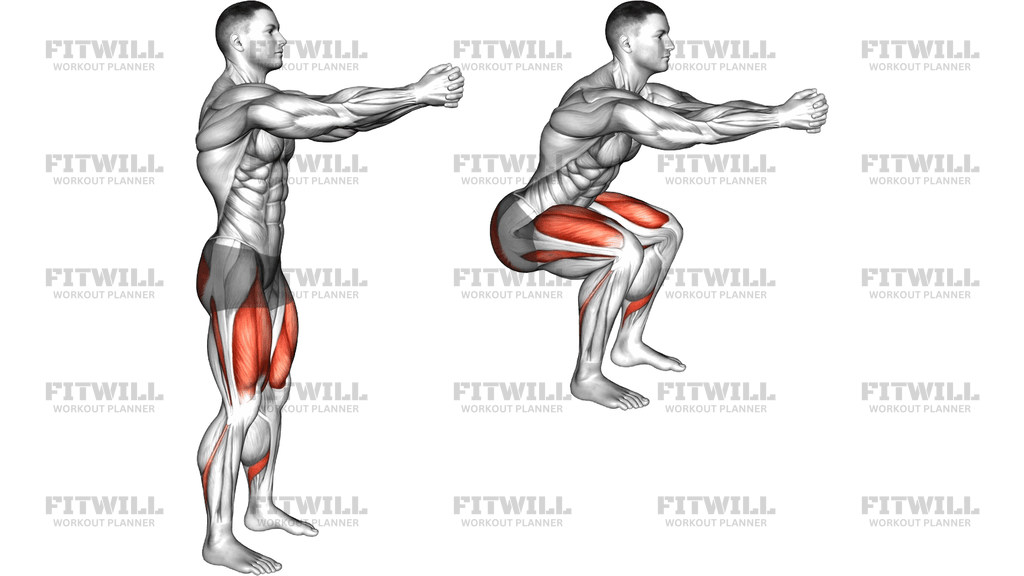
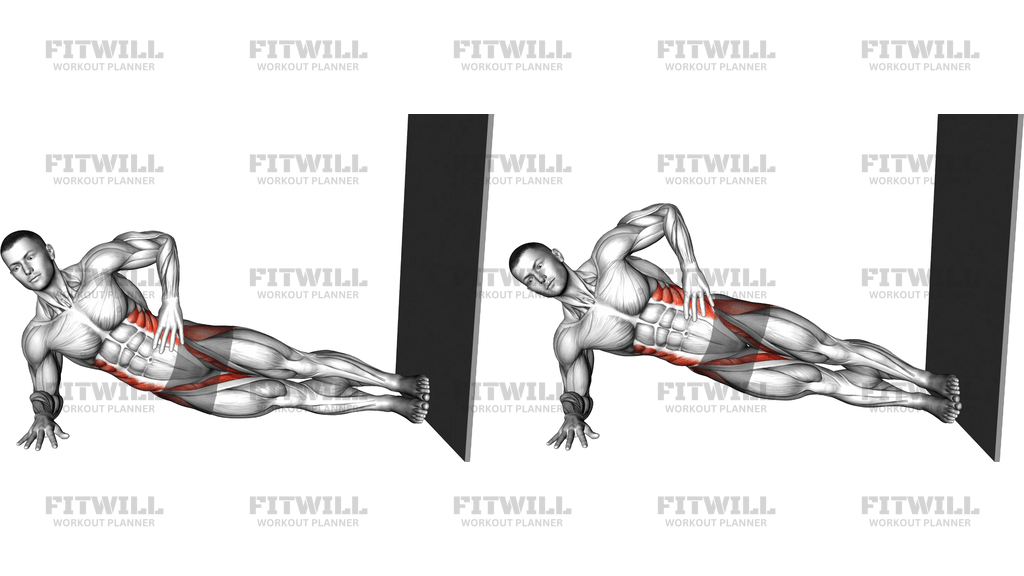
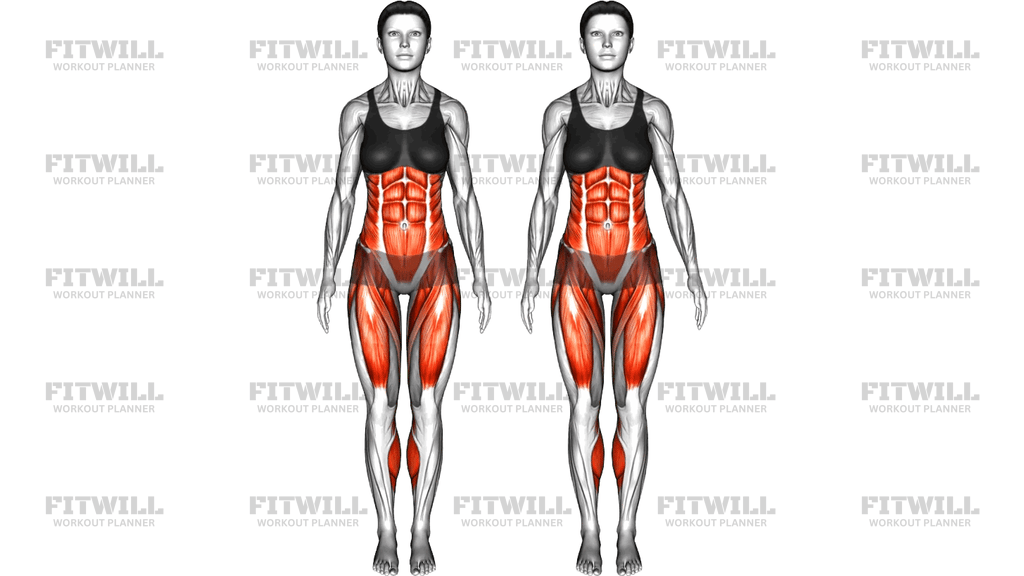
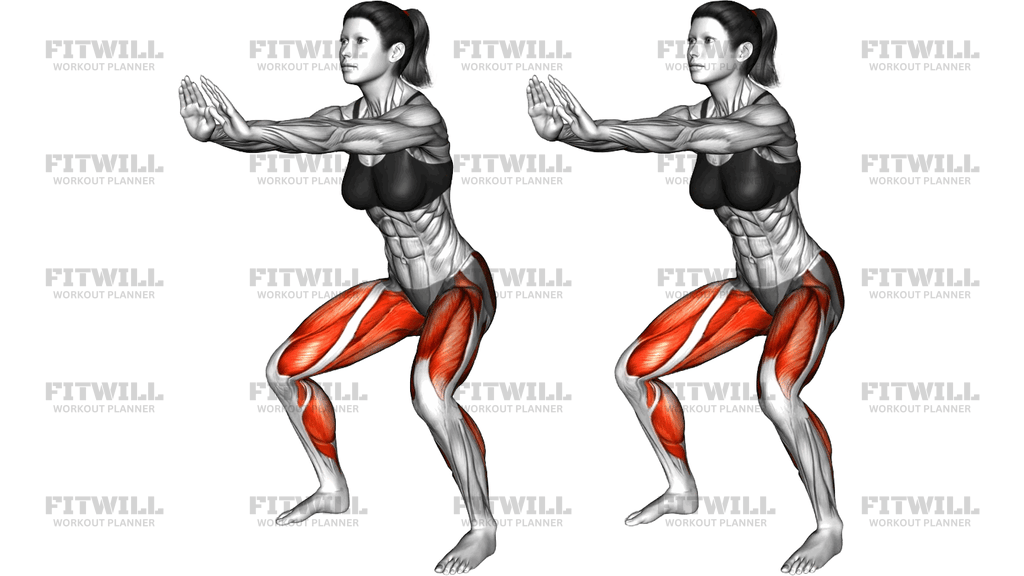
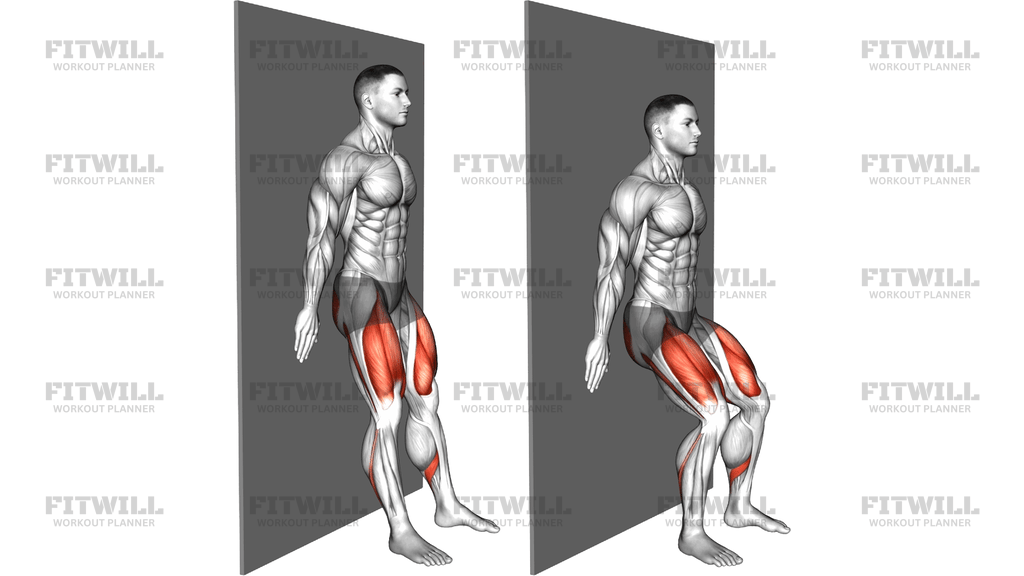
Clamshell Sit Agains Wall
Clamshell Sit Against Wall combines two familiar elements into one demanding hold: the wall sit and the clamshell. You settle into an isometric squat with your back flat against a wall, then repeatedly open your knees apart and draw them back together while your feet stay planted. The result is a movement that challenges your quads to hold the seated position at the same time your outer hips work to rotate the thighs outward and back.
This exercise is especially useful for anyone who wants to strengthen the hip abductors without loading the spine or needing equipment. The wall removes balance from the equation, so you can focus entirely on driving the knees apart with intent rather than wobbling through the motion. Runners, lifters recovering hip stability after time away from training, and people who sit for long hours and feel their outer hips have gone dormant all tend to benefit from it.
The primary work comes from the gluteus medius and other outer-hip muscles that control thigh rotation, while the quads and glutes work isometrically to keep you anchored in the squat position. Because the feet never move, every degree of knee separation has to come from the hips themselves, which makes the activation surprisingly focused for a body-weight drill.
Setup matters more here than in a standard clamshell. If your back peels off the wall or your heels lift as the knees open, you lose the anchor that makes the exercise effective. Keep your feet directly under your knees, toes pointing forward, and let the knees travel outward rather than letting the whole body shift sideways.
A common use case is pairing this with planks or bridges as part of a hip-focused warm-up or finisher. It also works well as a standalone hold when you want to fatigue the outer hips quickly. Start with shorter sets, because the combination of an isometric squat and repeated hip rotation becomes taxing faster than either element alone.
As for safety, the main caution is depth. If you have knee discomfort in a deep wall sit, slide your feet farther from the wall so your hips sit slightly higher, and reduce the range of the knee opening. The movement should feel like muscular effort in the hips and thighs, not pinching at the knees or strain in the lower back.
Fitwill
Log Workouts, Track Progress & Build Strength.
Achieve more with Fitwill: explore over 9600 exercises with images and videos, access built-in and custom workouts, perfect for both gym and home sessions, and see real results.
Start your journey. Download today!




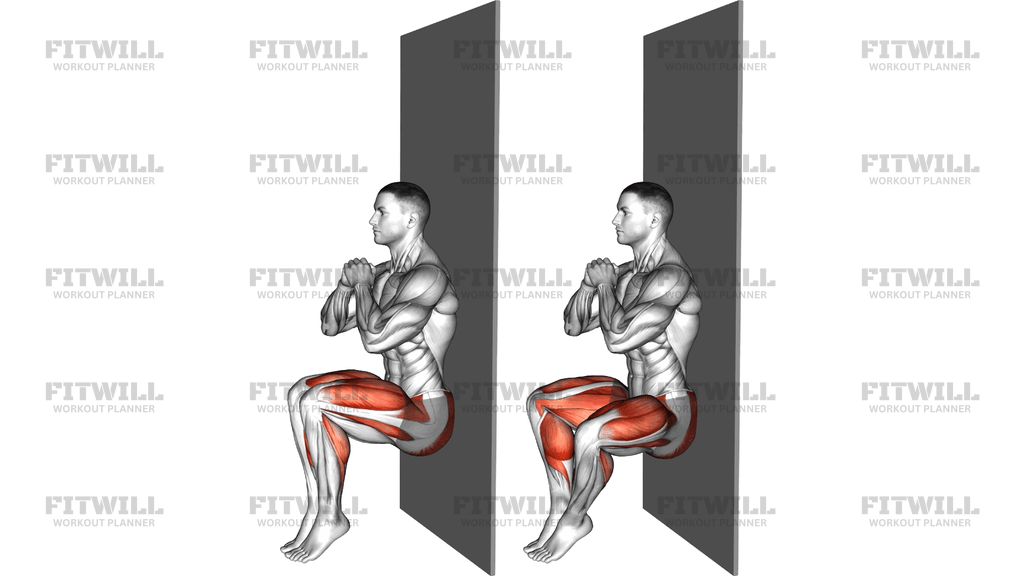
Instructions
- Stand with your back to a clear wall, then walk your feet out about 18 to 24 inches and slide down until your back is flat against the wall and your knees are bent roughly 90 degrees.
- Position your feet hip-width apart, flat on the floor and directly under your knees, with toes pointing straight ahead.
- Clasp your hands together in front of your chest and press your entire back, from shoulders to tailbone, against the wall.
- Brace your core gently and keep your weight spread evenly across both feet.
- Keeping your feet glued in place and your back on the wall, slowly open both knees outward as far as you can control, letting the hips rotate externally.
- Pause for a beat at the widest point and feel the outer hips working.
- Squeeze your knees back together with the same control, resisting the pull of gravity rather than letting them snap closed.
- Breathe steadily throughout, inhaling as the knees open and exhaling as they come back together.
- Complete your target repetitions, then walk your feet up the wall to stand back up, resting before the next set.
Tips & Tricks
- If your hips creep upward as the knees open, you are letting the squat position do the moving instead of the hips. Reset your depth and hold the seat height constant for every rep.
- Do not let your heels roll inward when the knees part. Press the outer edges of your feet into the floor to keep the rotation happening at the hips.
- A shallow wall sit makes this easier; if you cannot complete 8 controlled openings, slide your feet farther from the wall and sit slightly higher.
- Watch for one knee traveling farther than the other. Side-to-side differences in hip rotation are common, so match your weaker side and let the stronger side follow.
- Keep your hands relaxed at your chest. Pushing your hands down on your thighs to force the knees open defeats the purpose of the exercise.
- The temptation is to rush the closing phase. Slowing the return is where most of the outer-hip control is built, so take a full second to bring the knees together.
- If your quads burn before your hips feel anything, shorten the opening range slightly. The clamshell motion should stay comfortable while the hold does the fatiguing.
- Place a light ball or pad between your knees at the start if you want a clear target for the closed position and a consistent repeatable range.
Frequently Asked Questions
What muscles does the Clamshell Sit Against Wall work?
The outer hips, especially the gluteus medius, do the dynamic work of opening and closing the knees. The quads and glutes work isometrically the whole time to hold the wall-sit position.
Is the Clamshell Sit Against Wall suitable for beginners?
Yes, provided the wall sit is not too deep. Beginners can slide their feet farther from the wall to reduce knee bend and use a smaller knee-opening range until control improves.
How far should I open my knees during the Clamshell Sit Against Wall?
Open them only as far as you can without your back leaving the wall, your heels lifting, or your feet sliding. For most people that is somewhere between shoulder-width and a comfortable natural limit.
Why do my quads burn more than my hips in this exercise?
That usually means the wall sit itself is the limiting factor, either because the angle is too deep or the set is too long. Sit higher or reduce reps so the hip rotation remains the challenge.
Can I do the Clamshell Sit Against Wall every day?
Because it uses only body weight, most people can include it frequently. If your outer hips feel sore the next day, give them a day of recovery before repeating.
What can I substitute if a wall is not available?
A standard floor clamshell on your side trains the same outer-hip muscles, though without the added isometric quad demand of the seated hold.
Should my feet move during the Clamshell Sit Against Wall?
No. The feet stay planted exactly where they started, and all of the motion comes from the hips rotating the thighs outward and back.
Is it normal for one side to feel weaker in the Clamshell Sit Against Wall?
Yes, side-to-side differences in hip strength and rotation are very common. Work to the range of the tighter side so both hips receive the same stimulus.
How long should I hold the wall sit while doing the clamshell motion?
Start with sets of 8 to 12 slow openings, which usually means 30 to 60 seconds under tension. Rest when your form or seat height starts to drift.