Clock Push Up
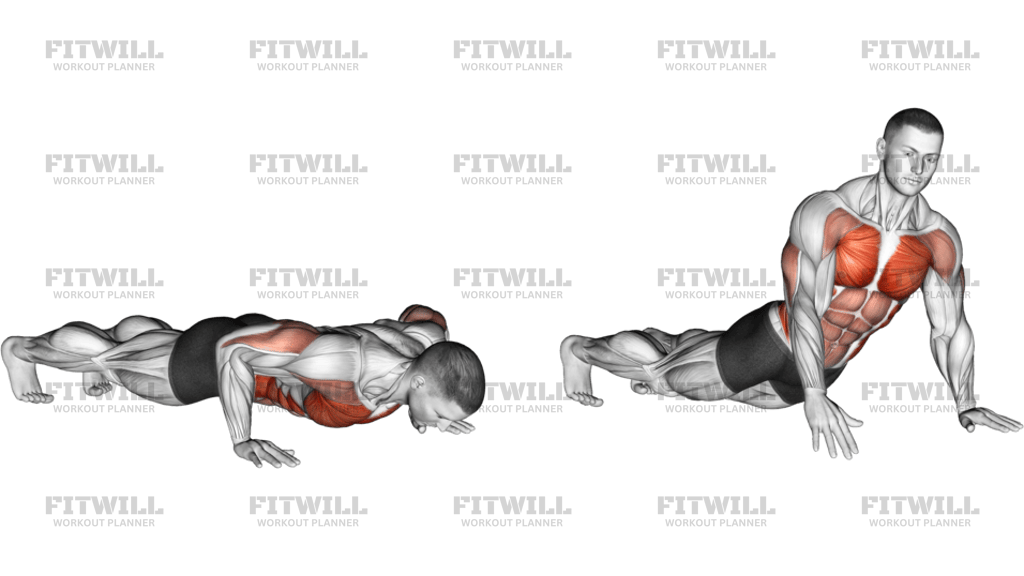
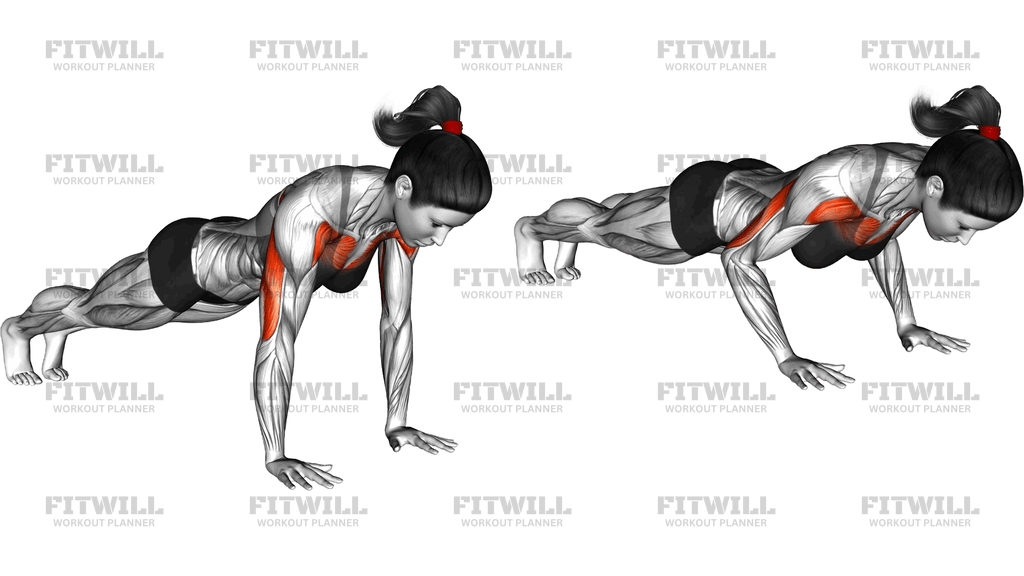
The Clock Push Up is a bodyweight push-up variation where you imagine your hands sit at the center of a clock face and move them to different hour positions — typically 12, 3, 6, and 9 — performing a push-up at each spot before rotating to the next. Instead of pressing in one fixed plane, you cycle through hand placements that shift the emphasis across your chest, shoulders, and triceps while your core works overtime to keep your torso level as your base changes.
This variation is especially useful once a standard push-up feels comfortable and repetitive. Because each hand position loads the pressing muscles from a slightly different angle, it challenges stabilizers around the shoulder joint in a way a single-plane set does not. It also adds a coordination element: repositioning your hands between reps forces you to re-brace and re-establish a straight line from head to heels every time.
The core gets more attention here than in a regular push-up. When your hands move to positions like 3 and 9 o'clock, your base narrows or becomes asymmetrical, and your obliques and deep core have to resist rotation to stop your hips from twisting or sagging. That anti-rotation demand is one of the main reasons lifters use this movement as a progression rather than just a change of pace.
Setup matters more than in a standard push-up because your hand placement is variable. Choose a spot with enough floor space around you for your hands to travel a full circle, and keep your fingers pointing forward with your weight spread across your palms. A straight, rigid body line — ears, shoulders, hips, and ankles stacked — is what turns each press into a clean rep instead of a wobbly grind.
To execute it well, complete a full push-up at one clock position, then walk or step your hands to the next position while keeping your body in that same plank line, reset your brace, and press again. Move deliberately between positions rather than rushing; the transitions are where form tends to break down.
The Clock Push Up fits well into home workouts, warm-ups, and circuit training since it needs no equipment and covers a lot of pressing territory in one movement. If full push-ups from the toes are still a challenge, drop to your knees for every position and keep the rotation format intact — the pattern of moving around the clock is the point, and you can scale the load without changing the structure.
Fitwill
Log Workouts, Track Progress & Build Strength.
Achieve more with Fitwill: explore over 9600 exercises with images and videos, access built-in and custom workouts, perfect for both gym and home sessions, and see real results.
Start your journey. Download today!




Instructions
- Clear floor space around you so your hands can move freely to positions on both sides and in front of your body.
- Start in a high plank with your hands at the center point of your imaginary clock, slightly wider than shoulder width, fingers spread and pointing forward.
- Set your body in a straight line from head to heels, brace your abs, squeeze your glutes, and tuck your chin so your neck stays neutral.
- At the 12 o'clock position, bend your elbows to lower your chest toward the floor, keeping your elbows at roughly 45 degrees to your torso.
- Press back up until your arms are straight, then walk your hands to the next clock position — for example, 3 o'clock to one side.
- Re-brace before each press, especially at the side positions, and lower with control so your hips do not twist as your base shifts.
- Continue moving hand to hand around the clock — for example 12, 3, 6, and 9 — completing one full push-up at each position.
- Exhale as you press up and inhale as you lower at every hand position.
- After finishing the full rotation, bring your hands back to center and reset your plank before starting the next round.
- Reverse the direction of rotation on alternating sets so both sides get equal work.
Tips & Tricks
- Think of your torso as the clock's center, not your head — your chest should stay squared toward the floor at the side positions instead of rotating open.
- If your hips sag every time you move your hands to a new position, take a brief pause in the plank between presses rather than rushing the transition.
- Widen your feet slightly at the 3 and 9 o'clock positions; a broader base makes it much easier to stop your body from tipping sideways.
- Keep your weight in your palms and fingertips rather than collapsing into your wrists, since the changing angles put more rotational stress on the wrists than a fixed-grip push-up.
- A common mistake is doing a full-depth press at the easy positions and a shallow dip at the hard ones — match your chest-to-floor depth across every clock position.
- Start with just two or three positions per set and build up to the full clock as your shoulder endurance improves; the side and front positions fatigue fast.
- If your elbows flare straight out to the sides at the 6 o'clock position, cue them back toward your hips to protect the shoulder joint.
- On a slippery surface, place your hands on a mat or towel so they do not slide as you shift positions mid-set.
- Film yourself from the side for one round — if your body line breaks during hand transitions, that is the first thing to fix before adding reps.
Frequently Asked Questions
What muscles does the Clock Push Up work?
The chest is the primary mover, with the triceps and front shoulders assisting on every press. Your abs, obliques, and shoulder stabilizers work hard to keep your torso level as your hand positions change.
Which clock positions should I use for the Clock Push Up?
Most people rotate through 12, 3, 6, and 9 o'clock for a balanced set. You can add intermediate positions like 1, 5, 7, and 11 for a greater challenge once the four-point version feels solid.
Is the Clock Push Up good for beginners?
Yes, as long as you scale it. Perform the same rotation from your knees, or limit yourself to the 12 and 6 o'clock positions until you can control the side positions without your hips twisting.
Why do my hips rotate during the Clock Push Up?
Rotation usually happens at the side positions because your base narrows and your core is not resisting the twist. Widen your feet, slow the hand transition, and consciously square your chest toward the floor before pressing.
How does the Clock Push Up differ from a regular push-up?
A regular push-up uses one fixed hand position, while the Clock Push Up changes your hand placement every rep, shifting the pressing angle and adding anti-rotation work for your core.
What can I use instead of the Clock Push Up if I need a substitution?
Spiderman push-ups, staggered-hand push-ups, or a wide-grip push-up paired with a narrow-grip push-up cover similar ground with less repositioning. Knee push-ups done in the same rotation format are the closest scaled version.
How many reps should I do per set of the Clock Push Up?
One full rotation through four positions counts as roughly four reps, so aim for two to four full rotations per set. Quality of the press and the transition matters more than total count.
Is it safe to do the Clock Push Up every day?
It is a moderate bodyweight movement, but the pressing muscles still need recovery. Two to four sessions per week with rest days in between is a sustainable rhythm for most people.
Should my fingers point forward at every clock position?
Keeping your fingers pointing forward or slightly outward at every position keeps your wrists in a comfortable range. Letting your hands rotate inward at the side positions is a common cause of wrist discomfort.