Push Up Mountain Climber
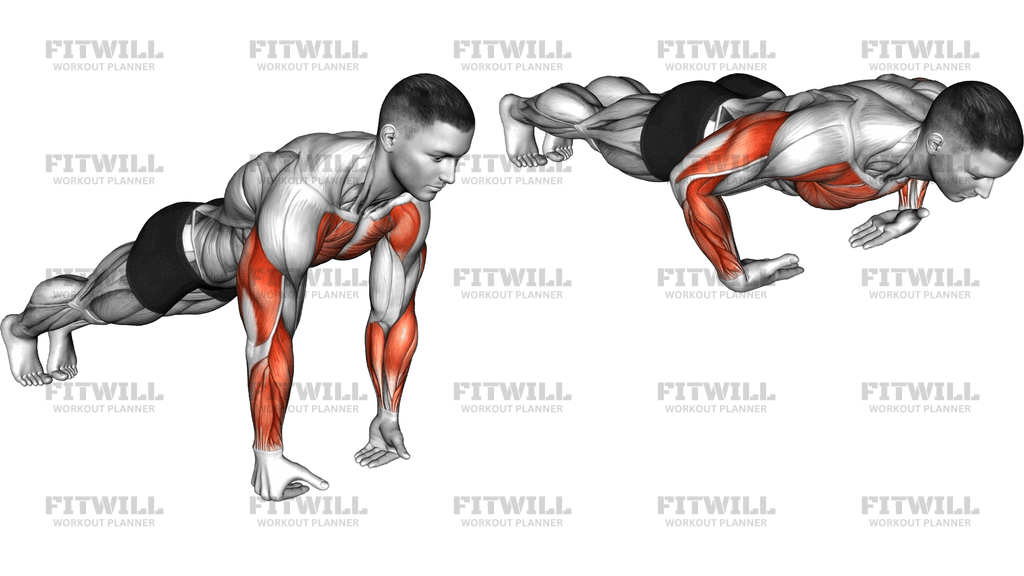
The Push Up Mountain Climber combines two bodyweight staples into one flowing movement: you perform a full push up, and while holding the top position, you drive your knees toward your chest in the running-style knee drive of a mountain climber. Because everything happens from one hand-and-feet support position, the exercise forces your trunk to stay rigid while your limbs move, which is exactly the kind of demand that builds usable, real-world core strength.
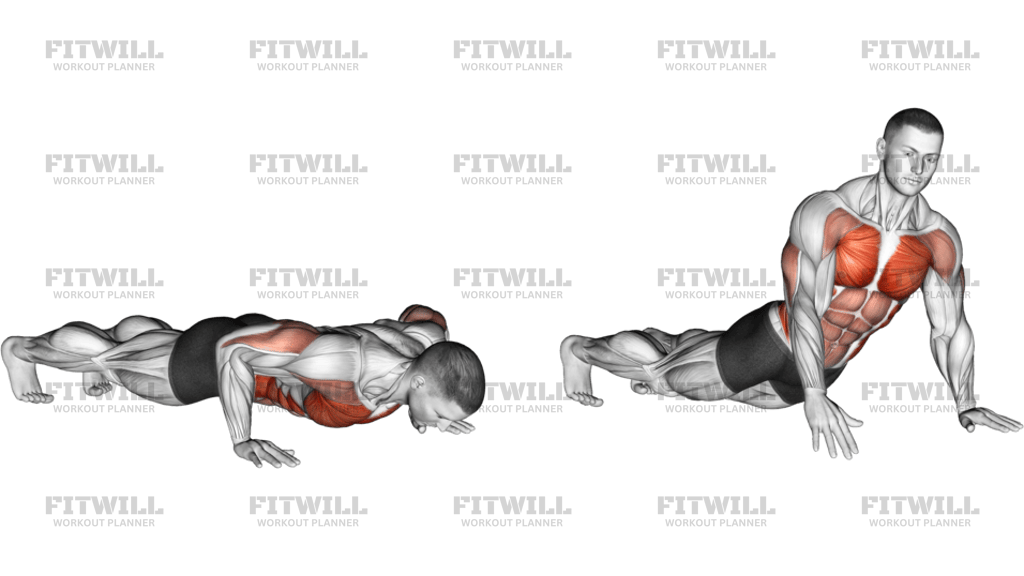
Muscularly, this is a hybrid. The push up portion loads the chest, front shoulders, and triceps, while the mountain climber portion hammers the hip flexors and abdominals as they control each fast knee drive. Throughout both phases, your shoulders, glutes, and deep core work isometrically to keep your hips from sagging or bouncing. Your heart rate climbs quickly as well, so the exercise doubles as light conditioning, especially when performed for higher reps or timed sets.
This movement suits anyone who has already mastered a standard push up and a solid plank and wants more out of the same floor space. It works well in circuit training, home workouts with no equipment, warm-ups for upper body days, and finishers when you want to fatigue the chest while keeping the core and lungs involved. Because it requires no gear beyond a floor surface, it travels easily.
Setup matters more than people expect. Hand position under the shoulders, a straight line from head to heels, and feet at roughly hip width all determine whether the knee drives stay clean or turn into a wobbly hip-hike mess. If your hips sit too high, the push up loses depth; if they sag, your lower back takes the strain during the knee drives.
To execute it well, lower through a controlled push up until your chest nears the floor, press back up to a strong plank, then alternate driving one knee at a time toward your chest for a set number of reps before performing the next push up. Keep each knee drive crisp and stop the knee under your hips rather than letting the foot slam down. The most common breakdown is the hips rising with every knee drive, which shifts the work away from the abs and turns the exercise into a shallow pike movement.
A practical safety note: keep your neck neutral and your wrists stacked under your shoulders, especially when fatigued, since the repeated knee drives tend to pull people forward onto their hands. If you cannot maintain a flat plank between knee drives, reduce the speed or drop to knee push ups for the pressing portion until your plank strength catches up.
[ Workout Log & Planner ]
Put your next workout in Fitwill
Keep your plan and training log ready when you are.


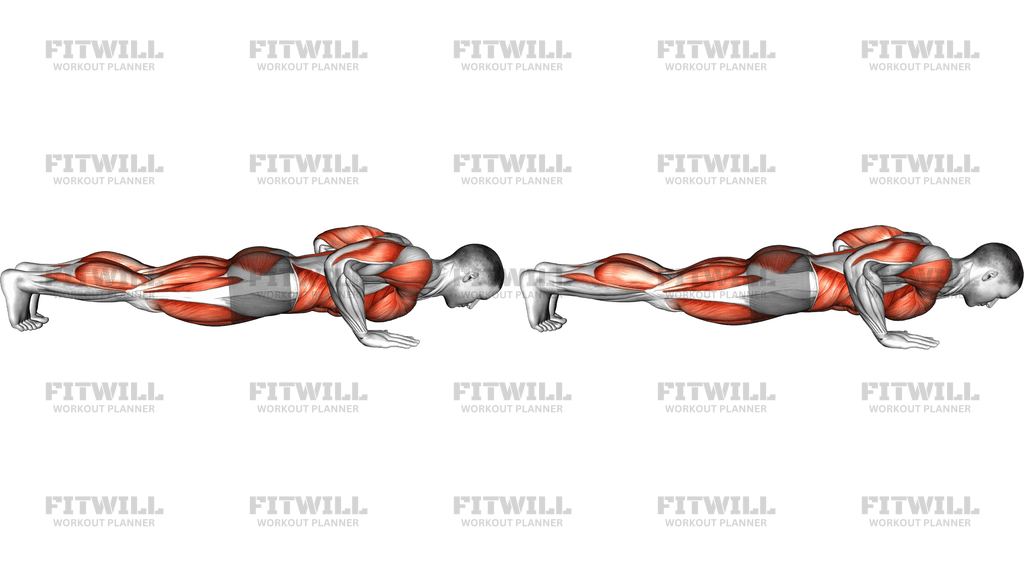
Instructions
- Place your hands on the floor slightly wider than shoulder width, fingers spread, with your wrists stacked directly under your shoulders.
- Step your feet back to a full plank position with your body forming a straight line from head to heels and your feet about hip width apart.
- Brace your abdominal muscles and squeeze your glutes so your hips are locked at plank height before you start moving.
- Bend your elbows to lower your chest toward the floor, keeping them at roughly a 45-degree angle to your torso rather than flaring straight out.
- Press through your palms until your arms are fully extended and you are back in a solid plank.
- From the top position, drive one knee in toward your chest, stopping it under your hips, then return that foot to the starting stance.
- Immediately drive the opposite knee toward your chest and continue alternating for your target number of knee drives per round.
- After finishing the knee drives, either perform another push up or complete the rep by resetting both feet to the starting plank.
- Inhale as you lower into the push up, exhale as you press up, and breathe in a steady rhythm during the knee drives rather than holding your breath.
- Between sets, shake out your wrists and reset your plank position before the next round so you never start with sagging hips.
Tips & Tricks
- If your hips lift toward the ceiling during the knee drives, shorten the range of the knee drive and think about pulling the knee toward the same-side elbow instead of tucking the whole pelvis up.
- Spread your fingers wide and grip the floor to protect your wrists, since the repeated forward knee drives shift load onto the hands more than a standard push up does.
- Keep the knee drive smooth rather than slamming your foot back down, because hard landings bounce your hips and bleed tension out of your core.
- Set your feet slightly wider than a typical push up stance if you struggle with balance during the knee drives; a wider base makes hip sway much easier to control.
- Do not let your head drop toward the floor as you fatigue; keep your eyes on a spot just in front of your hands to maintain a neutral neck.
- If your chest fails before your core, reduce the knee drives per round and add push up reps, or perform the knee drives with one knee down in a modified plank.
- Count knee drives in pairs, one left and one right, so your sets stay balanced instead of favoring one leg.
- Pause for a full second at the top of the push up before starting the knee drives, so you never initiate them from a half-pressed, unstable position.
Frequently Asked Questions
What muscles does the Push Up Mountain Climber work?
The push up portion primarily targets the chest, front shoulders, and triceps, while the knee drives load the hip flexors and abdominals. Your glutes and deep core stay engaged the entire time to hold the plank position.
Should I do all my knee drives between push ups or one push up at a time?
Both work. A common structure is one push up followed by a set number of alternating knee drives, then another push up. More knee drives between push ups shifts the set toward conditioning, while frequent push ups shift it toward upper body strength.
Is the Push Up Mountain Climber good for beginners?
It is best saved for people who can already do several clean push ups and hold a plank for at least 30 seconds. Beginners can regress it by doing knee push ups for the pressing portion and slower, smaller knee drives in a shortened plank.
Why do my hips keep rising when I drive my knees?
Rising hips usually mean the pelvis is piking upward instead of the knee moving independently. Brace your abs harder, slow the knee drive down, and focus on bringing the knee under your torso rather than lifting your seat toward the ceiling.
Can I substitute the Push Up Mountain Climber with separate push ups and mountain climbers?
Yes, and that is a valid substitute if you cannot maintain form in the combined version. The combined movement is harder because you must re-stabilize the plank after each press and transition cleanly between the two patterns.
How fast should the knee drives be?
Fast enough to feel like a run, but only as fast as you can keep your hips level and your feet controlled. Speed that comes at the cost of a bouncing pelvis reduces the core benefit and adds stress to the lower back.
Do my wrists need special care in this exercise?
They take more repeated load than in a plain push up because your hands support you through both the pressing and the knee drive phases. Keep the wrists stacked under the shoulders, spread your fingers for a wider base, and shake out your wrists between sets if they get achy.
How many reps should I do per set?
A practical starting point is 6 to 10 push ups with 10 to 20 alternating knee drives in between, adjusted to your level. Once form breaks, particularly hip height, end the set rather than pushing through sloppy reps.
Does the Push Up Mountain Climber count as cardio?
It has a meaningful conditioning component because the knee drives elevate your heart rate, but the pressing work makes it primarily a strength exercise. Performed in longer timed sets or circuits, it leans more toward cardio.