Standing Hip Extension To Leg Lift
The Standing Hip Extension To Leg Lift is a bodyweight movement performed entirely on your feet, combining two distinct leg actions into one smooth repetition. You start by sweeping one leg straight behind you into hip extension, feeling the glute do the work, then swing that same leg forward and lift it up in front of you to challenge the hip flexors. One hand rests lightly on your hip or a stable surface for balance, and your torso stays tall throughout. Because it requires no equipment, it fits easily into warm-ups, home workouts, or recovery days.
This exercise is especially useful for people who sit for long hours. Prolonged sitting tends to leave the glutes underactive and the hip flexors tight, and this movement wakes both up in a controlled way. It is also a smart activation drill before squats, lunges, or running, since it rehearses clean hip extension without load. Beginners appreciate it because the balance demands are modest, and more advanced trainees use it for higher-rep burnout sets or as part of a glute-focused circuit.
The main muscles at work are the glutes during the backward sweep, particularly gluteus maximus, with the hamstrings assisting as the leg travels behind the body. As the leg swings forward and lifts, the hip flexors and the quadriceps, especially rectus femoris, take over. Your standing leg works quietly the entire time: the calf, thigh, and deep hip stabilizers keep you level, and your core braces to stop your torso from rocking with each swing. That constant stabilizing demand is one of the quiet benefits of doing this standing instead of lying down.
Setup matters more than it looks. Stand tall with your weight firmly over the whole foot of your supporting leg, engage your abdominals, and place one hand on your hip or lightly touch a wall or chair for balance. If you lean your torso far forward during the backswing or arch your lower back during the front lift, you shift work away from the hips and into the spine, which defeats the purpose. A tall spine and a controlled leg path keep the tension where it belongs.
Execution should feel smooth rather than forced. Sweep the leg back only as far as you can keep your hips square and your back neutral, then reverse direction and lift the leg in front to about hip height or slightly lower. Move at a tempo you can repeat without your torso tipping or your standing knee collapsing inward. Common use cases include glute activation circuits, hip mobility flows, warm-up sequences for leg day, and low-impact home routines where floor work is not practical.
For safety, keep the working leg movement within a range where you stay balanced and pain-free, and avoid snapping the leg back and forth with momentum. If you feel pinching at the front of the hip during the lift, reduce the height rather than pushing through it. Start with one set of eight to ten repetitions per side and build up as your balance and control improve.
[ Workout Log & Planner ]
Put your next workout in Fitwill
Keep your plan and training log ready when you are.


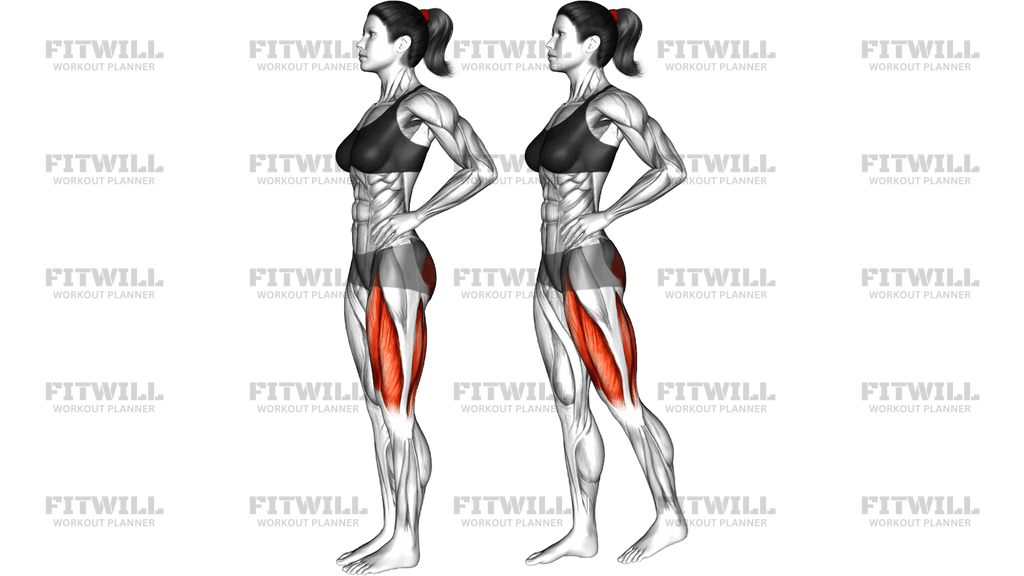
Instructions
- Stand upright with your feet hip-width apart and place one hand on your hip, or rest fingertips lightly against a wall or the back of a chair if you need extra balance support.
- Shift your weight fully onto your left foot, pressing evenly through the heel and ball, and let your right foot hover just off the floor beside it.
- Brace your abdominals and keep your chest lifted and your gaze forward so your spine stays neutral before the leg starts moving.
- Sweep your right leg straight back behind you, squeezing the right glute and stopping at the point where your hips stay square to the front and your lower back does not arch.
- Pause briefly at the back of the range, then reverse the direction in one smooth arc, bringing the leg forward under your body.
- Lift the straight right leg up in front of you to roughly hip height, keeping the torso tall instead of rounding or leaning away from the leg.
- Lower the leg back down with control until it hovers near the floor, and begin the next repetition without letting the foot rest.
- Exhale as the leg moves through each swing and lift, and inhale during the controlled lowering phase.
- Complete all repetitions on the right side, then switch hands if needed and repeat the same sequence standing on the right leg.
- Between sets, shake out your hips and reset your stance so each set starts balanced and squared rather than fatigued and tilted.
Tips & Tricks
- The most common fault is leaning the chest forward as the leg sweeps back. Keep your torso vertical and accept a shorter backswing rather than buying range with your spine.
- Do not arch your lower back to get the leg higher in front. If lifting to hip height causes your ribs to flare, lift slightly lower and keep the abdominals engaged.
- If you wobble on the supporting leg, soften the standing knee slightly and grip the floor with your toes instead of locking the knee straight.
- Avoid using momentum from a fast swing. The transition from hip extension to the front lift is where the glutes and hip flexors actually work, so slow that arc down.
- Keep the working leg straight but not rigid; a locked knee during the backswing can pull your hips out of position.
- Check that both hips stay facing forward. The lifting hip often hikes up toward the ribs, which shortens the range and hides the true hip motion.
- Hold the back position for one to two seconds if your goal is glute activation, since the squeeze at end range is what turns this from a swing into a strengthening drill.
- Place the balance hand on a wall rather than pressing down on it; a light touch is enough, and leaning on the support removes the stabilizing work from your standing hip.
- If the front of your hip pinches during the lift, reduce the height and slightly turn your toes outward a few degrees to find a comfortable path.
Frequently Asked Questions
What muscles does the Standing Hip Extension To Leg Lift work?
The glutes are the primary movers during the backward extension, with the hamstrings assisting. The hip flexors and quadriceps take over as you lift the leg forward, while your standing leg and core stabilize the whole time.
Is the Standing Hip Extension To Leg Lift good for beginners?
Yes. The balance demand is low and no equipment is needed, so beginners can learn it quickly. Starting with a light hand on a wall or chair makes the movement even more accessible.
How many repetitions of the Standing Hip Extension To Leg Lift should I do?
Start with two sets of eight to ten repetitions per leg and focus on smooth, controlled arcs. As your balance improves, work up to fifteen or more reps per side or add it to a warm-up circuit.
Why do I feel this exercise in my lower back instead of my glutes?
That usually means your torso is leaning forward during the backswing or your spine is arching to extend the leg further. Keep your chest tall, brace your abdominals, and shorten the range until the glute does the work.
Can I do the Standing Hip Extension To Leg Lift as a warm-up?
It is an excellent warm-up before squats, lunges, or running because it activates the glutes and mobilizes the hips without fatigue. One or two light sets per side is usually enough.
Should my working leg stay straight during the Standing Hip Extension To Leg Lift?
Keeping the leg mostly straight emphasizes the hip motion and matches the standard version of the exercise. A slightly soft knee is fine, but avoid fully locking it or bending it heavily, which changes the movement.
What can I use for balance if I am unsteady on one leg?
Stand next to a wall or place a sturdy chair in front of you and rest your fingertips on it lightly. Keep the contact minimal so your standing hip still does its stabilizing job.
What is a good substitute if standing balance is too difficult?
Try a quadruped hip extension on hands and knees or a standing rear leg raise holding a chair with both hands. Both train the glutes through a similar hip extension range with more support.
How high should I lift my leg in the forward phase?
Aim for roughly hip height or slightly below, as long as your torso stays upright and your lower back stays neutral. Height achieved by arching or leaning back does not add benefit and strains the spine.
Is it safe to do the Standing Hip Extension To Leg Lift every day?
For most people, yes, since it is a low-load bodyweight movement. If you feel persistent pinching at the front of the hip or any joint discomfort, reduce the range or frequency and let symptoms settle.