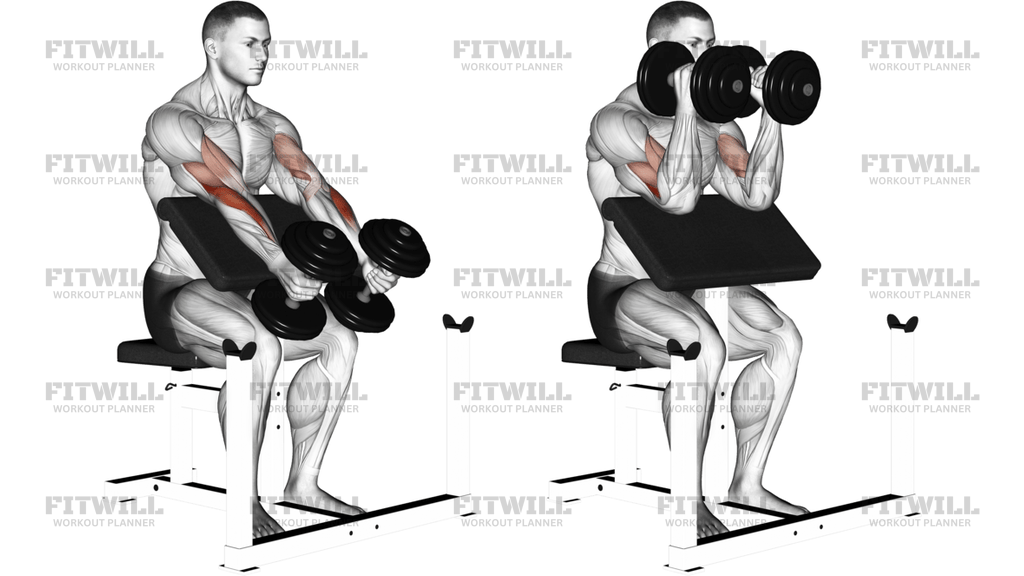
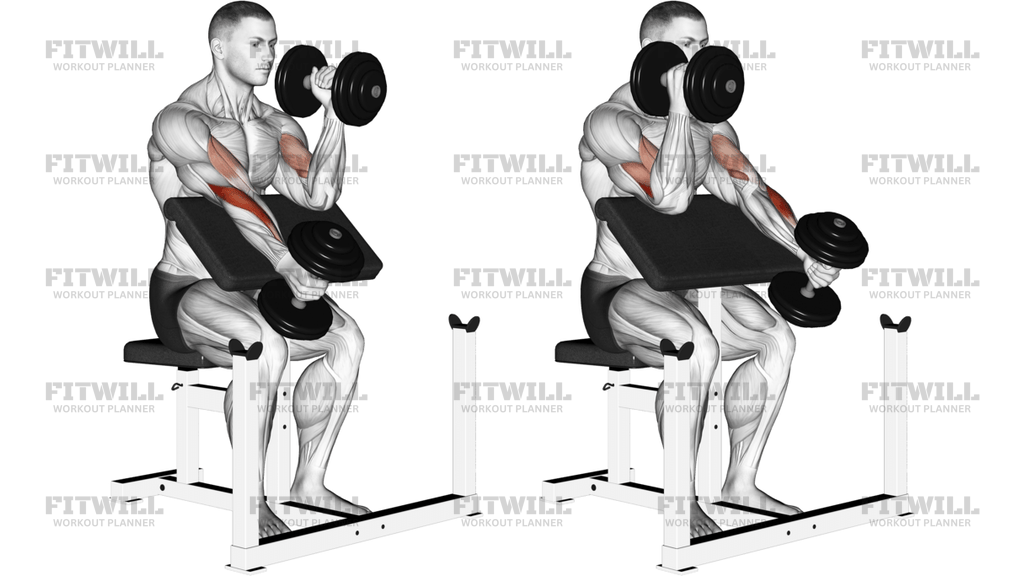
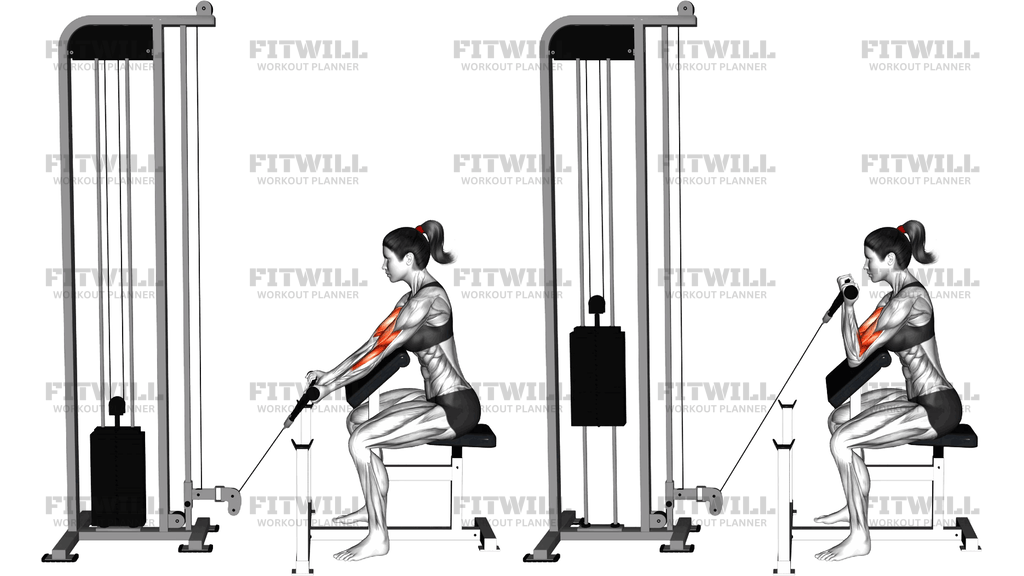
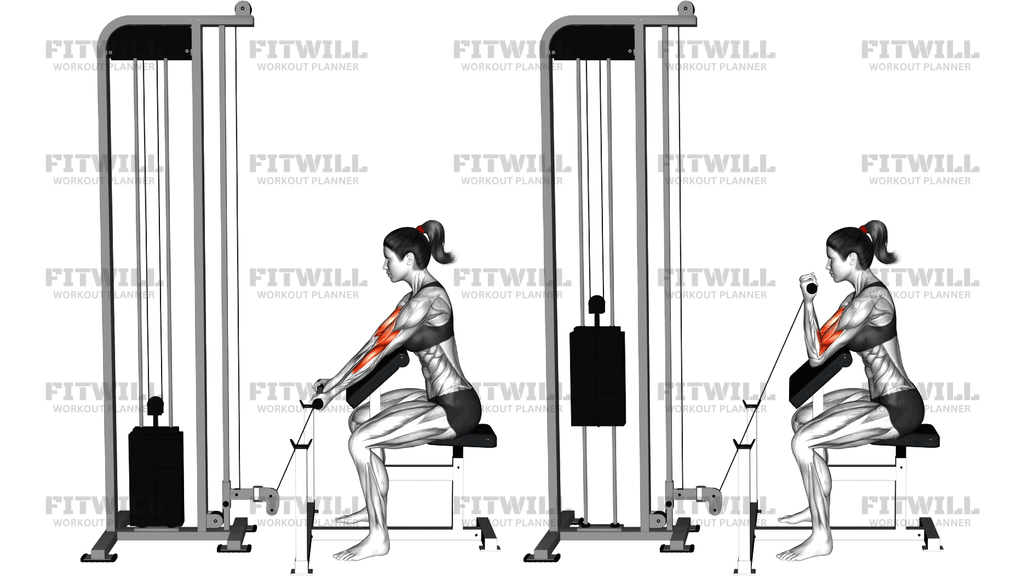
Sitting Biceps Curl On A Chair
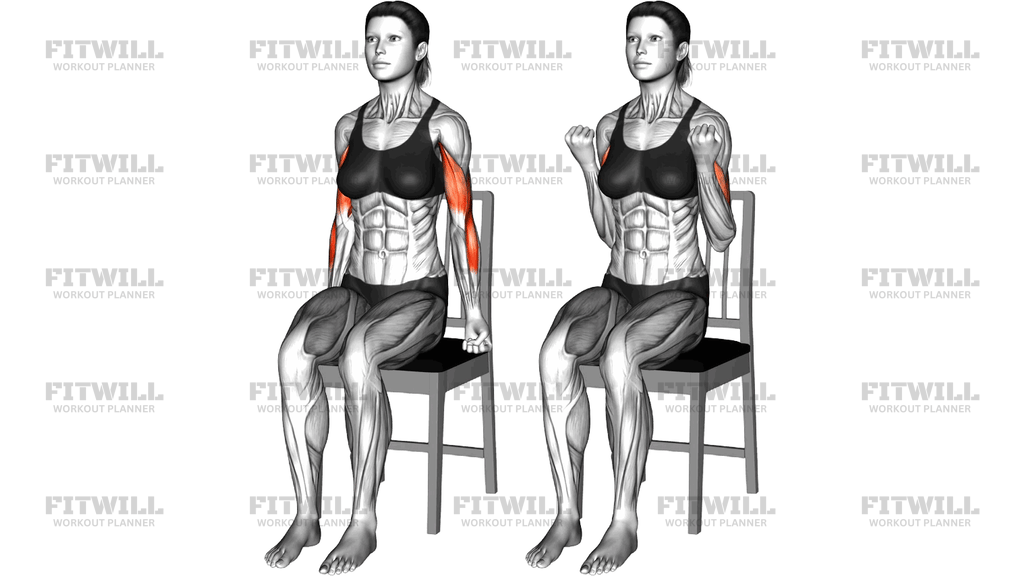
The Sitting Biceps Curl On A Chair is a simple arm exercise performed seated on an ordinary chair with no dumbbells, bands, or cables. You sit upright with your feet flat on the floor, arms hanging straight down at your sides, and curl your hands up toward your shoulders by bending at the elbows only. Because there is no external load, the movement relies on deliberate muscle tension and a full, controlled range of motion rather than heavy resistance, making it a pure form-focus and activation exercise.
This version is especially useful for beginners who are learning what a proper biceps curl feels like before adding weight, for older adults or anyone returning from a layoff who wants a joint-friendly way to reintroduce arm training, and for people at home or in an office who have no equipment handy. It also works well as a warm-up drill before weighted curl variations, since it takes the biceps and elbow joints through their full range with essentially zero stress.
The main muscles worked are the biceps brachii on the front of the upper arm, with support from the brachialis underneath it and the brachioradialis and forearm muscles that stabilize the wrist and hand. Keeping the upper arms pinned against the sides of your torso is what makes the exercise effective: the moment your elbows drift forward, the shoulders start doing the work and the biceps lose tension.
Setup matters more than it might seem for such a basic movement. Sit tall on the front half of the chair so your back is not slumped against the backrest, plant your feet about hip-width apart, and let your arms hang naturally with your palms facing your body or turned slightly forward. Squeezing your fists as you curl adds tension through the forearm flexors, which you can see emphasized in the demonstrated position.
To execute it well, bend your elbows and bring your hands up toward the fronts of your shoulders, keeping your upper arms vertical and glued to your ribs. Pause at the top with a hard squeeze, then lower your hands slowly and under control until your arms are fully straight again. The lowering phase is where most of the benefit lives in an unloaded curl, so take two to three seconds on the way down instead of letting gravity snap your arms back.
Common use cases include home workouts, office break routines, rehabilitation-style conditioning, and teaching proper curl mechanics. If you want to progress the exercise later, hold light household objects such as water bottles, add a pause at the top, or slow the lowering phase even further. Stop and adjust if you feel any pinching at the elbow or wrist, and keep the movement smooth rather than jerky.
[ Workout Log & Planner ]
Put your next workout in Fitwill
Keep your plan and training log ready when you are.


Instructions
- Sit on a sturdy chair with your buttocks on the front half of the seat, spine tall, and your feet flat on the floor about hip-width apart.
- Let your arms hang straight down at your sides, close to your torso, with your palms facing in toward your body and your shoulders relaxed and pulled slightly back.
- Brace your core lightly and press your upper arms gently against your ribs so they stay fixed throughout the set.
- Clench your fists and begin bending your elbows, curling your hands up toward the fronts of your shoulders in a smooth arc.
- Keep your elbows pinned at your sides the entire time; do not let them swing forward as your hands rise.
- At the top, when your hands are near shoulder height and your elbows are fully bent, squeeze your biceps hard for a one-second pause.
- Lower your hands slowly back down to the starting position over two to three seconds until your arms are completely straight.
- Exhale as you curl up and inhale as you lower your hands back down.
- Complete your target repetitions, then shake out your arms and reset your posture before the next set.
Tips & Tricks
- The most common mistake is letting the elbows drift forward toward the front of the body, which turns the movement into a shoulder-driven raise; picture your upper arms taped to your ribs for the whole set.
- Because there is no weight, tempo is your resistance. If you finish reps in under a second each, slow the lowering phase to three seconds or add a two-second squeeze at the top.
- Keep your wrists straight and your fists firm rather than letting your hands flop backward; a broken wrist position bleeds tension out of the biceps and into the wrist joints.
- Do not lean your torso back or rock your shoulders to help lift your hands. If you feel yourself swaying, brace your abs and imagine a string pulling the crown of your head toward the ceiling.
- Fully straighten your arms at the bottom of every rep. Partial reps that never reach full elbow extension leave the lower range of the biceps untrained.
- Sitting on the front half of the seat instead of slumping against the backrest keeps your spine neutral and stops your lower back from rounding.
- Try turning your palms slightly forward as you curl to get a stronger biceps contraction, or keep them neutral for a more brachialis and forearm-focused feel.
- If your chair has armrests, choose a different seat; armrests block the path of your arms and force an awkward arc.
- Use this drill as a pre-workout primer before dumbbell or barbell curls to establish the elbow position you want to carry into the loaded version.
Frequently Asked Questions
Which muscles does the Sitting Biceps Curl On A Chair work?
The biceps brachii on the front of the upper arm is the primary mover, supported by the brachialis and brachioradialis. Clenching your fists during the curl also recruits the forearm flexors.
Can the Sitting Biceps Curl On A Chair build muscle without any weight?
It builds coordination, activation, and some muscular endurance, but it provides very little resistance for meaningful strength or size gains. Treat it as a learning, warm-up, or mobility tool, then progress to dumbbells or household objects for real overload.
Is the Sitting Biceps Curl On A Chair good for beginners?
Yes, it is one of the best ways to learn proper curl mechanics. With no load to distract you, you can focus on keeping your elbows pinned to your sides and feeling the biceps shorten and lengthen through the full range.
Why should my elbows stay against my sides during the Sitting Biceps Curl On A Chair?
When your elbows drift forward, the front shoulders take over and the biceps lose tension at the top of the rep. Keeping the upper arms vertical ensures the elbow joint alone produces the movement, which is exactly what a curl should be.
How slow should I lower my hands in the Sitting Biceps Curl On A Chair?
Aim for two to three seconds on the way down. Since there is no external weight, the controlled lowering phase and the top squeeze are what create training stimulus.
What can I use instead of a chair for the Sitting Biceps Curl On A Chair?
Any stable seat works, such as a bench, stool, or the edge of a bed, as long as your feet rest flat on the floor and your arms can hang freely beside your torso. Avoid chairs with armrests or wheels.
How can I make the Sitting Biceps Curl On A Chair harder?
Hold light objects like water bottles or soup cans, add a two-second pause at the top of each rep, or slow the lowering phase to four or five seconds. Any of these increases time under tension without needing real equipment.
Is it safe to do the Sitting Biceps Curl On A Chair every day?
For most people, yes, because the load on the elbows is minimal. If you notice any aching in the elbow or wrist joints, reduce the number of reps, slow down further, or take a rest day.
Should my palms face in or forward during the Sitting Biceps Curl On A Chair?
Start with palms facing your body and, if you like, rotate them slightly upward as you curl, which mimics a standard supinated curl and increases biceps involvement. Keeping the palms neutral the whole time shifts a bit more emphasis toward the brachioradialis and forearms.