Sitting Core Twist On A Chair
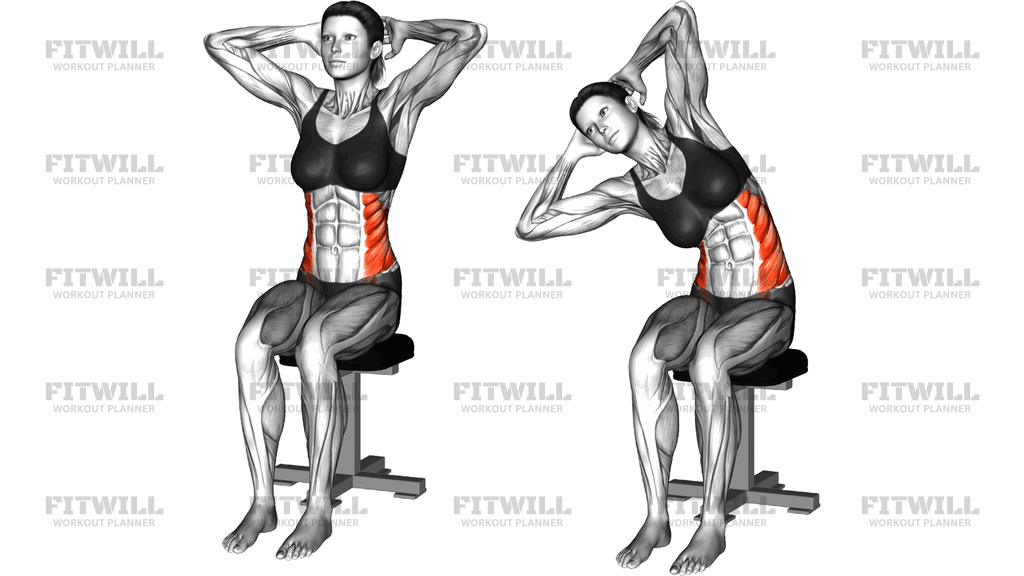
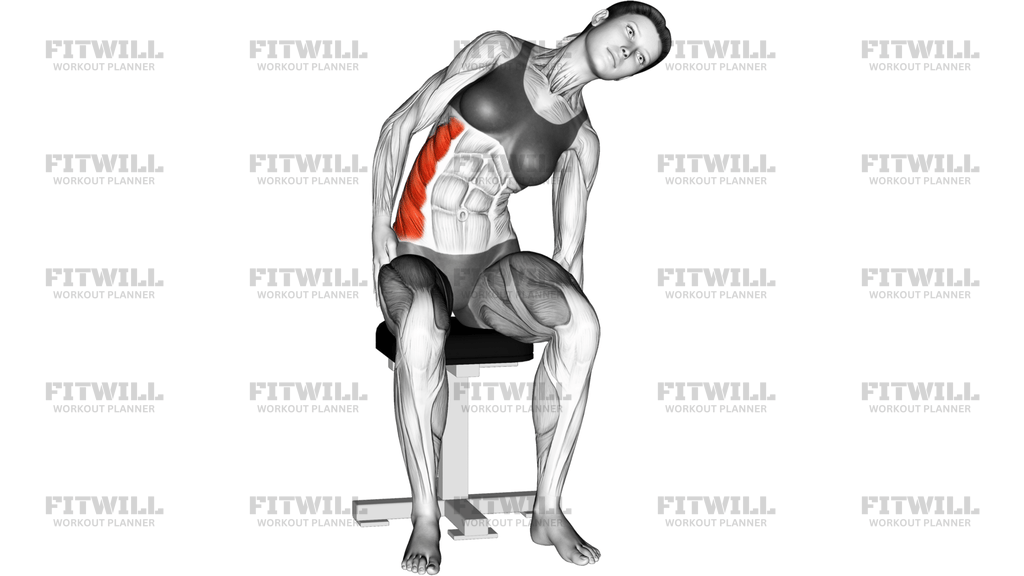
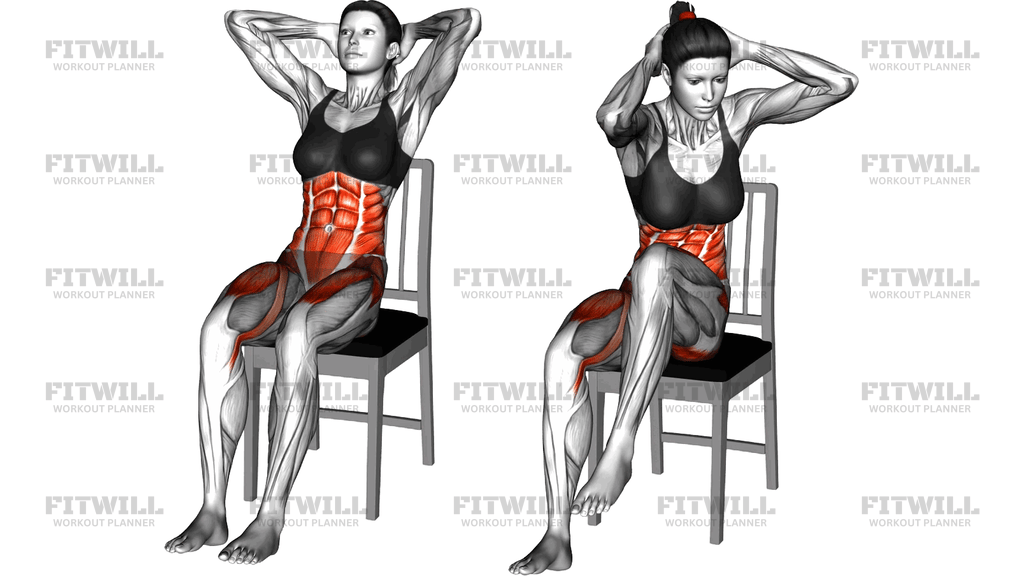
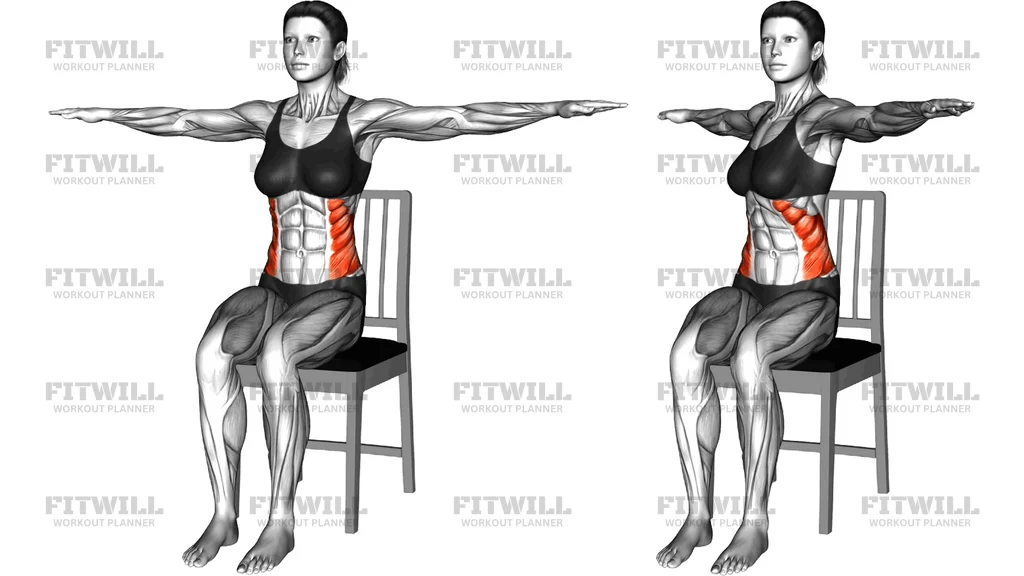
Sitting Core Twist On A Chair is a seated rotational exercise that targets the obliques, the muscles running along the sides of your waist. You sit upright on a sturdy chair with your feet flat on the floor, extend both arms straight out to your sides at shoulder height, and rotate your upper body from one side to the other while keeping your hips and legs facing forward. Because the chair removes the balance demands of standing variations, all of your attention goes into controlled rotation of the trunk.
This movement is especially useful for people who spend long hours seated, beginners building core awareness, older adults who want a joint-friendly way to train rotation, and anyone recovering their trunk mobility after time away from training. Office workers can do it right at their desk, and it requires nothing more than a stable, armless chair, which makes it one of the most accessible rotational exercises you can program.
The main muscles working are the external and internal obliques on both sides of your waist. The rectus abdominis helps brace the front of the trunk, the transverse abdominis stabilizes your midsection through each turn, and the muscles of the lower back and hips work to keep your pelvis steady while your shoulders rotate above it. Holding the arms out at shoulder height also adds a light endurance demand on the shoulders, which is part of the challenge but not the primary target.
Setup matters more than it looks. The chair must be stable and not swivel, because a rolling office chair will move with you and eliminate the work. Sit tall on your sit bones rather than slumped back against the backrest, and plant your feet firmly so your lower body stays anchored. The twist should come from your ribcage and waist rotating over a still pelvis, not from your arms swinging or your hips rocking side to side.
To execute it well, brace your core lightly, then rotate your shoulders and arms as one block to one side until you feel the waist engage, pause briefly, and rotate across to the other side at the same steady pace. Keep your head traveling with your shoulders so your neck stays neutral. Speed is the most common mistake here; slow, deliberate turns with a brief pause at each end will do far more for your obliques than fast, momentum-driven swings.
Use this exercise as a warm-up for heavier training, as a movement break during the workday, or as a higher-rep finisher for the waist. Because it is low load, it suits frequent practice, but stop short of forcing range; the rotation should feel like a muscle contraction, not a stretch you are prying open.
[ Workout Log & Planner ]
Put your next workout in Fitwill
Keep your plan and training log ready when you are.


Instructions
- Choose a stable, armless chair that will not tip or roll, and sit on the front half of the seat so your torso is unsupported.
- Sit tall on your sit bones with your feet flat on the floor, knees bent to roughly 90 degrees, and your thighs parallel.
- Raise both arms straight out to your sides at shoulder height, keeping them long and in line with your shoulders.
- Lightly brace your abdominal muscles as if preparing for a gentle nudge, and keep your chest lifted.
- Keeping your hips and knees pointing forward, rotate your shoulders, chest, and arms together to the right as far as your waist can turn without strain.
- Pause for a moment at the end of the rotation and feel the left side of your waist engage.
- Rotate smoothly all the way across to the left side at the same controlled speed, keeping the arms level throughout.
- Breathe steadily throughout, exhaling as you rotate into each turn and inhaling as you pass through center.
- Continue alternating side to side for your target number of reps, then lower your arms and reset your posture before the next set.
Tips & Tricks
- Imagine your belly button stays glued to the front of the chair; if your hips swivel with your shoulders, the obliques stop doing the work.
- Do not let your arms drop as the set goes on. Tired shoulders cause the arms to sag and turn the exercise into a momentum swing.
- If your chair has wheels, lock them or swap for a solid chair; a rolling seat silently robs you of almost all the rotation work.
- Keep your head and eyes moving with your shoulders instead of facing forward. Twisting only the arms while the face stays fixed limits your range and strains the neck.
- A slower tempo, about two seconds per side with a one-second pause, makes this far harder than rushing, so resist the urge to speed up on later reps.
- If you feel your lower back pinching rather than your waist working, reduce the rotation depth and re-brace before each turn.
- Cross your arms over your chest or bring your hands to your shoulders if holding the arms out at shoulder height fatigues your shoulders before your waist.
- Stay equally tall when rotating left and right; most people lean or slump slightly on their tighter side, which shortens the range on that half.
Frequently Asked Questions
Which muscles does the Sitting Core Twist On A Chair work?
The external and internal obliques along the sides of your waist do the main work, with the rectus abdominis and transverse abdominis bracing the trunk. The lower back and hips contribute by keeping the pelvis stable while the shoulders rotate.
Is the Sitting Core Twist On A Chair good for beginners?
Yes, it is one of the most beginner-friendly rotational exercises because the seated position removes balance demands and the load is only your body weight. Start with a modest range and slow tempo before turning further or adding reps.
Why do my arms get tired before my waist during the Sitting Core Twist On A Chair?
Holding the arms extended at shoulder height fatigues the shoulder muscles, especially in longer sets. If this happens first, bend your elbows or bring your hands to your shoulders so the waist remains the limiting factor.
Can I do the Sitting Core Twist On A Chair in an office chair?
Only if the chair does not swivel or roll. A rotating chair turns with your torso, so your obliques barely have to work; lock the wheels or use a fixed, sturdy chair instead.
Should my hips move during the Sitting Core Twist On A Chair?
No, your hips and knees should stay facing forward while your ribcage and shoulders rotate above them. If your hips are twisting, slow down and think of rotating from the waist rather than swinging the arms.
How many reps of the Sitting Core Twist On A Chair should I do?
Because the resistance is light, higher reps work well, such as 20 to 30 total alternating turns per set. Focus on controlled tempo and even range to both sides rather than chasing a high number quickly.
What can I use instead of a chair for the Sitting Core Twist On A Chair?
Any stable seated surface works, such as a bench, the edge of a bed without wheels, or a sturdy stool. You can also do the same arm-out rotation standing or on the floor, though those versions demand more balance and hip control.
Is it safe to do the Sitting Core Twist On A Chair with back problems?
Many people tolerate gentle seated rotation well, but if you have a current or recurring back issue, use a smaller range, move slowly, and stop if the movement produces pain rather than muscle effort. Check with a qualified professional if you are unsure.
Will the Sitting Core Twist On A Chair reduce fat around my waist?
Spot reduction is not how fat loss works; the exercise strengthens the obliques but does not selectively burn waist fat. Pair it with overall training and nutrition habits if reducing waist size is your goal.