Sitting Shoulder Press On A Chair
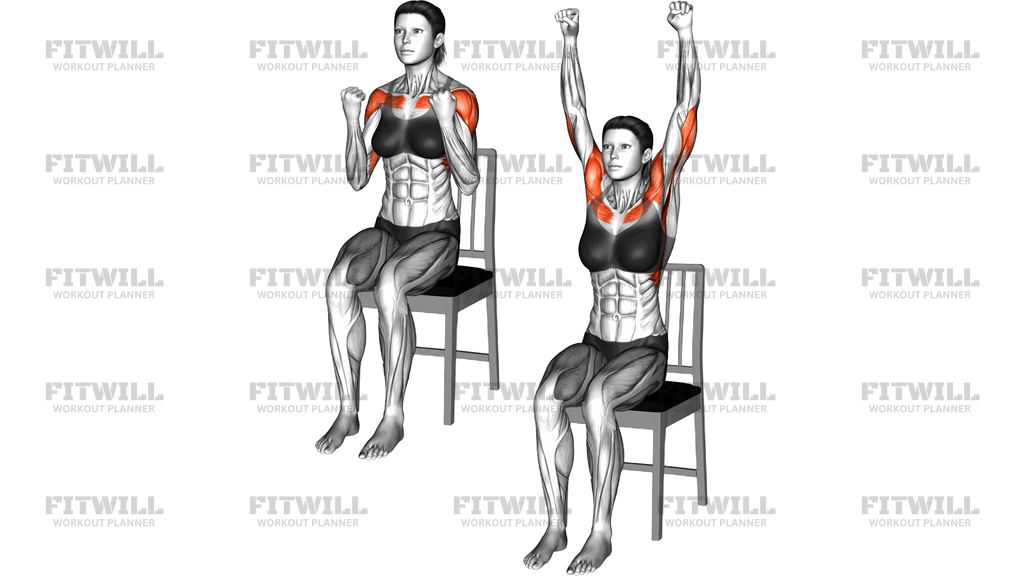
Sitting Shoulder Press On A Chair is a bodyweight overhead press performed seated on an ordinary chair. You sit upright with feet flat on the floor, raise your fists to shoulder height, and press both arms straight up overhead until they fully extend, then lower them back to the starting position under control. Because there is no external load, the movement relies entirely on your shoulder and arm strength, making it an accessible entry point for overhead pressing.
This exercise is especially useful for beginners, older adults, or anyone returning from time away from training who wants to rebuild comfortable overhead mobility before adding dumbbells or a barbell. It also works well as a warm-up for heavier pressing days, as a high-repetition burnout finisher, or as a low-impact option for home workouts where no equipment is available beyond a sturdy chair.
The primary muscles working are the shoulders, particularly the front and side portions of the deltoids, which drive the arms upward. The triceps extend the elbows to lockout, the upper chest assists in the early part of the press, and the upper traps and core stabilizers keep your torso upright and balanced on the chair. Seated pressing removes help from the legs, so the shoulders do the work on their own.
The setup matters more than it looks. A stable, armless chair with your back off the backrest forces you to hold your own posture, which trains the trunk along with the shoulders. Feet planted flat and knees bent to roughly ninety degrees give you a solid base so you are not wobbling or leaning as you press. Sitting also limits how much you can arch your lower back, which encourages a cleaner vertical pressing path.
To execute it well, think about pressing your fists toward the ceiling in a straight line while keeping your ribs down and your head neutral. Full extension at the top, with your biceps beside your ears, gives the shoulders and triceps a complete range. On the way down, resist the descent rather than dropping your arms, stopping when your elbows reach about shoulder height with fists facing forward.
A few practical points keep this safe and effective. Move within a range that feels smooth at the shoulder joints, and if overhead motion causes pinching, reduce the range or lower your elbows slightly at the bottom. Because the resistance is only your arm weight, this exercise shines with higher repetitions and slow, deliberate tempo rather than rushing through sloppy reps.
[ Workout Log & Planner ]
Put your next workout in Fitwill
Keep your plan and training log ready when you are.


Instructions
- Sit sideways-neutral on a sturdy armless chair with your feet flat on the floor, knees bent to about ninety degrees, and your upright torso not leaning on the backrest.
- Clench your fists and raise both arms so your upper arms are roughly parallel to the floor and your elbows are bent about ninety degrees, forearms vertical, fists facing forward.
- Brace your abdominal muscles, keep your ribs stacked over your pelvis, and pull your shoulder blades down slightly so you are not shrugging before you even press.
- Exhale and press both fists straight up toward the ceiling, letting the elbows travel just slightly forward of your shoulders rather than flaring wide behind you.
- Continue until your arms are fully extended overhead with your biceps near your ears, elbows soft rather than aggressively locked.
- Pause briefly at the top and feel your shoulders and triceps supporting the position without letting your lower back arch.
- Inhale and lower your arms under control, bending the elbows back to shoulder height and returning your forearms to the vertical start position.
- Reset your posture between reps: sit tall, feet planted, ribs down, before starting the next press.
- Complete your set with the same controlled tempo, then stand up carefully by pushing through your legs rather than pulling on anything overhead.
Tips & Tricks
- The most common mistake is turning this into a leaning back press. Because you are seated without weight, the temptation is to arch your lower back to help the arms up; keep your ribs down and let the shoulders do the lifting.
- Do not let your elbows drift behind your body at the bottom position. Keep them slightly in front of or in line with your torso so the shoulder joint stays in a comfortable pressing path.
- Slow the lowering phase to two or three seconds. With only bodyweight as resistance, the eccentric portion is where most of the useful tension comes from.
- If your shoulders pinch or feel cramped at the top, stop just short of full lockout or angle your palms slightly toward each other instead of pressing with fists facing straight forward.
- Watch for shrugging. If your shoulders creep up toward your ears as you press, consciously press them down before each rep and keep your neck long.
- Keep your feet flat and avoid letting your heels lift or your thighs bounce; a quiet lower body means the work stays in your shoulders and arms.
- To make the exercise harder without adding weight, pause for two seconds at the top of each press or slow the entire rep down.
- Make sure the chair is stable and will not slide. Pressing against a rolling or tipping chair is the main safety risk in this setup.
- If your elbows want to swing outward during the press, think about keeping your forearms stacked directly over your elbows throughout the whole movement.
Frequently Asked Questions
Which muscles does the Sitting Shoulder Press On A Chair work?
The front and side shoulders do most of the pressing, with the triceps extending the elbows to lockout. The upper chest assists early in the press, and the upper traps and core stabilize your seated posture.
Is the Sitting Shoulder Press On A Chair good for beginners?
Yes, it is one of the gentlest ways to learn the overhead pressing pattern because there is no external load on the shoulder joints. It is a sensible first step before progressing to light dumbbells.
Why sit on a chair instead of standing for this shoulder press?
Sitting removes momentum from the legs and makes it harder to arch your lower back, so the shoulders have to do the work. It also gives a stable base for anyone with balance or mobility limitations.
Should my palms be in fists or open for the Sitting Shoulder Press On A Chair?
The standard version uses closed fists facing forward, which keeps the wrists neutral and the focus on the shoulders. If your wrists feel strained, open your hands with palms facing forward or slightly toward each other.
How high should I press at the top of the movement?
Press until your arms are fully extended overhead with your biceps close to your ears, but keep a small amount of softness in the elbows. If full lockout causes shoulder discomfort, stop just short of it.
How many repetitions should I do of the Sitting Shoulder Press On A Chair?
Since the resistance is limited to your arm weight, higher repetitions work best, typically 12 to 20 or more per set. Slowing the tempo or pausing at the top adds difficulty without equipment.
My lower back arches when I press overhead. How do I fix it?
Brace your abs before each rep and think about keeping your ribs pulled down over your pelvis. If it persists, reduce the range slightly and build up overhead mobility gradually.
What can I use if I do not have a suitable chair?
Any stable, armless seat such as a bench or sturdy stool works the same way. Avoid chairs with wheels, soft cushions that shift under you, or seats high enough that your feet cannot rest flat on the floor.
Is the Sitting Shoulder Press On A Chair safe for shoulder pain?
It is generally low stress because there is no added weight, but any pressing can aggravate an irritated shoulder. Move within a pain-free range, and if pinching or sharp discomfort occurs, stop and consult a qualified professional.
Can I combine this with other seated exercises on the same chair?
Absolutely. It pairs naturally with seated lateral raises, seated rows with a band, or chair squats, letting you run a complete home session without leaving your seat.