Sitting Chest Fly On A Chair
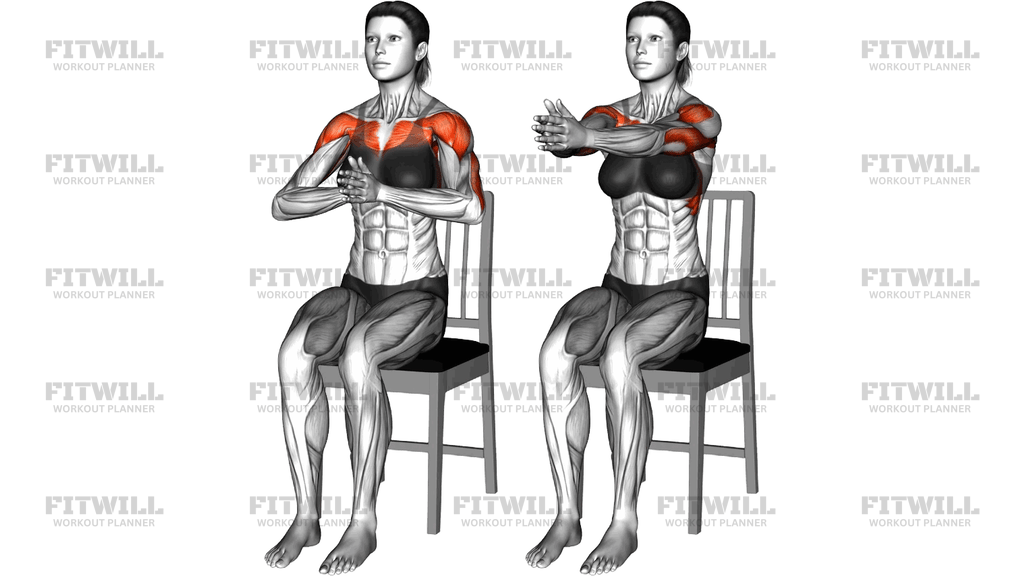
The Sitting Chest Fly On A Chair is a bodyweight chest exercise performed seated upright on a regular chair. With your elbows bent to roughly 90 degrees and raised to chest height, you sweep your forearms and hands from a wide position in toward the midline of your body, then control them back out to the start. Because there is no dumbbell, cable, or machine involved, the resistance comes from deliberately squeezing the arms together and resisting on the way back, which makes this a low-load but surprisingly effective way to feel the chest working.
This movement is especially useful for beginners who have never felt their chest contract during pressing work, for people training at home or in an office with no equipment, and for anyone recovering training volume after a layoff who wants gentle, joint-friendly chest work. It is also a practical teaching drill: the seated position removes momentum from the legs and lower body, so any cheating shows up immediately as leaning or shrugging.
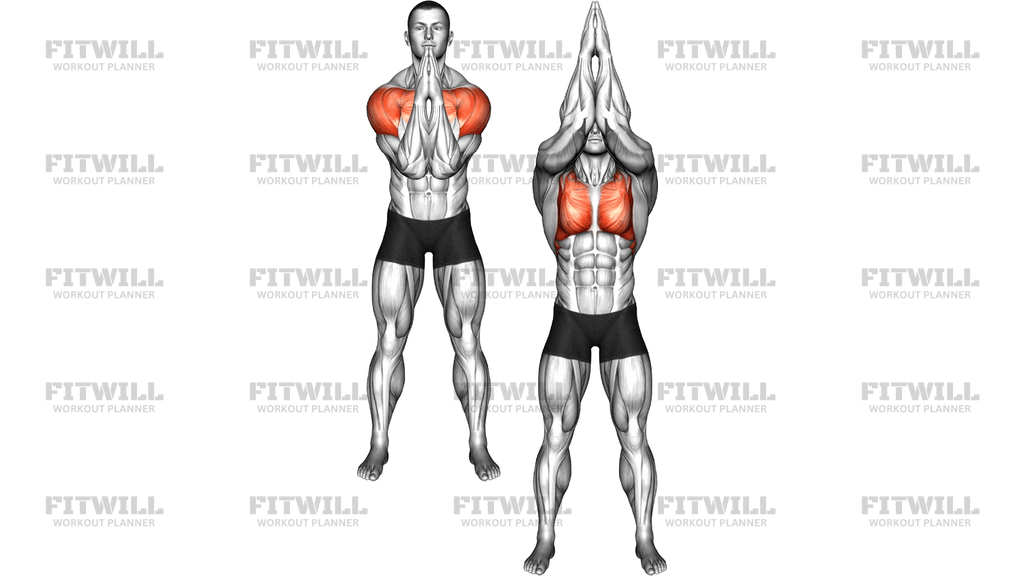
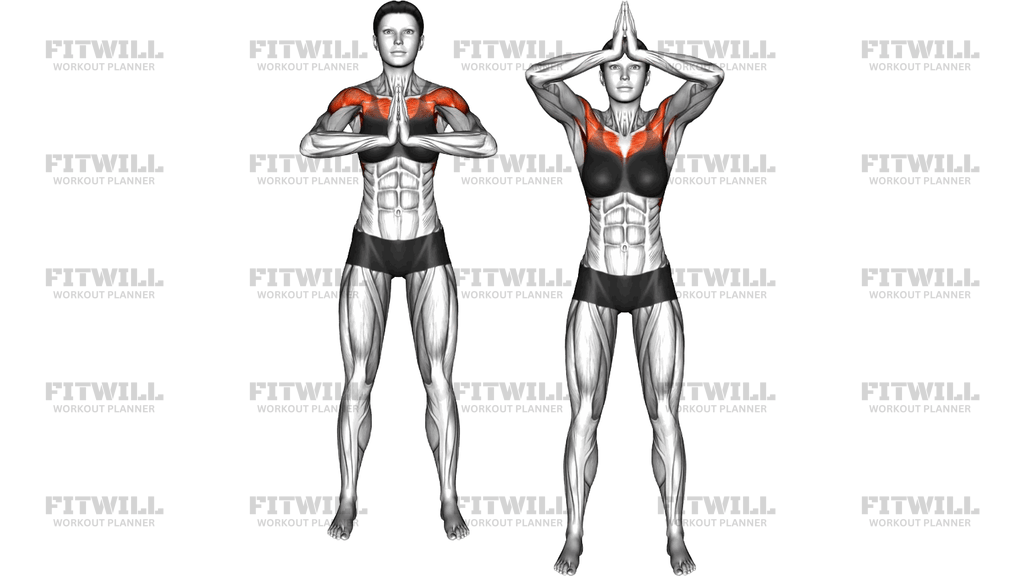
The primary muscles trained are the pectorals, particularly the sternal portion of the chest across the middle of the torso, with the front delts assisting as the arms travel horizontally. The upper back and rear shoulder muscles work eccentrically to control the arms as they open wide, and the core stays quietly engaged to keep the torso tall against the chair back.
Setup matters more than it looks. Sit tall with your feet flat and your shoulders pulled lightly back and down, and keep your elbows at chest height throughout. If your elbows drift down toward your ribs the exercise turns into a squeeze-less arm movement, and if they climb toward your ears your traps take over. The arms should travel in a horizontal arc, as if hugging a barrel.
To execute well, open the arms wide until you feel a comfortable stretch across the chest, then bring your forearms together in front of you and hold the squeeze for a beat before controlling the return. Move slowly enough that you could pause at any point in the arc. Typical use cases include warm-up activation before bench or push-up work, high-rep finishers, and short desk-break routines.
For safety, keep the range within a pain-free stretch and avoid forcing the elbows far behind your torso. Since the movement is unweighted, progress comes from slower tempos, longer squeeze holds, and added reps rather than external load.
[ Workout Log & Planner ]
Put your next workout in Fitwill
Keep your plan and training log ready when you are.


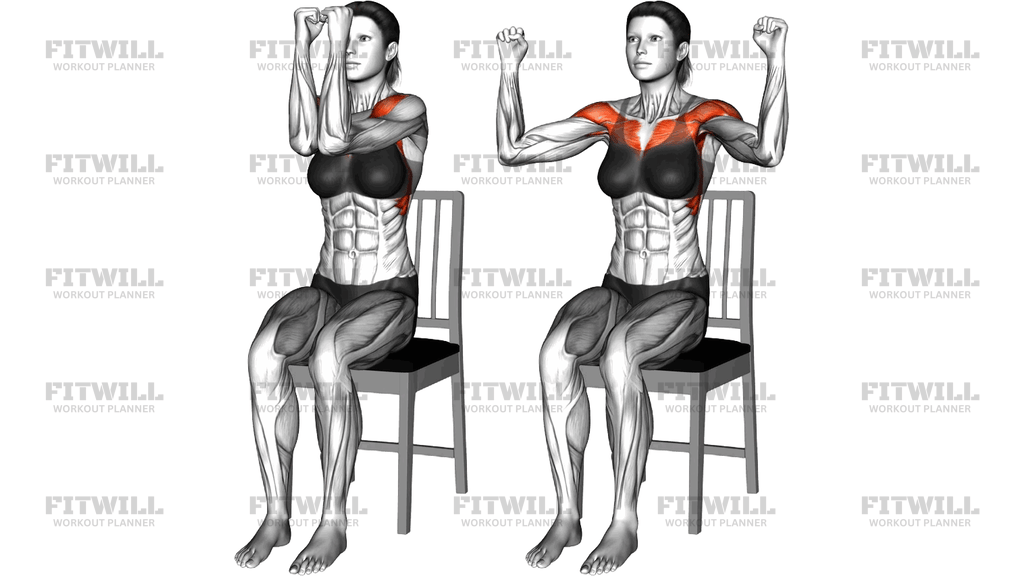
Instructions
- Sit on a sturdy chair with your feet flat on the floor about hip-width apart and your back tall, without slumping against the backrest.
- Raise both arms out to your sides and bend your elbows to about 90 degrees so your forearms point upward and your elbows sit at chest height.
- Lightly clench your fists and pull your shoulders back and down so your chest feels open before you start moving.
- Brace your core gently to keep your torso still, and confirm your elbows stay level with your shoulders, not lower.
- Exhale as you sweep your forearms and elbows forward and inward in a horizontal arc until your forearms nearly touch in front of your chest.
- Squeeze your chest hard at the front of the movement and hold the pressed position for one to two seconds.
- Inhale as you slowly open your arms back out to the wide starting position, resisting the whole way rather than letting them drop back.
- Stop at the wide position when you feel a mild stretch across your chest, keeping your elbows up and slightly forward of your torso.
- Complete your reps, then rest your hands on your thighs and reset your posture before the next set.
Tips & Tricks
- The most common mistake is letting the elbows sink toward the ribs as fatigue sets in, which shifts work away from the chest; check your elbow height in a mirror every few reps.
- Do not rush the opening phase. The stretch back to the wide position is where the chest and upper back do most of their controlling work, so take two to three seconds on the way out.
- If your shoulders creep up toward your ears, consciously press them down and think about leading the movement from your elbows rather than your hands.
- Keep your lower back neutral. Arching off the chair to make the arc bigger reduces chest engagement and can strain the spine.
- Because there is no external load, add tension by imagining you are pressing your forearms through thick mud throughout the entire arc.
- A mild stretch across the chest at the wide position is the goal; sharp pulling at the front of the shoulder means you have opened too far for your current mobility.
- Try pausing one second at the widest point as well as the squeezed point to eliminate any dead spots in the arc.
- If you cannot feel your chest working, place a light towel or small pillow between your forearms at the front of the rep and squeeze into it briefly for feedback.
Frequently Asked Questions
Which muscles does the Sitting Chest Fly On A Chair work?
The chest, especially the mid-pectoral fibers, is the primary mover, with the front shoulders assisting as the arms sweep inward. The upper back works to control the arms on the way back out to the wide position.
Is the Sitting Chest Fly On A Chair good for beginners?
Yes, it is one of the easiest ways to learn what a chest contraction feels like because there is no load to fight and the seated position limits cheating. Beginners should focus on slow tempo and elbow height rather than rep count.
Why should my elbows stay at chest height during this exercise?
Elbows at chest height keep the arms moving in the horizontal arc that targets the pectorals. Lower them and the movement loses its fly character; raise them toward your ears and your upper traps take over.
Can I build muscle with a bodyweight chest fly like this?
It can support muscle growth at the beginner stage and as a high-effort, high-rep finisher, but the tension available is limited without load. Once it feels easy, progress to banded, cable, or dumbbell fly variations.
How many reps and sets should I do?
Because the resistance is low, work in the 12 to 20 rep range for two to four sets, using a slow two-second squeeze and a controlled return. Stop the set when your elbow height or tempo starts to break down.
What is the most common mistake in the Sitting Chest Fly On A Chair?
Rushing the reps and swinging the arms together using momentum, which usually comes with leaning the torso forward. Keep your back tall against your posture and make the squeeze, not the speed, the point of each rep.
What can I use instead if I want more resistance?
A resistance band wrapped around your back and held in your hands turns this into a loaded seated fly, or you can perform a standing cable or dumbbell fly. The seated pattern and elbow position stay the same in all versions.
Is it safe if I have shoulder discomfort?
The unweighted arc is generally gentle, but shorten the range so the wide position stays pain-free and avoid forcing the elbows behind your torso. If discomfort persists, check with a qualified professional before continuing.
Can I do this exercise at a desk during the workday?
Yes, that is one of its best uses. Any stable chair without wheels works, and a set of slow, deliberate flys takes under two minutes with no equipment or floor space needed.