Resistance Band Glute Bridge (Version 2)
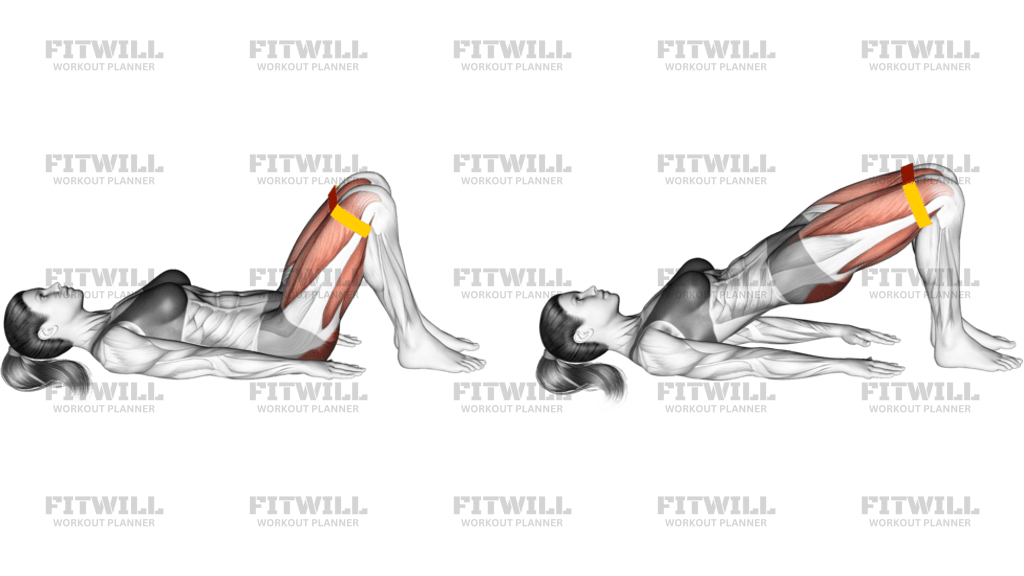
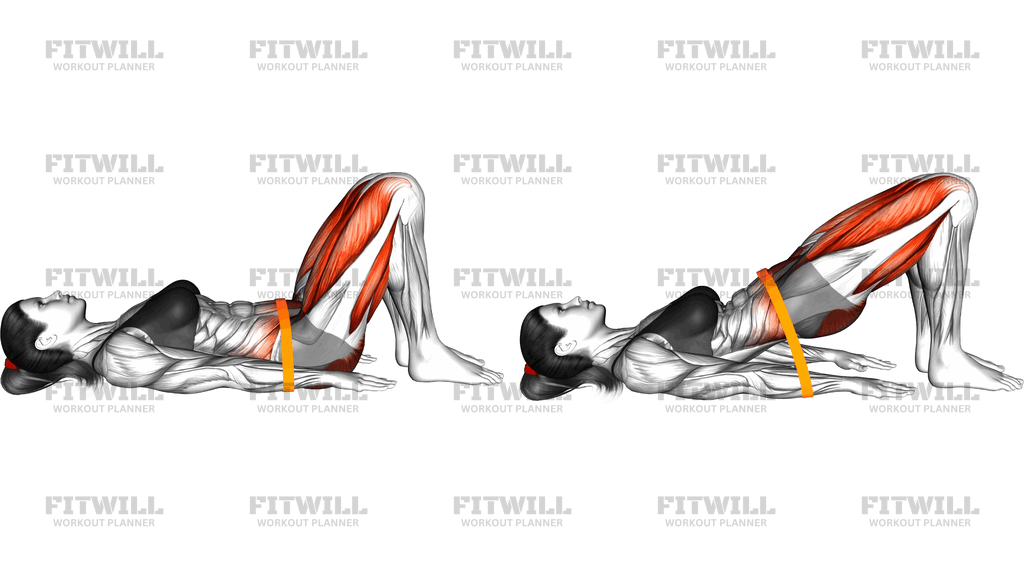
The Resistance Band Glute Bridge (Version 2) is a floor-based hip extension exercise performed with a short loop band wrapped around both upper thighs. Unlike the basic bodyweight glute bridge, the band adds outward tension that you actively push against with your knees, so your hips have to extend and abduct at the same time. That combination is exactly what most glutes are missing, especially if you spend long hours sitting.
This variation works the gluteus maximus as the prime mover, while the gluteus medius on the side of each hip works hard to keep pressing outward against the band. Your hamstrings assist with hip extension, and your core and lower back stabilize the trunk so the lift comes from the hips rather than from arching the spine.
Setup matters more here than in a regular bridge because the band position determines how much outward resistance you get. Lie on your back with the band looped around both thighs near your hips, feet flat on the floor about hip-width apart, heels close enough to your glutes that you can brush them with your fingertips at the bottom. Keep your arms relaxed at your sides with palms down for balance.
To execute the movement, brace your abs, gently press your knees outward into the band, and drive through your heels to lift your hips until your body forms a straight line from shoulders to knees. Squeeze your glutes hard at the top without pushing your ribs upward, then lower your hips back down with control while keeping light tension in the band the entire time.
This exercise suits beginners learning to feel their glutes, lifters using it as a warm-up before squats or deadlifts, and anyone training at home with minimal equipment. It is also a common choice in rehab-style programs for waking up the side glutes, though it should not replace professional guidance if you are managing pain.
Keep the reps smooth and the band tension constant. If your lower back takes over, your heels drift too far away, or your knees collapse inward, reset your position rather than pushing through sloppy reps. Quality of the squeeze at the top matters far more than how high the hips travel.
[ Workout Log & Planner ]
Put your next workout in Fitwill
Keep your plan and training log ready when you are.


Instructions
- Lie on your back on the floor with your knees bent and a short loop resistance band wrapped around both thighs near your hips.
- Place your feet flat on the floor about hip-width apart, heels roughly a hand-span from your glutes, and rest your arms at your sides with palms facing down.
- Tuck your pelvis slightly so your lower back rests close to the floor, then brace your abdominal muscles as if preparing for a light push to the belly.
- Apply gentle outward pressure with your knees so the band is already taut before you lift.
- Drive through your heels and the backs of your feet to raise your hips toward the ceiling, keeping the outward knee pressure the whole way up.
- Stop when your shoulders, hips, and knees form a straight line, and squeeze your glutes firmly at the top without letting your lower back arch.
- Hold the top position for a brief pause, keeping tension in the band by not letting your knees fall inward.
- Lower your hips slowly back toward the floor, stopping just before your glutes touch down so the band stays loaded.
- Exhale as you lift your hips and inhale as you lower them, maintaining a steady breathing rhythm.
- Complete your reps, then release the knee pressure first and slide the band off your legs before standing up.
Tips & Tricks
- If your knees snap inward at the top of the bridge, the gluteus medius is switching off — actively push outward for the entire rep, even when your hips are fully extended.
- Heels too far from your body turn the movement into a hamstring-dominant pull; walk your feet in until your shins are close to vertical at the top.
- Do not chase height by arching your lower back — if your ribs flare and your belly drops, your hips have gone past the point your glutes control.
- If the band rolls or digs in, reposition it slightly higher or lower on your thighs until it sits flat against your legs without twisting.
- Pause for a full second at the top of each rep instead of bouncing; the pause is what makes the glute squeeze noticeable.
- Drive through your whole foot rather than your toes — lifting your heels shifts the work away from the glutes and strains the knees.
- Keep your neck relaxed and your gaze straight up; craning your chin toward your knees tensed the front of the neck for no benefit.
- If you feel your hamstrings cramping, point your knees slightly more outward and soften the intensity of the top squeeze — cramps here usually mean the glutes are not doing their share.
- Progress by using a thicker band or adding a pause, not by letting your hips drop and rebound quickly between reps.
Frequently Asked Questions
Which muscles does the Resistance Band Glute Bridge (Version 2) work?
The gluteus maximus does most of the hip extension, while the gluteus medius works continuously to press the knees outward against the band. The hamstrings assist and the core stabilizes your torso throughout.
Why does this version use a band around the thighs instead of over the hips?
A band around the thighs creates outward pull that you resist by pressing your knees apart, which recruits the side glutes in addition to the main glute muscles. This makes it a two-in-one movement for hip extension and hip abduction.
Is the Resistance Band Glute Bridge (Version 2) good for beginners?
Yes, it is one of the most beginner-friendly glute exercises because the floor supports your spine and the resistance is easy to adjust. Start with a light band and focus on feeling your glutes rather than lifting high.
How far should my heels be from my glutes?
Close enough that you can just brush your heels with your fingertips at the bottom, which puts your shins close to vertical at the top. Heels placed too far away shift the work toward the hamstrings.
My knees cave in at the top of the bridge — what am I doing wrong?
You are letting the band win the abduction battle, usually because the load or fatigue is too high. Deliberately push your knees outward through the whole rep, or switch to a lighter band until the pattern sticks.
Can I do this exercise without a mat?
Yes, any firm, non-slip floor surface works, though a mat makes the lie-down position more comfortable on your spine and tailbone.
What can I substitute if I don't have a loop band?
A regular bodyweight glute bridge trains the same hip extension pattern, or you can hold a dumbbell across your hips for added load. You lose the outward knee pressure, so consciously squeeze your glutes and keep your knees tracking over your feet.
Should my glutes touch the floor between reps?
Lower until they are just above the floor without resting, so the band tension and muscle engagement carry over from rep to rep. Fully resting between reps turns each lift into a fresh start and reduces the training effect.
Is it safe for my lower back?
When done with a braced core and a controlled range, the movement is gentle on the spine because the floor supports it. Stop short of the point where your lower back starts to arch, and avoid forcing extra height at the top.
How many reps and sets should I do?
For strength and muscle, work in the range of 10 to 15 reps for 2 to 4 sets with a pause at the top. As a warm-up before squats or deadlifts, one or two lighter sets of 10 to 12 reps is usually enough.