Sitting Pigeon Stretch On A Chair
The Sitting Pigeon Stretch On A Chair is a seated hip opener that recreates the classic pigeon pose position without needing to get down on the floor. You sit upright on a sturdy chair, rest one ankle across the opposite knee so the shin lies roughly parallel to the floor, and let gravity and a gentle forward lean sink you into the outer hip of the crossed leg. The highlighted areas in the movement are the glutes and the deep rotator muscles on the side of the crossed leg, which is exactly where most people feel the stretch within a few seconds.
This stretch is especially useful for people who sit for long stretches of the day. Prolonged sitting keeps the hips flexed and the glutes switched off, which often shows up as tightness across the back of the hips, stiffness when standing up, or a dull ache in the lower back. Office workers, drivers, and anyone returning to training after a long break tend to feel the benefit quickly. It is also a practical option for older adults or anyone with knee, wrist, or balance issues who cannot comfortably perform a floor-based pigeon stretch.
The setup matters more than it looks. Sitting tall with both sit bones planted evenly on the chair keeps your pelvis level, which lets the stretch target the outer hip instead of twisting strain into the lower back. If you slouch or tip to one side, the tension drifts into the spine and you lose the effect on the hip. A stable, armless chair gives you the support you need to relax into the position rather than fight for balance.
To execute it well, cross the ankle just above the opposite kneecap rather than directly on the joint, flex the crossed foot, and keep the knee of the crossed leg tracking outward. From there, hinge forward from the hips with a long, neutral spine until you feel a moderate pull through the buttock of the crossed leg. You can add gentle pressure with a hand on the crossed knee or ankle to fine-tune the depth, but the stretch should come from your own position, not from forcing the leg down.
Because it requires no floor space and only a chair, this stretch fits easily into a workday, a warm-up before lower body training, or a cooldown after running or cycling. Hold each side for twenty to sixty seconds while breathing steadily, and repeat two to three rounds if the hips feel particularly tight. Stop if you feel sharp pain in the knee or hip, and reduce the forward lean if the sensation is too intense.
[ Workout Log & Planner ]
Put your next workout in Fitwill
Keep your plan and training log ready when you are.


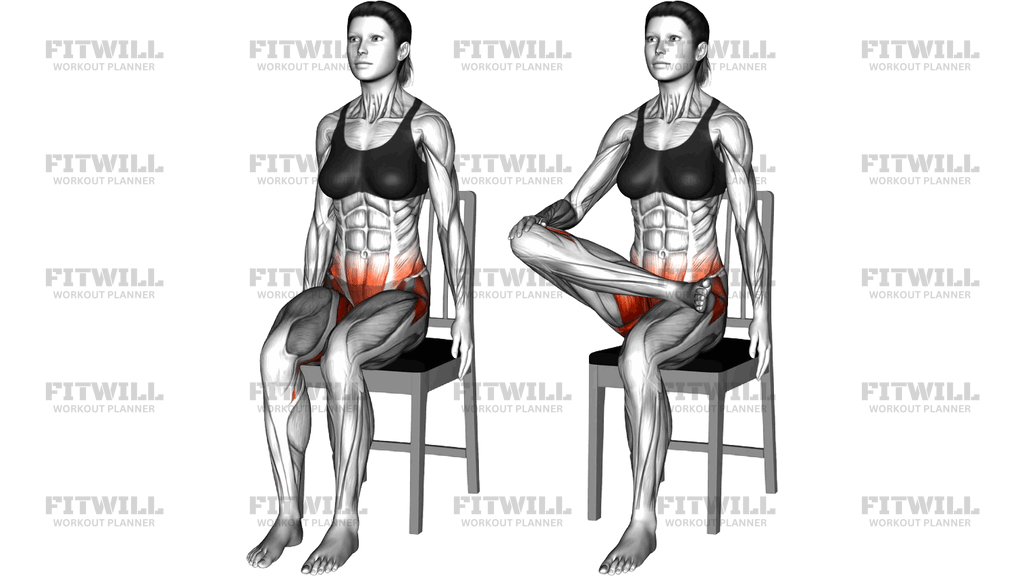
Instructions
- Sit sideways-neutral on a sturdy, armless chair with both feet flat on the floor and your weight spread evenly across both sit bones.
- Sit up tall, lengthen the back of your neck, and rest your hands on your thighs to settle into a neutral spine before moving.
- Lift one foot and place that ankle on top of the opposite knee, just above the kneecap, so the shin sits roughly parallel to the floor.
- Flex the crossed foot by pulling the toes back toward the shin to protect the knee, and let the crossed knee open out to the side.
- Brace your core lightly and hinge forward from the hips, keeping your chest long and your back flat rather than rounding.
- Continue leaning until you feel a steady stretch through the buttock and outer hip of the crossed leg; you may rest your forearms or hands on the crossed shin or thigh for support.
- Hold the end position for 20 to 60 seconds, breathing slowly and letting the hip release a little more with each exhale.
- Slowly sit back upright, lift the crossed foot off the knee, and return it to the floor with control.
- Shake out the leg briefly, then cross the other ankle over the opposite knee and repeat the same sequence on the second side.
Tips & Tricks
- A common mistake is letting the crossed knee collapse inward toward the other leg, which kills the stretch in the glutes and loads the knee instead. Actively guide the knee toward the floor and away from your midline.
- Rounding the lower back to reach further forward is the most frequent fault in this position. Keep the chest lifted and hinge from the hips; a flat back at a shallower angle stretches the hip more than a rounded back that leans far down.
- If your knee floats high and the stretch feels sharp in the hip, lower the height of the ankle placement slightly toward the shin rather than forcing the leg down with your hand.
- Do not press directly on the kneecap to deepen the stretch. Apply pressure to the outer thigh or the ankle instead, keeping the knee joint itself free.
- Keeping the crossed foot relaxed and pointed lets the knee drift; dorsiflexing the foot, pulling the toes back, locks the knee in a safer alignment.
- Check that both sit bones stay on the chair throughout the lean. Tilting onto one hip turns the movement into a spinal twist and reduces the stretch on the outer hip.
- Breathe out slowly as you hinge forward. Holding your breath tends to tense the glutes, which is exactly the muscle you are trying to lengthen.
- If the chair slides or wobbles when you lean forward, place it against a wall or choose a heavier seat. Stability lets you relax into the hold instead of bracing for balance.
- Expect a difference between sides, especially if you habitually cross one leg over the other while sitting. Spend extra time on the tighter side rather than equalizing by shortening the looser side.
Frequently Asked Questions
Which muscles does the Sitting Pigeon Stretch On A Chair target?
It primarily targets the glutes and the deep external rotators of the crossed hip, with secondary stretch through the outer hip structures. A mild stretch can also be felt along the lower back when you hinge forward.
Is the Sitting Pigeon Stretch On A Chair suitable for beginners?
Yes, it is one of the most beginner-friendly hip openers because the chair supports your weight and you control the depth entirely with your torso angle. Start with a small forward lean and increase gradually as the hip loosens.
Where exactly should I place my ankle during the Sitting Pigeon Stretch On A Chair?
Rest the ankle on the opposite thigh just above the kneecap, so the crossed shin sits roughly parallel to the floor. Avoid placing the ankle directly on the knee joint itself, as this puts unnecessary pressure on the knee.
Why do I feel the Sitting Pigeon Stretch On A Chair in my knee instead of my hip?
This usually means the crossed knee is drifting inward or the ankle is positioned too close to the knee joint. Flex the crossed foot, guide the knee outward, and move the ankle slightly further up the thigh toward the groin.
How long should I hold the Sitting Pigeon Stretch On A Chair?
Hold each side for 20 to 60 seconds, repeating two to three rounds per side. For tight hips from long sitting sessions, the longer holds tend to produce a more noticeable release.
Can I do the Sitting Pigeon Stretch On A Chair if I cannot get on the floor?
Yes, that is one of its main advantages. Because everything happens on a stable seat, it works well for people with knee discomfort, wrist sensitivity, or balance limitations who cannot manage a floor-based pigeon stretch.
How does the Sitting Pigeon Stretch On A Chair differ from the floor pigeon pose?
Both place the shin across the front of the body to open the outer hip, but the chair version lets gravity do less of the work and removes the load on the supporting knee and lower back. It is generally gentler and easier to control, though slightly less intense.
What kind of chair works best for the Sitting Pigeon Stretch On A Chair?
Use a sturdy, armless chair that does not swivel or roll, such as a dining chair, placed against a wall if needed. An unstable seat makes it hard to relax into the stretch and raises the risk of losing balance.
Should I feel pain in my lower back during the Sitting Pigeon Stretch On A Chair?
No, discomfort in the lower back usually signals that you are rounding your spine instead of hinging from the hips. Sit taller, reduce the forward lean, and focus on keeping a long, flat back so the stretch stays in the hip.
When is the best time to use the Sitting Pigeon Stretch On A Chair?
It works well as a mid-day break from prolonged sitting, as part of a warm-up before squats, running, or cycling, or as a cooldown to release the hips after training. There is no wrong time, as long as the muscles are warm enough to stretch comfortably.