Sitting Triceps Stretch On A Chair
The Sitting Triceps Stretch On A Chair is a simple overhead stretch performed from an upright seated position, usually on a sturdy chair with your feet flat on the floor. You raise one arm overhead, bend the elbow so the hand drops behind your head, and use the opposite hand to gently guide the elbow back and inward until you feel a clear stretch along the back of the upper arm. The chair does more than give you a place to sit — it removes the balance demands of a standing version, so you can focus entirely on the stretch instead of stabilizing yourself.
This movement primarily targets the triceps, with an emphasis on the long head, which runs down the inside of the upper arm and crosses the shoulder joint. Because the arm is overhead, the shoulder is placed in flexion while the elbow is deeply flexed, which is exactly the position that lengthens the long head. The shoulder muscles and the tissues around the armpit also get some lengthening in this position, which is why the stretch often feels broader than just the back of the arm.
It is especially useful for people who press, push, or lock out their arms frequently — anyone who does bench presses, overhead presses, dips, or push-ups will recognize the tight, shortened feeling in the triceps this stretch addresses. It is also a good fit for office workers who spend long hours at a desk with the elbows bent at their sides, and for older adults or anyone recovering general mobility, since the seated setup is stable and low-skill.
Setup matters more than it looks. Sit tall on the front half of the chair with both sit bones grounded and your ribs stacked over your pelvis. If you lean back against the chair back or arch your low back to fake extra range, you change the angle of the shoulder and reduce the stretch on the triceps. Keeping your head neutral — not jutting forward as the elbow moves back — protects the neck and keeps the tension where you want it.
To execute it well, lift one arm straight up, then bend the elbow and let the hand travel down behind your head toward the opposite shoulder blade. Place the other hand on the raised elbow and ease it back and slightly toward the midline until you feel a moderate stretch, not a sharp pull. Hold, breathe steadily, and let the tissue release gradually before switching sides.
Use it as part of a warm-up before upper-body pressing sessions, as a cooldown after arm or shoulder training, or as a standalone mobility break during the workday. Keep the stretch at a comfortable intensity — you should feel lengthening, never pain — and remember that the elbow behind the head should come from gentle guidance, never from forcing the joint deeper.
[ Workout Log & Planner ]
Put your next workout in Fitwill
Keep your plan and training log ready when you are.


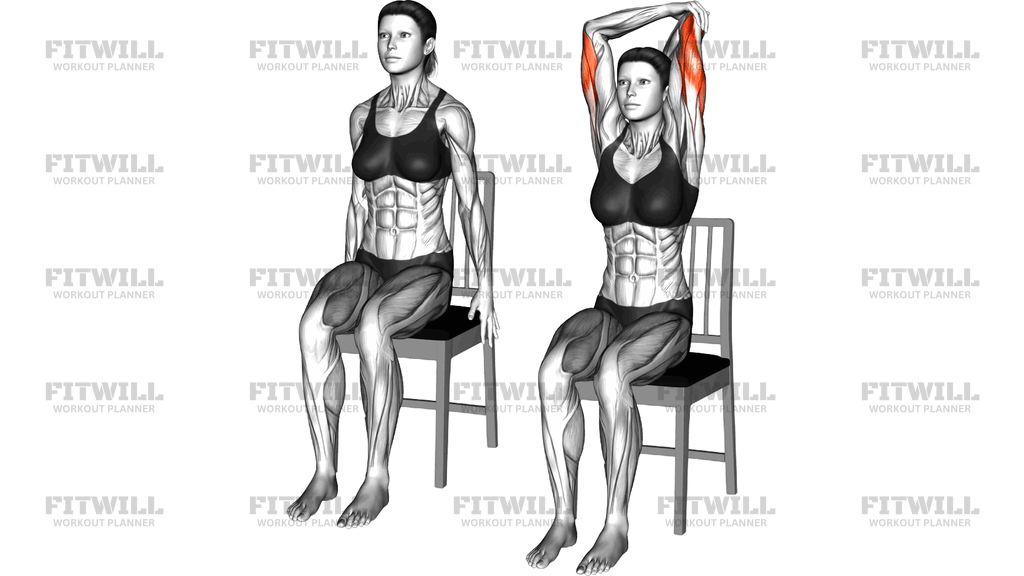
Instructions
- Sit on the front edge of a sturdy chair with your feet flat on the floor, hip-width apart, and your sit bones evenly grounded.
- Sit up tall, ribs stacked over your pelvis, shoulders relaxed down away from your ears, and look straight ahead.
- Raise your right arm straight overhead so it lines up with your ear.
- Bend your right elbow and let your right hand drop behind your head, aiming toward the base of your neck or upper back.
- Place your left hand on the top of your right elbow.
- Gently guide the elbow back and slightly inward until you feel a steady stretch along the back of your right upper arm.
- Keep your head neutral and your torso upright — resist the urge to lean back or arch your low back to deepen the stretch.
- Hold the position for 20 to 30 seconds, breathing slowly and letting the tension ease with each exhale.
- Release the left hand first, then slowly straighten your right arm and lower it back to your side.
- Repeat the full sequence on the left arm, and complete 2 to 3 holds per side.
Tips & Tricks
- If your hand cannot reach far behind your head, simply hold wherever your elbow stops comfortably — the stretch comes from the elbow position, not from touching your upper back.
- Do not pull the elbow hard toward the midline; a slow, light push is enough, and forcing it usually makes the shoulder shrug and steals tension from the triceps.
- Watch for the raised-side shoulder creeping up toward the ear — actively press that shoulder down to keep the long head of the triceps lengthened.
- If your low back arches as the elbow goes back, brace your core lightly and tuck your ribs; this keeps the stretch in the arm instead of compensating through the spine.
- A mild tingling or numbness in the hand or fingers means the stretch is compressing nerves near the elbow or shoulder — back off the intensity immediately.
- Exhale as you guide the elbow back; many people hold their breath at the deepest point, which increases overall tension and limits the release.
- Keep both hips planted on the chair; twisting toward the stretching side is a common way to fake extra range without actually lengthening the triceps.
- If one side is noticeably tighter, do an extra set on that side, but never push the tighter side harder than the comfortable side in the same session.
Frequently Asked Questions
Which muscles does the Sitting Triceps Stretch On A Chair target?
It primarily stretches the triceps, especially the long head, because the overhead position lengthens that portion across the shoulder. The shoulder muscles and tissues around the armpit receive some secondary lengthening.
Why sit on a chair instead of standing for this triceps stretch?
Sitting removes the balance requirement so you can focus on the position of the shoulder and elbow. It also makes it easier to keep the torso upright, which is what positions the triceps correctly for the stretch.
How long should I hold the Sitting Triceps Stretch On A Chair?
Hold for 20 to 30 seconds per side and repeat 2 to 3 rounds. For a post-workout cooldown, you can extend holds closer to 45 seconds as long as the intensity stays comfortable.
My hand will not reach behind my head far — is that a problem?
Not at all. The stretch comes from guiding the elbow back and down, not from touching your upper back. Work wherever your current range stops and let it improve gradually over weeks.
I feel a pinch in my shoulder during the stretch. What should I change?
Reduce how far back you pull the elbow and make sure the raised shoulder stays pressed down rather than shrugging. If the pinch persists, lower the arm slightly and stretch at a smaller angle, or consult a professional before continuing.
Can beginners do the Sitting Triceps Stretch On A Chair?
Yes, it is one of the most beginner-friendly triceps stretches because the chair provides stability and the intensity is fully self-controlled. Beginners should focus on sitting tall and using light, gradual pressure on the elbow.
What is the most common mistake in this stretch?
The most common mistake is pulling the elbow aggressively, which makes the shoulder shrug and the torso twist. Keep the pull gentle, the hips planted, and the head neutral so the tension stays on the back of the upper arm.
When is the best time to do this stretch — before or after training?
Shorter holds of 15 to 20 seconds work well as part of a warm-up before pressing or pushing sessions. Longer holds of 30 to 45 seconds are better after training or on rest days to maintain flexibility.
What can I use if I do not have a chair available?
The same stretch can be done standing, sitting on a bench, or on the edge of a bed — any stable seat works. The key is keeping the torso upright and the feet supported so nothing else compensates for the stretch.
Is it normal to feel the stretch more on one arm than the other?
Yes, side-to-side differences are common, especially if you favor one arm in sports or lifting. Stretch both sides equally, and add an extra gentle set to the tighter side rather than pushing it harder in a single hold.