Standing Assisted Abduction With Rope
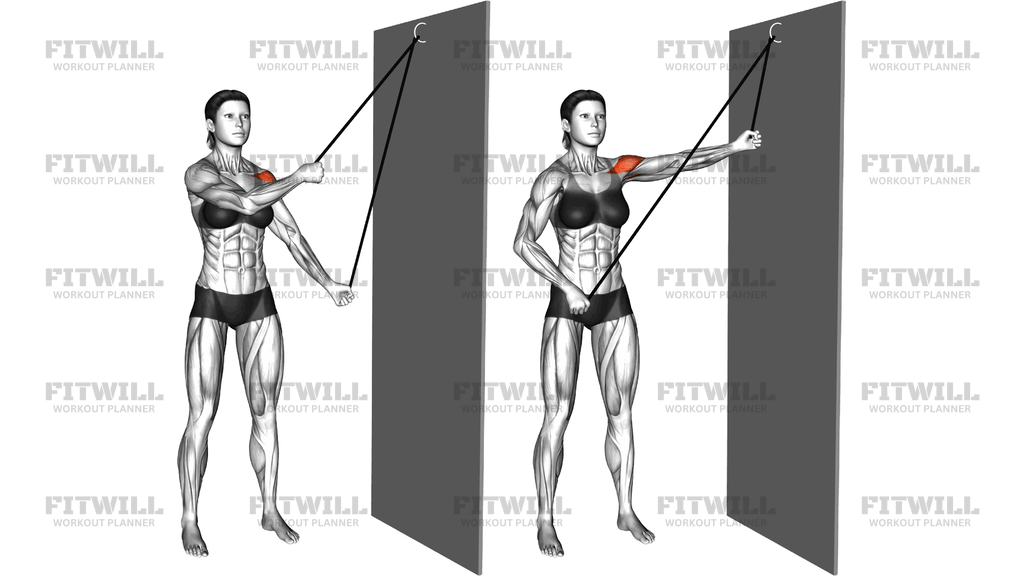
Standing Assisted Abduction With Rope is a self-assisted shoulder exercise where you anchor a rope or elastic band high behind you and sweep one arm from across your body out to the side and up. The free hand holds the rope lower down, which lets you dial in how much help the working arm gets on each rep. That built-in assistance is what makes this movement stand out from a standard lateral raise: you can guide the arm through its full arc even when the shoulder feels sticky or weak at certain angles.
The main muscle at work is the side deltoid, the cap of muscle on the outer shoulder that lifts the arm away from the body. The front deltoid and the supraspinatus, a small rotator cuff muscle that starts the lift, contribute along the way, and the muscles around the shoulder blade work to keep the joint stable as the arm travels. Because the resistance comes from an anchored line behind you rather than a weight in your hand, the tension stays smooth and joint-friendly through the whole range.
This is a useful drill for people rebuilding overhead comfort after a layoff, lifters who struggle at the bottom of a lateral raise, and anyone who wants a controlled way to train shoulder abduction without loading the joint heavily. It also works well as a warm-up before pressing or as a finisher when the shoulders are already fatigued but you still want quality reps.
Setup matters more here than in most shoulder exercises. The anchor needs to be high and behind you, your stance needs to be stable, and the working hand needs to start with the arm drawn across the body so the rope is taut before you begin. If the anchor is too low or you stand too far away, the rope either goes slack or yanks the arm into a path the shoulder does not like.
To execute it well, think of the movement as an arc, not a pull. Lead with the elbow slightly, sweep the arm out and up until it is level with or just above the shoulder, and let the assisting hand take just enough tension off that the working arm never stalls or jerks. Lower the arm back across the body under control, keeping contact with the rope the entire time so there is no free fall at the bottom.
Stay in a pain-free range and keep the motion smooth. If you feel pinching at the top, stop a little lower, and if the rope slackens mid-rep, step slightly farther from the anchor or re-grip with the assisting hand. This exercise rewards patience and clean reps far more than speed or heavy tension.
[ Workout Log & Planner ]
Put your next workout in Fitwill
Keep your plan and training log ready when you are.


Instructions
- Anchor the rope or band securely at a high point behind you, roughly above head height, and check that it cannot slip during the set.
- Stand facing away from the anchor with feet about hip-width apart and a soft bend in the knees, positioned so the rope hangs taut when your working arm is drawn across your body.
- Grip the rope with your working hand so the arm starts adducted, reaching across the front of your body toward the opposite hip or waist.
- Take hold of the rope lower down with your free hand at hip or thigh level; this grip is your assistance, and squeezing it reduces the load the working arm has to overcome.
- Brace your core, keep your ribs stacked over your pelvis, and relax the shoulder of the working arm away from your ear before you start.
- Exhale and sweep the arm out to the side and upward in a wide arc, leading with the elbow and keeping the elbow slightly soft, until the arm is level with or just above the shoulder.
- Pause briefly at the top with the rope still taut, then inhale and lower the arm back across the body over two to three seconds.
- Keep the assisting hand gripping the rope through the entire rep so the tension never drops to zero or spikes unexpectedly.
- Complete all reps on one side, re-grip if your hand position drifts, then switch sides and match the rep count.
- Release the rope from the working hand first, then let the assisting hand follow, and step away from the anchor only after the rope has gone slack.
Tips & Tricks
- The most common mistake is turning this into a shrug: if the working shoulder creeps toward the ear as the arm rises, drop the end range an inch or two and keep the shoulder blade settled.
- Do not let the assisting hand yank the rope; its job is steady, mild support, so a constant grip pressure works better than sharp pulls that bounce the arm through the sticking point.
- If the rope goes slack at the start of the rep, you are standing too far forward relative to the anchor; shift your position until the line is taut with the arm across your body.
- Avoid locking the elbow dead straight. A slightly soft elbow keeps tension on the shoulder muscles instead of stressing the joint at the top of the arc.
- Keep the torso quiet. Rocking the trunk to fling the arm upward usually means the assistance grip is doing too little or the tension is set too high for the current rep range.
- Keep the palm facing down or slightly inward as the arm rises. Twisting the wrist aggressively mid-arc changes the shoulder path and can cause discomfort.
- Slow the lowering phase down before adding any tension. Most people rush the return and lose the benefit of the bottom half of the movement, where the shoulder is weakest.
- If one side is noticeably weaker, start with that side and match the reps with the stronger arm rather than letting the strong side set the standard.
- Warm the shoulder up with a few easy circles or band pull-aparts first; going straight into abduction from a cold start is where most shoulder twinges happen.
Frequently Asked Questions
Which muscles does Standing Assisted Abduction With Rope work?
The side deltoid on the outer shoulder does most of the lifting, with the front deltoid and the supraspinatus assisting through the early part of the arc. Muscles around the shoulder blade stabilize throughout.
Why does the free hand hold the rope during Standing Assisted Abduction With Rope?
That lower grip is the assistance mechanism. Squeezing and holding it takes a controlled amount of tension off the working arm, which is what makes this a self-assisted version of a shoulder abduction.
How high should the anchor be for Standing Assisted Abduction With Rope?
Anchor it high, above head height and behind you, so the rope is taut when your working arm is drawn across your body. If the anchor sits low, the resistance angle changes and the arm gets pulled in an awkward path.
Is Standing Assisted Abduction With Rope good for beginners?
Yes, because the assisting hand lets you scale the difficulty rep by rep. Beginners should start with light tension, a short range, and slow tempo before chasing a higher end position.
Can I replace dumbbell lateral raises with Standing Assisted Abduction With Rope?
It trains the same abduction pattern, but the feel is different because the resistance pulls from behind rather than straight down. It works well as a complement or a low-stress substitute, though heavy dumbbell work has its own place.
What should I do if I feel a pinch at the top of Standing Assisted Abduction With Rope?
Stop the arc slightly below the pinch point and keep the reps smooth there. Persistent pinching is a signal to reduce tension, check your shoulder position, and consult a professional if it does not settle.
How many reps should I do of Standing Assisted Abduction With Rope?
Because it is a self-assisted, joint-friendly movement, moderate reps in the 10 to 15 range per side work well for most people. Higher reps with light tension also suit warm-ups.
Why does my rope go slack during Standing Assisted Abduction With Rope?
You are most likely standing too far from the anchor line or drifting the arm forward instead of out to the side. Reset your stance so the rope stays taut from the crossed-body start to the top of the arc.
Should I do both sides in Standing Assisted Abduction With Rope?
Yes, train both sides and match the reps, starting with your weaker or stiffer side. The single-arm setup means you simply turn around or switch hands to work the other shoulder.
How do I breathe during Standing Assisted Abduction With Rope?
Exhale as the arm sweeps out and up, then inhale during the controlled return. Holding your breath usually shows up as trunk tension and a jerky arc.