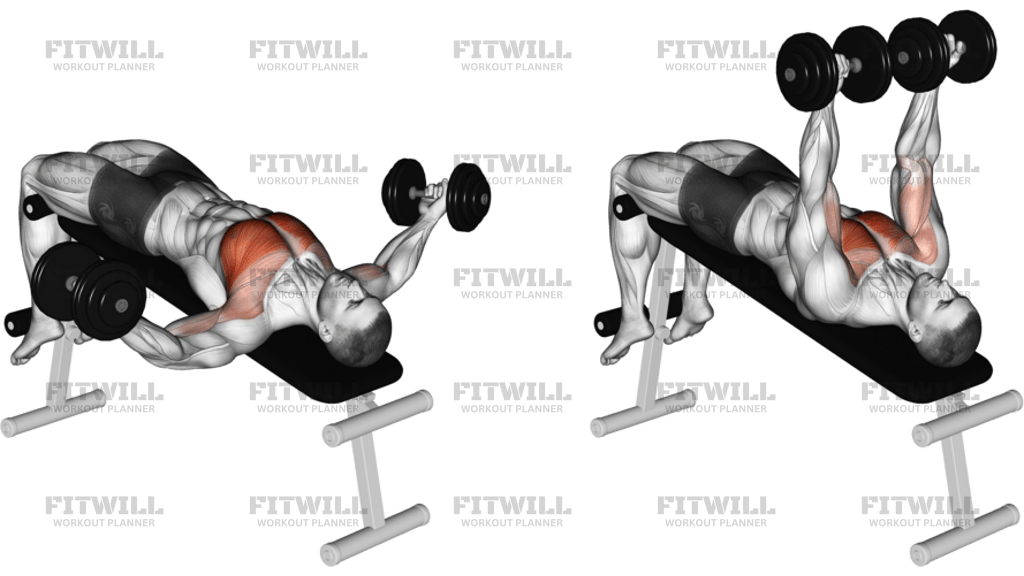
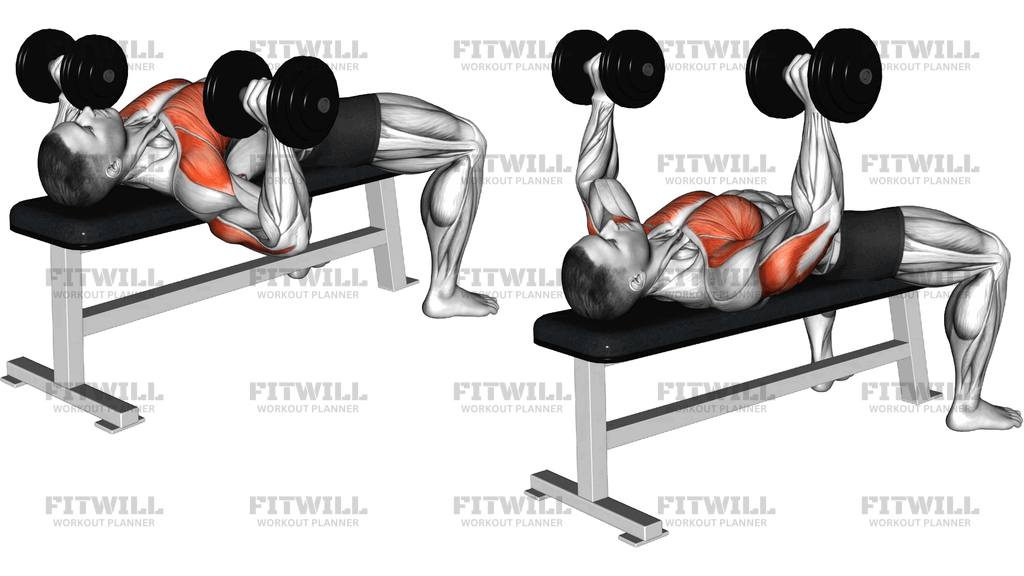
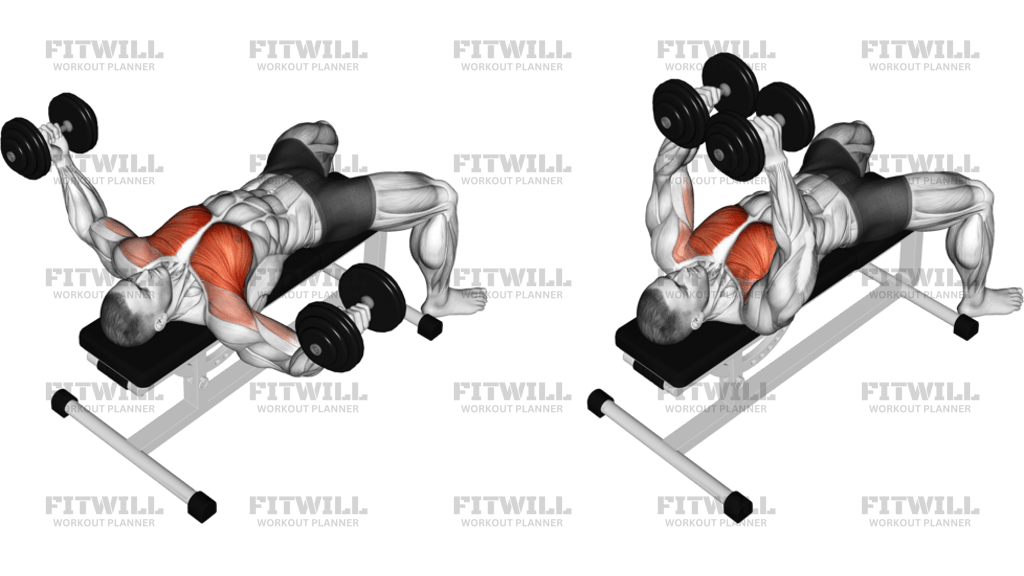
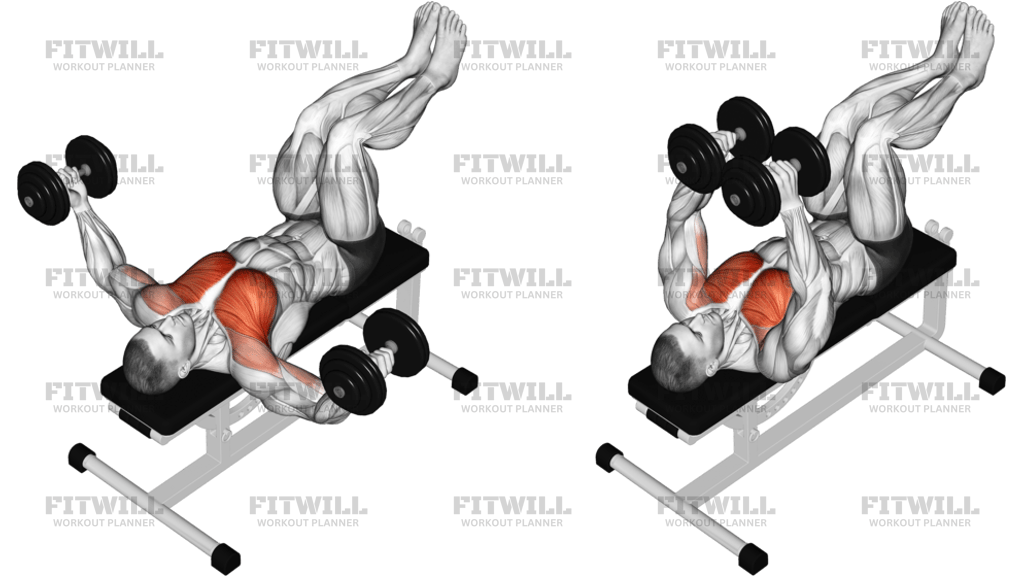
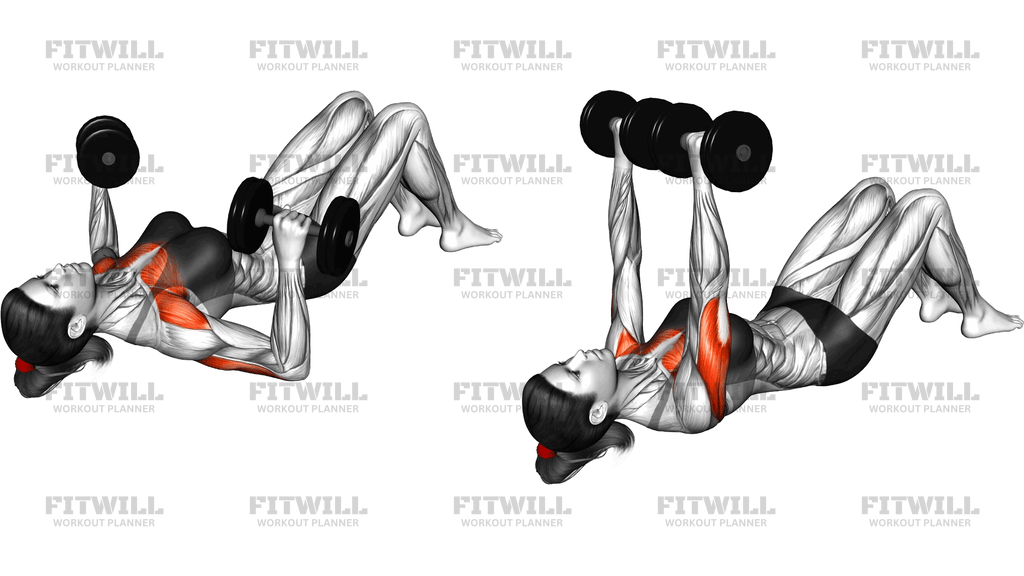
Dumbbell Lying Fly On Floor
The Dumbbell Lying Fly On Floor is a chest isolation exercise performed flat on the ground with a dumbbell in each hand. You start with your arms extended straight above your chest, then lower the weights out to the sides in a wide arc until your upper arms gently touch or near the floor, before squeezing the dumbbells back together over your chest. Because there is no bench behind you, the floor acts as a natural stopping point for the descent, which removes most of the stretch-end range strain that some lifters feel at the shoulder during bench flyes.
This movement primarily trains the pectorals, with the sternal or lower-middle portion of the chest doing the majority of the work as the arms sweep inward. The front delts assist throughout, and the biceps and triceps work statically to hold the fixed elbow angle. Your core and hip stabilizers are quietly engaged the whole time since you are bracing on the floor with bent knees rather than resting on a padded bench.
The floor-based setup makes this a particularly good choice for beginners learning the fly pattern, home lifters who train without a bench, and anyone whose shoulders dislike deep bench-fly stretch positions. It also works well as a finishing movement after presses when the chest is pre-fatigued and heavy loads are no longer needed. Working from the floor limits how far the dumbbells can drop, so it is one of the safest ways to load the chest in a wide arc.
Setup matters more than most people expect. Lie flat with your knees bent and feet planted, press your low back comfortably toward the floor, and keep the elbows bent at roughly the same soft angle from the first inch of the descent to the last inch of the return. If that elbow angle changes into a press, you turn the fly into a half press and lose the isolation. The dumbbells should travel in a smooth horizontal arc, not dip toward your hips or drift behind your head.
Execution comes down to controlled tempo and feeling the chest pull the weights together rather than throwing them. Lower over two to three seconds, let the backs of your upper arms lightly meet the floor, pause just long enough to own the position, then sweep the dumbbells up as if hugging a barrel. Keep the wrists firm and stacked over the elbows at the top, exhale as you close, and avoid clanging the dumbbells together.
The main safety points are simple. Choose lighter dumbbells than you would press, because flyes have poor leverage and heavy weights tend to drag the shoulder joint into bad positions. Keep the descent within a comfortable shoulder range, and if you cannot get the dumbbells off the floor at the end of a set, lower them to your chest, sit up with them, and set them down rather than rolling them awkwardly to the sides.
[ Workout Log & Planner ]
Put your next workout in Fitwill
Keep your plan and training log ready when you are.


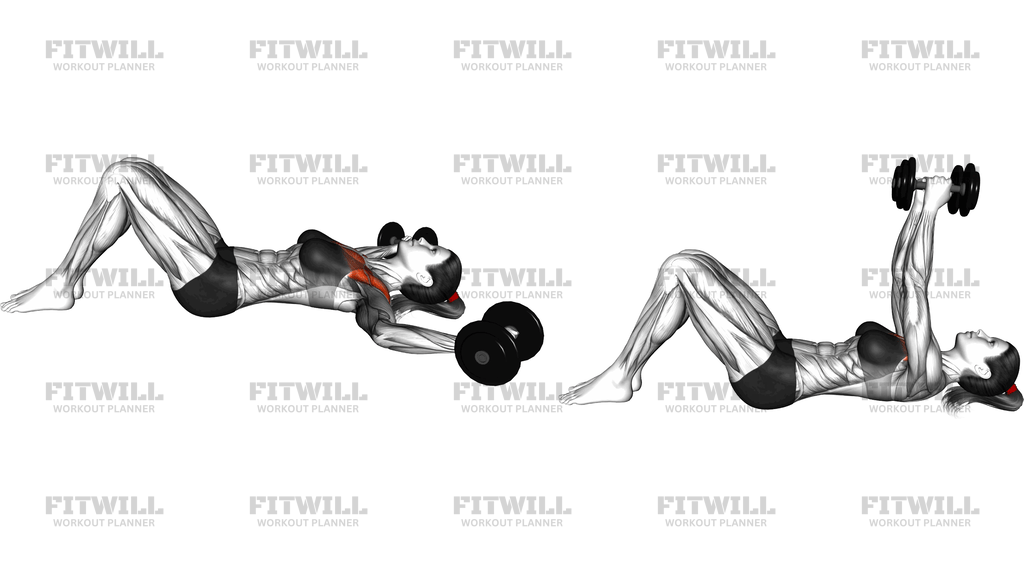
Instructions
- Sit on the floor with a dumbbell in each hand resting on your thighs, then lie back onto the floor or a mat, letting the dumbbells come up with you as you bend your knees and plant your feet flat.
- Press the dumbbells straight up over your chest with your palms facing each other, leaving a soft bend in each elbow that you will hold for the entire set.
- Draw your shoulder blades gently down and back so your upper back stays settled on the floor, and brace your core lightly with your low back close to neutral.
- Inhale, then slowly open your arms out to the sides in a wide arc, keeping the elbow bend fixed and imagining your hands tracing a big semicircle away from your chest.
- Stop when the backs of your upper arms lightly touch or just graze the floor, and do not let the dumbbells sink lower or bounce off the ground.
- Pause for a beat in the stretched position, feeling the chest under gentle tension without letting the shoulders roll forward.
- Exhale and sweep the dumbbells back up along the same arc, driving the motion from your chest as if pulling your elbows toward each other over your body.
- Finish each rep with the dumbbells nearly touching over your chest, wrists stacked over your elbows, without clanging the weights together.
- Keep breathing in a steady rhythm: inhale as the arms open, exhale as they close, and reset your shoulder position between reps if it drifts.
- To finish the set, lower the dumbbells to your chest, bend your elbows, and rock up to sitting before placing them on the floor beside you.
Tips & Tricks
- Pick a weight noticeably lighter than what you would use for a floor press; flye leverage is poor, and heavy dumbbells usually pull the elbows open into a press instead of an arc.
- The most common mistake on the floor is bouncing the upper arms off the ground to launch the next rep. Let the arms kiss the floor and pull the weights up under muscular control instead.
- If your elbows straighten as the dumbbells lower, you have drifted from a fly into a pressing angle. Cue yourself to hold the same small elbow bend from top to bottom, as if cradling a ball in each arm.
- Watch that the dumbbells do not travel back over your face or forehead as you fatigue. Keep the arc centered over the chest so a missed rep cannot come down on your head.
- Bend your knees and plant your feet firmly instead of lying with straight legs. This keeps your low back comfortable and stops your ribs from flaring up as the arms open.
- If your shoulders pinch at the bottom, stop the descent an inch or two above the floor rather than forcing contact. The floor fly still trains the chest well with a slightly shortened range.
- Squeeze for a half second when the dumbbells meet over your chest rather than rushing the top. That pause is where most of the chest contraction quality comes from in this exercise.
- Avoid letting your shoulder blades ride up toward your ears as the arms lower. Keep them pinned down and wide so the chest, not the traps, does the work.
- Set the dumbbells down by first lowering them to your chest and sitting up with momentum. Dropping them straight out to the sides from the stretched position is rough on the shoulders and hard on your floor.
Frequently Asked Questions
What muscles does the Dumbbell Lying Fly On Floor work?
The pectorals, especially the sternal or mid-lower chest, do most of the work as the arms sweep inward. The front delts assist, and the biceps and triceps hold the elbow angle statically throughout.
Why do this fly on the floor instead of on a bench?
The floor acts as a built-in depth stop, so your upper arms cannot sink far below torso level. That makes the stretch position easier on the shoulder joint and lets beginners learn the arc without a bench.
How much should my elbows bend during the Dumbbell Lying Fly On Floor?
Use a small, fixed bend of roughly 10 to 20 degrees and hold it through the whole set. Straightening the elbows strains them at the bottom, and bending more turns the movement into a press.
Is it okay if my upper arms do not touch the floor at the bottom?
Yes. Lower only until you feel a comfortable stretch across the chest; stopping an inch above the floor is a fine range if your shoulders feel pinched at full depth.
How heavy should the dumbbells be for this exercise?
Start lighter than you would for a floor press, since flyes have poor leverage and the chest works alone here. A weight you can control for 10 to 15 smooth reps is a good starting point.
What is the most common mistake with the Dumbbell Lying Fly On Floor?
Bouncing the upper arms off the floor and turning the fly into a half press by opening the elbow angle. Both habits steal work from the chest, so slow the descent and keep the elbows soft and fixed.
Can beginners do the Dumbbell Lying Fly On Floor?
It is one of the best beginner chest isolation exercises because the floor limits the range and no bench is needed. Begin with very light dumbbells to groove the arc before adding load.
What can I use if I do not have dumbbells?
A resistance band looped around your back and held in each hands works for a similar arc, though tension increases toward the top instead of the bottom. Cable flyes on a low pulley are another good substitute.
How do I get the dumbbells into position and back down safely?
Hold them on your thighs as you lie back, then kick them up over your chest one at a time. To finish, lower them to your chest, rock up to sitting, and place them on the floor beside you rather than dropping them at your sides.
Where should the dumbbells travel during the rep?
Keep the arc centered over your chest the entire time, from directly above the mid-chest at the top to out beside your shoulders at the bottom. Drifting over the face or hips shifts stress away from the chest and can be unsafe if a rep fails.