Bodyweight Squat Overhead Press
The Bodyweight Squat Overhead Press is a compound movement that links two fundamental patterns—squatting and vertical pressing—into one continuous rep. You start standing with your fists raised to shoulder height, drop into a controlled squat, and as you drive back up you extend your arms straight overhead, finishing tall with your hands reaching toward the ceiling. Because no equipment is needed, it works anywhere: your living room, a hotel room, or a warm-up area at the gym.
This movement earns its place in a program because it trains the whole body under a single coordinated effort. The quads and glutes handle most of the work during the squat, the shoulders and triceps drive the press, and your core has to stay braced the entire time to transfer force from the ground through your hands. When those pieces work together, you get a conditioning effect that isolated exercises cannot match, which is why it shows up so often in circuit training, warm-ups, and general strength work.
Setup matters more than people expect. Your stance should be about shoulder-width with toes turned out slightly, and your fists start at shoulder height with elbows tucked under them rather than flared wide. That position lets you press in a straight vertical line as you stand, instead of pushing the arms forward and losing the overhead path. Feet flat, weight spread across the whole foot, and ribs stacked over the pelvis set you up for every rep that follows.
To execute it well, think of the press and the stand as one action. Sink into the squat until your thighs are at least parallel to the floor or as deep as your mobility allows, keep your chest up and heels down, then drive the floor away. As your hips and knees extend, punch both fists toward the ceiling until your arms are fully extended overhead and your body is tall. Lower the arms back to shoulder height as you sink into the next squat, keeping the transition smooth rather than jerky.
Most people benefit from this exercise in fat-loss circuits, home workouts with no equipment, or as a movement primer before heavier lower-body lifting. It is also a smart choice for beginners learning to coordinate the upper and lower body, and for anyone who sits a lot and needs to reintroduce full-range overhead reaching. Start with two to three sets of eight to twelve reps and adjust from there.
A few safety points are worth repeating. Never let your lower back arch excessively as you press overhead—brace your abs like you are about to be lightly tapped in the stomach. Keep your knees tracking over your toes rather than collapsing inward, and if shoulder mobility limits your overhead reach, press slightly forward of vertical rather than forcing a straight line that strains the joint.
[ Workout Log & Planner ]
Put your next workout in Fitwill
Keep your plan and training log ready when you are.


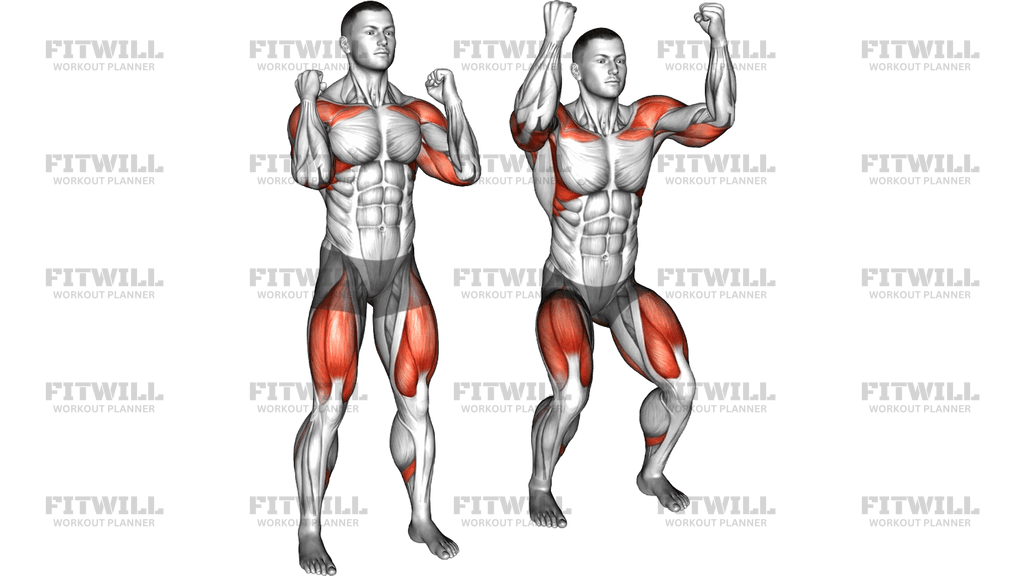
Instructions
- Stand with your feet about shoulder-width apart, toes turned out slightly, and your weight spread evenly across both feet.
- Raise both fists to shoulder height with palms facing forward and elbows bent, tucked directly beneath your fists.
- Brace your core by tightening your abs and pulling your ribs down so your lower back is not already arched before you move.
- Push your hips back and bend your knees to lower into a squat, keeping your chest up, heels flat, and knees tracking over your toes.
- Descend until your thighs are at or near parallel with the floor, or as deep as you can go without your lower back rounding or heels lifting.
- Drive through the floor to stand, pressing both fists straight up overhead as your hips and knees extend.
- Finish the rep standing tall with arms fully extended overhead, biceps beside your ears, without leaning back.
- Lower your arms back to shoulder height in a controlled way as you begin sinking into the next squat.
- Exhale as you stand and press, inhale as you lower into the squat.
- Complete your set, then shake out your shoulders and reset your stance before the next set.
Tips & Tricks
- If your arms drift forward during the press, the elbows started too wide—reset them directly under the fists so the hands travel vertically.
- Lower back arching at the top of the press usually means the core went slack; stop the press at the height where you can keep your ribs stacked over your hips.
- Heels lifting out of the squat points to limited ankle mobility—widen your stance slightly and turn your toes out a few more degrees before reducing depth.
- Knees caving inward on the way up is a common fault; cue yourself to spread the floor with your feet as you stand.
- Do not rush the transition between squat and press—the value of this movement comes from coordinating the two, not from bouncing through reps.
- Keep your fists at shoulder height during the squat rather than letting them drop, so you are ready to press the moment you start standing.
- If your shoulders cannot reach a straight overhead position, press slightly in front of your head instead of forcing your biceps against your ears.
- Breathe in a rhythm—holding your breath through both the squat and press fatigues you faster and stiffens your shoulders.
- Film yourself from the side once: check that your torso stays upright in the squat and your arms finish in line with your ears, not out in front.
Frequently Asked Questions
What muscles does the Bodyweight Squat Overhead Press work?
The quads and glutes do the bulk of the squatting work, while the front shoulders and triceps handle the overhead press. Your core stays active throughout to link the lower and upper body.
Is the Bodyweight Squat Overhead Press good for beginners?
Yes, it is an excellent beginner movement because the load is your own body and the pattern teaches coordination between squatting and pressing. Start with a shallower squat and focus on a smooth press before chasing depth or reps.
Where should my fists start in the Bodyweight Squat Overhead Press?
Start with your fists at shoulder height, palms facing forward, and elbows bent directly beneath them. This lets you press straight up as you stand instead of pushing your arms forward.
Why does my lower back arch when I press overhead?
That usually happens when the core relaxes and the torso leans back to finish the press. Tighten your abs before each rep and stop the press at a height where your ribs stay stacked over your hips.
Can I do the Bodyweight Squat Overhead Press every day?
Because the resistance is light, most people recover quickly and can perform it several times a week. Still, if your legs or shoulders feel sore, take a day off or reduce the volume.
What can I use instead of the Bodyweight Squat Overhead Press at home?
Alternating squat-to-press reps with dumbbells or a light household object works the same pattern with more load. A plain squat paired with separate presses is a simpler substitute if coordination is the limiting factor.
How deep should I squat during the Bodyweight Squat Overhead Press?
Aim for thighs at or near parallel as long as your heels stay flat and your lower back does not round. Depth you cannot control adds risk without adding benefit.
Should I press at the same time as I stand, or press after standing up?
Press as you stand so the two actions flow together—this is what makes the exercise a full-body movement. Pressing only after standing turns it into two separate exercises and reduces the coordination demand.
My shoulders feel tight when my arms go overhead—should I stop?
Reduce the range and press slightly in front of vertical rather than directly over your head. If you feel pinching or sharp pain rather than simple tightness, stop the overhead portion and work on shoulder mobility first.
How many reps of the Bodyweight Squat Overhead Press should I do?
Two to three sets of eight to twelve controlled reps is a solid starting point for strength and coordination. For conditioning circuits, lighter-effort sets of fifteen to twenty reps work well.