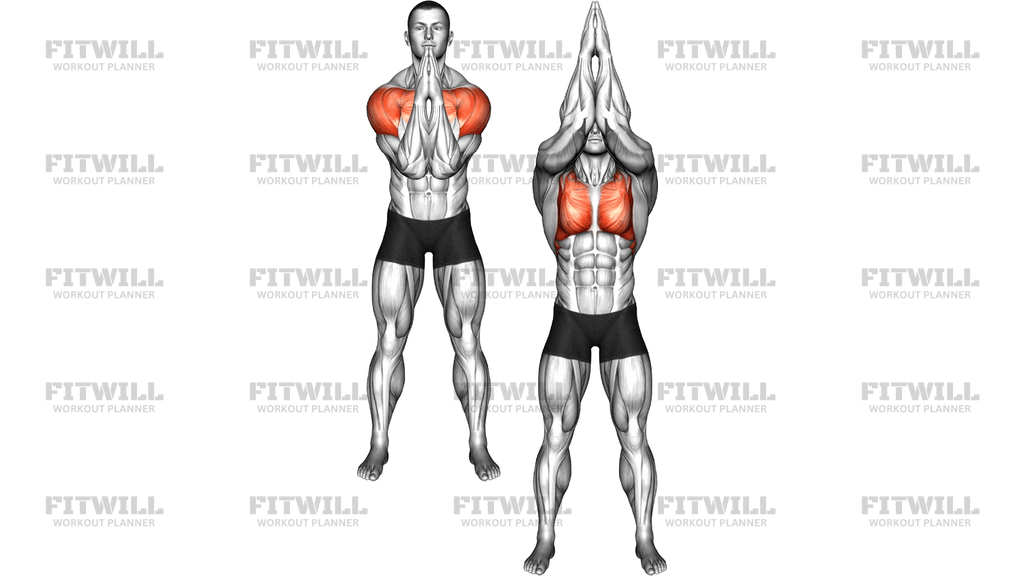
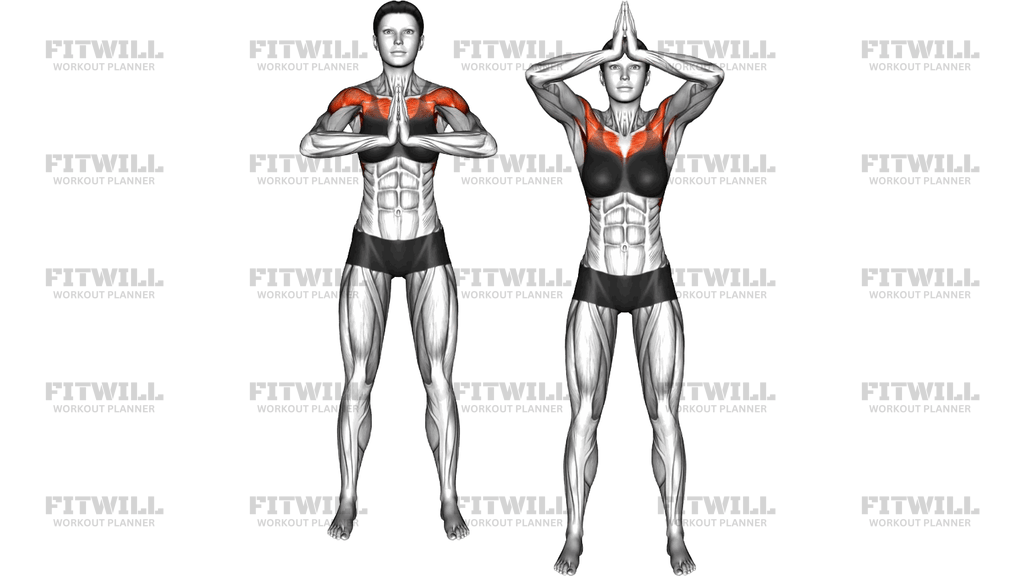
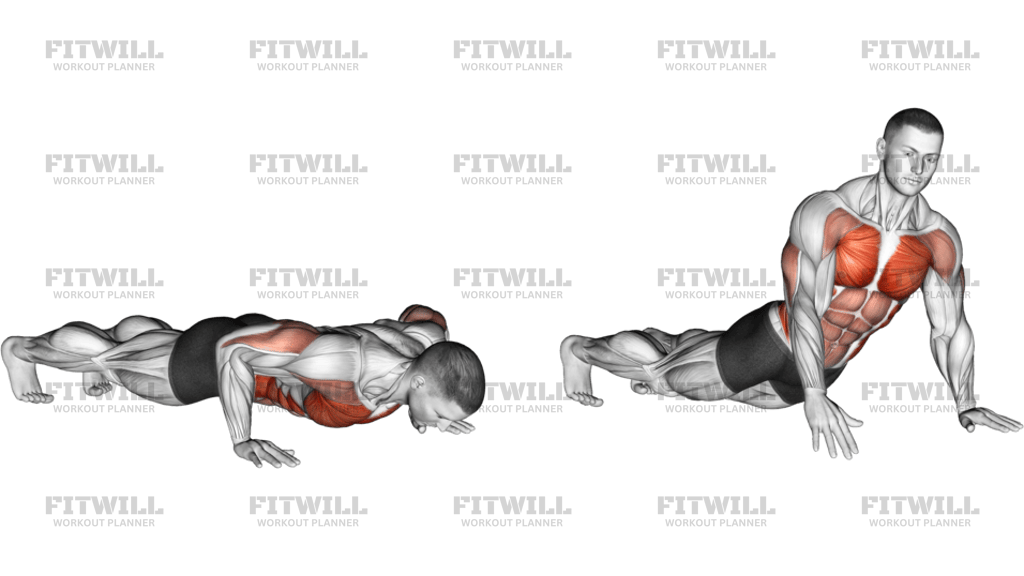
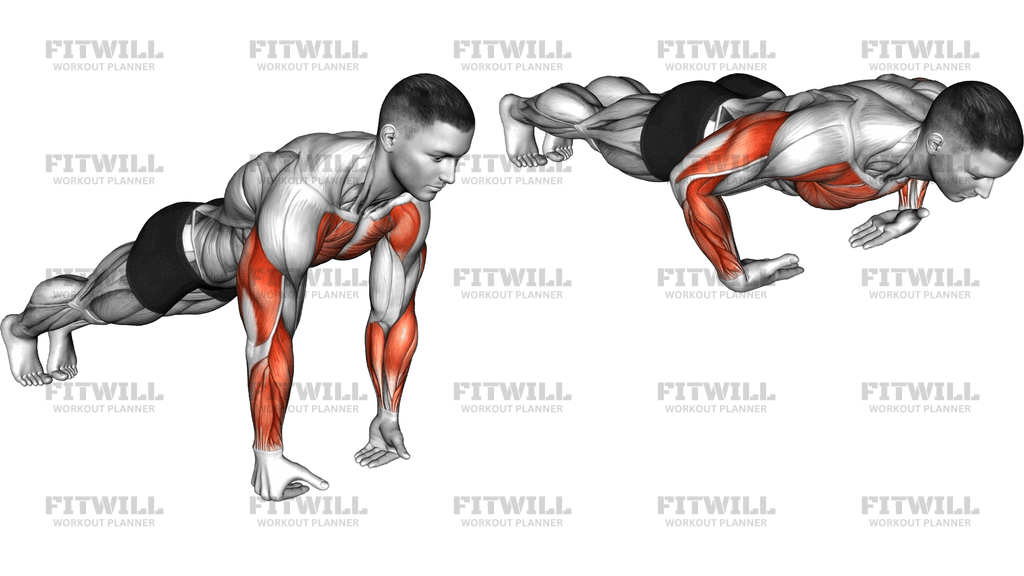
Walking Chest Push On Spot
The Walking Chest Push On Spot is a standing, full-body rhythm drill where you march in place while alternately driving each fist forward at chest height, as if you were shoving a heavy sled or pushing through a series of swinging doors. Nothing moves except you: no equipment, no travel distance, just your own legs, arms, and trunk working against each other in a coordinated push-and-step pattern. It looks simple, but when you match the arm drive to the opposite knee lift and keep the pressure strong through each push, it quickly raises your heart rate and lights up the front of your upper body.
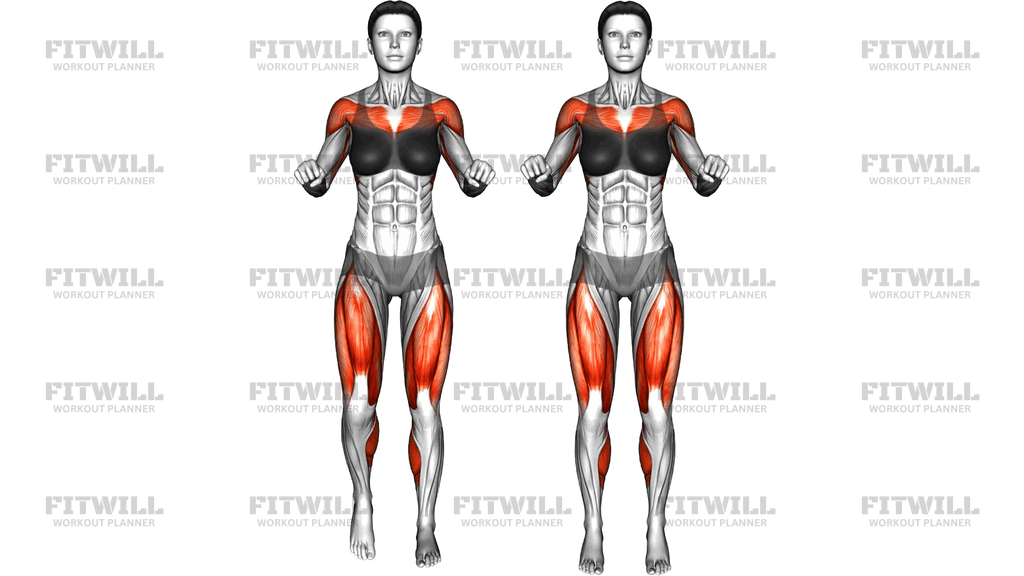
Because it combines marching with forceful horizontal pushing, this movement trains several systems at once. The chest and front shoulders do the bulk of the pressing work, the triceps extend the arm at the end of each push, and the core stiffens to stop your torso from twisting every time one arm fires forward. Meanwhile the quads, hips, and calves handle the continuous on-the-spot stepping, which is what turns a simple press drill into a conditioning exercise.
This is a great choice for warm-ups, low-impact cardio circuits, home workouts with no equipment, and sport preparation. Athletes in pushing sports — rugby, football, wrestling, basketball — use drills like this to groove the hip-and-arm coordination of driving forward, while general exercisers use it to elevate the heart rate without jumping or joint impact. Because you stay in one spot, it works well in small spaces and can be scaled up or down just by changing your pace and push intensity.
Setup matters more than it appears to. Stand tall with feet roughly hip-width apart, elbows bent and fists held up beside your chest, not down by your hips. If your fists start low, each push becomes a floppy arm swing instead of a genuine chest-driven press. Keep your ribs stacked over your pelvis and brace your midsection lightly so the pressing force transfers through your trunk instead of leaking into a sway or twist.
Execution is about opposition and intent. As your left knee lifts, drive your right fist forward at chest height with real effort, then swap instantly — right knee up, left fist forward. Your hands should travel straight out and straight back, not arc across your body. The knees stay moderate in height; this is a march, not a high-knee sprint, unless you deliberately turn it into one.
The most common faults are shrugged shoulders, hands drifting upward or crossing midline, leaning back as the pace rises, and letting the push turn into a lazy swing. Keep the push crisp and horizontal, shoulders relaxed and down, and shorten the march stride if your torso starts rocking. Breathe steadily throughout rather than holding your breath, and stop the set as soon as your rhythm breaks down — quality of the push pattern is the whole point of the exercise.
[ Workout Log & Planner ]
Put your next workout in Fitwill
Keep your plan and training log ready when you are.


Instructions
- Stand tall with your feet about hip-width apart, toes facing forward, and soften your knees slightly so you are ready to step.
- Bend both elbows to about 90 degrees and hold your loose fists up at chest height, just in front of your ribs, with shoulders relaxed and down.
- Brace your midsection lightly and keep your ribs stacked over your hips so your torso stays quiet as your arms start moving.
- Lift your left knee to a comfortable march height while simultaneously driving your right fist straight forward at chest level, pressing with intent as if shoving a heavy object away.
- Pull your right hand straight back to your ribs as you set your left foot down, and immediately lift your right knee while punching your left fist forward.
- Continue this contralateral march-and-push cycle on the spot, keeping the hands traveling horizontally at chest height and the knees lifting rhythmically.
- Inhale and exhale steadily through the nose and mouth as you go — do not hold your breath as the pace increases.
- Maintain an upright posture; if you feel yourself leaning back or rocking, slow the tempo and reduce the knee height.
- Work for a set time, such as 20-40 seconds, or a set number of pushes per side, then stop with both feet together and both fists back at your chest.
- Reset your posture and brace before starting the next set, making sure your first push of each set is as deliberate as the last.
Tips & Tricks
- Think "push the wall away," not "swing the arms" — the chest should feel like it initiates each press, with the elbow and wrist simply following through.
- If your shoulders creep up toward your ears as you fatigue, drop your pace and consciously pull your shoulder blades down before resuming.
- Watch that your pushing hand stays at sternum height; hands drifting up to face level turns the push into a shoulder raise and loses the chest emphasis.
- If your torso twists with every push, imagine a string pulling the crown of your head to the ceiling and reduce how far forward you press.
- Match the hand to the opposite knee — right fist with left knee — because same-side stepping breaks the natural driving rhythm and makes the drill feel awkward.
- Keep the wrist firm but not clenched at the end of each push; a soft wrist on a hard press is a common cause of forearm fatigue.
- Progress by adding time first, then tempo, and only then knee height — adding all three at once usually collapses the marching rhythm.
- On a soft floor or thin shoes, stay on the balls of your feet lightly rather than stomping your heels; the march should be quiet and controlled.
- Use this as a warm-up finisher before pressing exercises — a short set pre-activates the chest and front shoulders without fatiguing them.
Frequently Asked Questions
What muscles does the Walking Chest Push On Spot work?
The chest and front shoulders drive each push, with the triceps extending the arm, while the core stabilizes the torso against rotation. The quads, hips, and calves work continuously from the on-the-spot marching.
Is the Walking Chest Push On Spot a strength exercise or a cardio exercise?
It sits in between — the pressing action is muscular, but the continuous march makes it primarily a low-impact conditioning drill. Most people use it for warm-ups, cardio circuits, and active recovery rather than maximal strength work.
Can beginners do the Walking Chest Push On Spot?
Yes, and it is actually a good beginner drill because there is no equipment and no impact. Start with a slow tempo, short 15-20 second sets, and low knee lifts until the opposite hand-and-knee rhythm feels natural.
Why do I push with the opposite hand and knee instead of the same side?
Opposite hand and knee mirrors natural gait and athletic driving patterns, letting the core resist rotation more efficiently. Same-side movement forces the torso to twist and makes the drill feel clumsy and less stable.
How high should my hands be during the push?
Keep your fists traveling at sternum or chest height, straight out and straight back. Pushing up toward your face shifts the work into the shoulders and turns the movement into an arm swing rather than a chest press.
My lower back gets tight during this exercise — what am I doing wrong?
You are most likely leaning back as the pace rises or letting your ribs flare while your core relaxes. Slow down, shorten the march, and re-brace your midsection so your trunk stays stacked over your hips.
What can I substitute if marching in place is uncomfortable for my knees?
You can perform the same alternating chest pushes while standing still with your feet planted, or seated on a sturdy bench. You lose some of the leg and conditioning benefit but keep the chest, shoulder, and core work.
How long should a set of Walking Chest Push On Spot last?
For a warm-up, 20-30 seconds at a moderate tempo is enough. For conditioning, work in 30-45 second intervals and rest until your breathing settles before repeating.
Do I need to push hard, or is a light press enough?
A deliberate, forceful push is what recruits the chest properly — a limp arm swing barely challenges the upper body. That said, keep the effort crisp rather than tense; your face, neck, and hands should stay reasonably relaxed.
Is the Walking Chest Push On Spot safe to do every day?
Yes, it is a low-impact, body-weight movement and is gentle on the joints when performed with an upright posture and controlled tempo. As with any repeated drill, vary the duration and intensity so your muscles and foot tissues get easier days.