Stick Standing Torso Twist
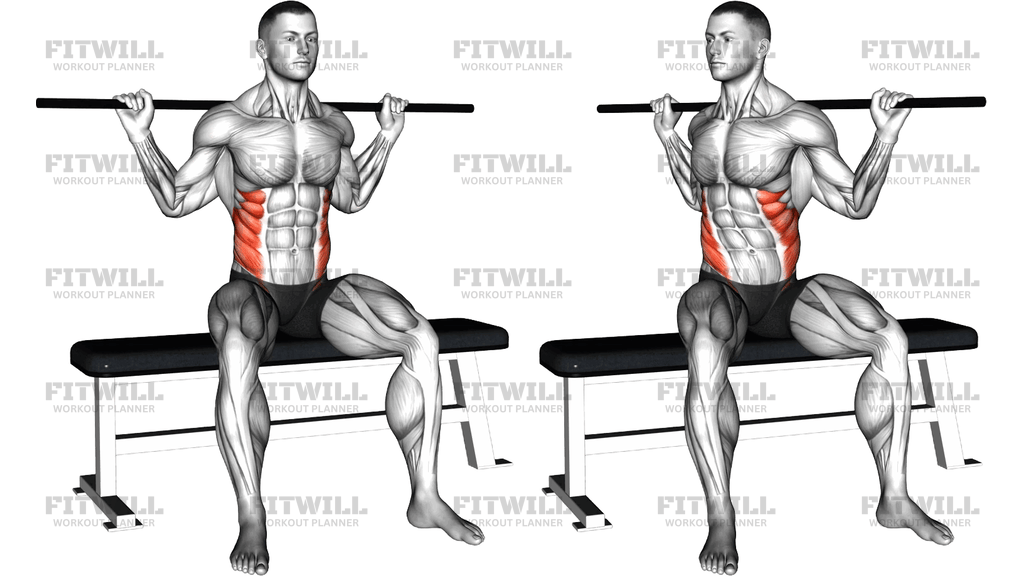
The Stick Standing Torso Twist is a simple rotational drill where you rest a light stick or bar across the back of your shoulders, stand with feet wider than hip width, and sweep your torso from side to side in a controlled arc. Because the stick sits across the traps rather than in front of the chest, it locks your shoulder line in place and makes any cheating obvious — if the bar starts tilting or drifting, you know your hips are trying to do the work instead of your waist.
The main target is the obliques on both sides of your trunk, supported by the rectus abdominis and the deeper core muscles that brace your spine through every turn. Your lower back works isometrically to keep you tall, and your legs stay quietly engaged to hold a stable base. This is rotation without load, so the emphasis is on range, control, and rhythm rather than force.
This movement suits a lot of situations. It works well as a warm-up before squats, deadlifts, or any throwing and swinging sport, since it gently takes the trunk through rotation before heavier work. It is also a friendly starting point for beginners who want to train the waist without equipment beyond a broomstick, and a useful reset for people who sit all day and feel stiff through the midsection.
Setup matters more than it looks. The stick should rest across the rear deltoids and upper traps with a relaxed overhand grip on the ends, elbows pointing down rather than flared to the ceiling. Stand tall, feet roughly shoulder-width to slightly wider, knees soft, and ribs stacked over hips. If you arch back or push the hips forward, the twist turns into a lumbar-hinge mess instead of a clean trunk rotation.
To execute it well, exhale as you twist to one side, turning from the waist while your hips stay facing forward, pause briefly at your end range, then rotate through the middle to the opposite side without bouncing. Keep the movement smooth and continuous, as if the stick were drawing a slow arc across the room. Speed kills this drill — the moment you swing, momentum takes over and the obliques stop doing the job.
A practical note on safety: keep the rotation coming from the trunk with the spine tall, and never whip the neck or shoulders around with the bar. If you feel any sharp sensation in the lower back, shorten the range and slow down. The Stick Standing Torso Twist rewards consistency and control, not reps done fast.
[ Workout Log & Planner ]
Put your next workout in Fitwill
Keep your plan and training log ready when you are.


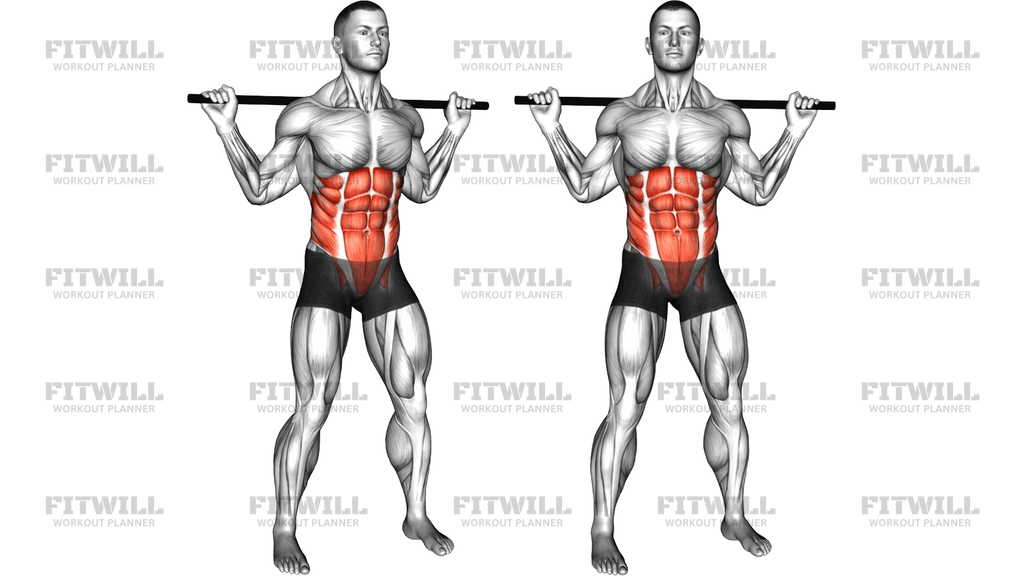
Instructions
- Stand with feet about shoulder-width apart or slightly wider, toes turned out a few degrees, knees soft.
- Place a light stick across the back of your shoulders and upper traps, holding each end with an overhand grip, elbows pointing down toward the floor.
- Stand tall, lift your chest, and brace your core lightly as if preparing to be tapped in the stomach.
- Keeping your hips facing forward, rotate your torso to the right as far as you can control, letting your head and eyes travel with the turn.
- Pause for a moment at the end of the rotation, feeling the work on the opposite side of your waist.
- Rotate back through the center and continue to the left side in one smooth, controlled arc.
- Keep the stick level with the floor throughout — if one end dips, your torso is leaning instead of twisting.
- Breathe steadily: exhale as you twist into each turn, inhale as you come back through the middle.
- Complete your repetitions alternating sides, then step the stick forward off your shoulders and reset your stance before the next set.
Tips & Tricks
- Think about turning from the ribs and waist, not from the hips — your pelvis should stay square to the front for the drill to load the obliques properly.
- If the stick tilts toward one end, you are side-bending instead of rotating; correct it by imagining the bar sliding along a flat tabletop.
- Avoid letting the lower back arch as you turn. Ribs stacked over hips keeps the rotation in the trunk instead of dumping stress into the lumbar spine.
- Slow the tempo down before adding range. A twist that takes two to three seconds each way does far more for the waist than fast swinging.
- Keep your grip relaxed. Squeezing the stick hard transfers tension into the shoulders and neck, which defeats the purpose of a trunk drill.
- If your shoulders feel pinched with the stick behind the neck, widen your grip slightly or rest the bar higher on the top of the traps.
- Use this before heavy lower-body or overhead training as a warm-up, keeping the reps modest so you prime rotation without fatiguing the core.
- Never yank the end range by bouncing. If you cannot pause at the turn, you have found your honest range — work there and let it expand gradually.
- Soft knees matter more than they seem; locked legs with a stiff spine turn this into an awkward full-body twist instead of a controlled trunk rotation.
Frequently Asked Questions
What muscles does the Stick Standing Torso Twist work?
The obliques on both sides of the waist are the primary movers, with the rectus abdominis and deeper core muscles assisting to control the turn. The lower back and legs work statically to keep you upright and stable.
Why is the stick held behind the shoulders instead of in front of the chest?
Resting the stick across the upper back fixes your shoulder line and makes tilting or leaning immediately visible. It also prevents your arms from doing the twisting, so the rotation has to come from your trunk.
Is the Stick Standing Torso Twist good for beginners?
Yes. It uses no load beyond the stick itself, the range is self-determined, and the feedback from the bar is immediate. Beginners should start with a short range and slower tempo before turning further.
Should my hips move during the twist?
Ideally the hips stay facing forward so the rotation comes from the waist. Some natural movement is fine as range improves, but if the pelvis swings with every rep, the obliques stop being challenged.
How many reps should I do?
One alternating twist to each side counts as one rep. Ten to twenty controlled reps work well as a warm-up, while two to three sets of fifteen or more can serve as light standalone core work.
Can I use a barbell instead of a stick?
It is not recommended. Even an empty barbell adds meaningful load to a rotating spine, and the goal here is controlled movement, not resistance. A broomstick, dowel, or PVC pipe is the right tool.
Is it normal to feel this in the lower back?
A mild working sensation in the lower back is normal since it stabilizes through every turn. Sharp or pinching discomfort is not — reduce your range, keep the ribs down, and slow the tempo.
What is the most common mistake with this exercise?
Swinging fast and letting the hips spin with the torso. This turns a waist drill into momentum-driven flailing. Fix it by pausing at each end range and keeping the pelvis square to the front.
Can I do the Stick Standing Torso Twist every day?
For most people yes, since it is a light, unloaded rotation drill. It fits naturally into a daily warm-up or desk-break routine, as long as it stays pain-free and controlled.