Long Lever Standing Hip Extension
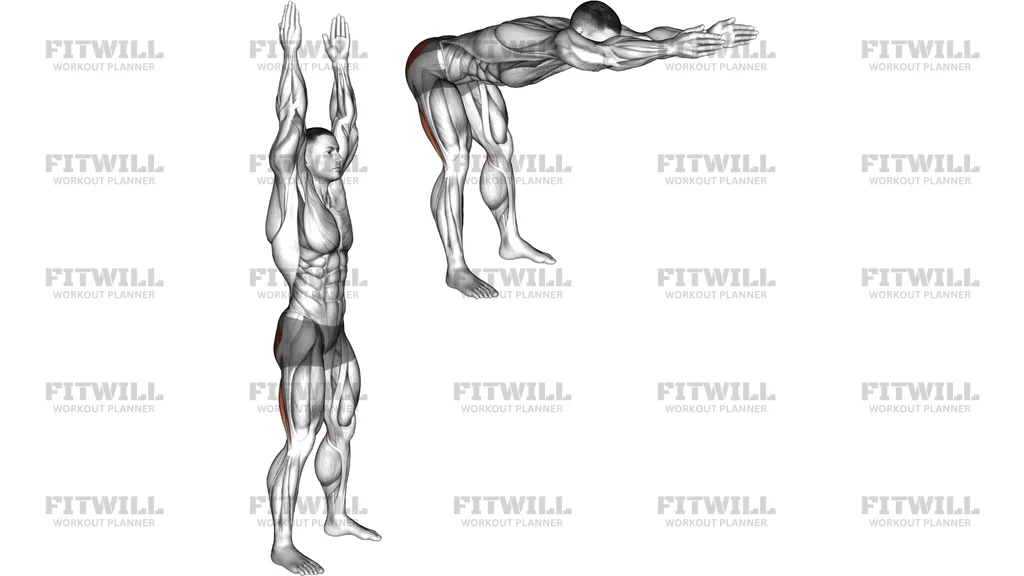
The Long Lever Standing Hip Extension is a bodyweight hinge performed on one leg with the arms extended straight overhead. That overhead arm position is what makes the lever long: with your hands far from your hips, every degree of forward fold asks more from your glutes, hamstrings, and trunk to keep the torso and lifted leg moving as one connected line. From a tall stand, you hinge forward over your standing leg while the free leg reaches back behind you, then drive through the floor to return upright.
The main work comes from the glutes and hamstrings of the standing leg, which control the fold and power the return. The glute of the moving leg holds the rear leg in extension against gravity, while the muscles of the lower back and deep core fight to keep your spine from rounding as the long lever pulls you forward. Because the load is your own body positioned away from the hip joint, the demand is surprisingly high even though no external weight is involved.
Setup is where this exercise is won or lost. Your standing foot should be planted firmly with weight spread across the whole foot, and your arms locked out overhead before you start the hinge. If the arms drift forward or the elbows bend mid-rep, the lever shortens and the exercise quietly becomes easier. Keep a soft knee on the standing leg, about a ten to fifteen percent bend, so the hip can travel back freely without the knee taking over the movement.
To execute it, brace your midsection, shift your weight into the standing foot, and push your hips back as your torso lowers and your free leg lifts behind you. Move until your torso, arms, and rear leg approach one long, roughly horizontal line, like the position shown in the movement, then squeeze the standing glute and press the floor away to stand back up tall with the arms finishing overhead. The return should take as long as the descent; falling forward and bouncing up is the most common way people cheat this drill.
This exercise fits well as a warm-up primer before deadlifts, squats, or sprint work, as a balance and hip-hinge teaching tool for beginners, or as a high-rep glute finisher when no equipment is available. It also carries over directly to single-leg strength patterns, since the balance demand exposes side-to-side differences that two-legged hinges tend to hide.
Move within a range you can control with a flat back and a quiet, stable standing foot. If your back rounds, your hips twist, or you wobble excessively, shorten the range rather than forcing the horizontal position. Perform all reps on one side before switching, and stop the set when your balance, not just your muscles, starts to break down.
[ Workout Log & Planner ]
Put your next workout in Fitwill
Keep your plan and training log ready when you are.


Instructions
- Stand tall with your feet hip-width apart and your arms extended straight overhead, elbows locked and biceps beside your ears.
- Shift your weight fully onto one leg, spread your toes for grip, and let the other foot hover just off the floor.
- Brace your abs and pull your ribs down slightly so your lower back is set before any movement begins.
- Keep a small, fixed bend in your standing knee throughout the set.
- Push your hips back and fold forward over the standing leg while your free leg extends straight behind you, keeping both hips square to the floor.
- Lower until your torso, arms, and rear leg form one long line close to horizontal, arms reaching forward and rear leg reaching back.
- Pause briefly at the bottom and feel the stretch across the hamstring of your standing leg.
- Squeeze the standing glute and press through the middle of your foot to return to a tall stand, arms finishing overhead.
- Exhale on the way up and inhale as you hinge down, keeping the breath steady rather than holding it.
- Complete all reps on one side, re-ground your floating foot between reps if needed, then switch legs.
Tips & Tricks
- If your back rounds near the bottom, stop a few degrees short of horizontal; a shorter range with a flat back trains more than a deep fold with a rounded spine.
- Watch for the arms collapsing forward mid-rep. Once the elbows bend or the hands drop toward your head, the long lever is gone and the drill loses most of its difficulty.
- If the rear leg drops toward the floor, think about actively reaching it back and up rather than letting it trail passively; the moving-side glute holds that position.
- Hips that rotate open toward the lifted leg are a common fault. Point both hip bones at the floor and imagine your rear toes facing down, not out.
- If you wobble badly, fix your eyes on a fixed point on the floor about a meter ahead of you and slow the descent; speed, not weakness, causes most balance failures here.
- Avoid bending the standing knee deeper as you fatigue. If the knee keeps sinking into a squat, the hinge has turned into a single-leg squat, which shifts work off the hamstrings and glutes.
- Hinge from the hip crease, not by rounding through the waist. Thinking push the hips back and reach the chest forward produces a better line than thinking bend down.
- Start with your rear foot lightly tapping the floor for balance on your first few sessions, then progress to holding it fully off the ground for every rep.
- Grip the floor with your standing foot and keep the big toe pressed down; balance problems at the ankle show up as twisting at the hip.
Frequently Asked Questions
Which muscles does the Long Lever Standing Hip Extension work?
The glutes and hamstrings of the standing leg do most of the work, while the glute of the lifted leg holds the leg in extension. Your lower back and core work hard to keep your torso stable under the long overhead lever.
Why are the arms overhead instead of at my sides in the Long Lever Standing Hip Extension?
The overhead arms lengthen the distance between your hands and your hips, which increases the leverage demand on your hips and trunk. The same hinge with arms hanging down is significantly easier.
Is the Long Lever Standing Hip Extension suitable for beginners?
Yes, but beginners should use a shorter range and may let the rear foot tap the floor for balance. Once a flat-back hinge feels natural, progress to the full horizontal position with the rear leg fully off the ground.
How far forward should I fold in the Long Lever Standing Hip Extension?
Aim for a position where your torso, arms, and rear leg approach one long line close to parallel with the floor. Stop short of that if your back starts to round or your hips twist.
Why do I keep losing my balance during the Long Lever Standing Hip Extension?
Balance usually fails because the movement is rushed or the standing foot is passive. Slow the descent, fix your gaze on a point on the floor ahead of you, and actively grip the ground with your whole foot.
Can I add weight to the Long Lever Standing Hip Extension?
It is rarely necessary, since the overhead arm position already creates a long lever. If you need more challenge, add a pause at the bottom or slow the tempo before reaching for external load.
What can I substitute for the Long Lever Standing Hip Extension?
A single-leg Romanian deadlift with hands free is the closest substitute, and a standard bodyweight good morning works if single-leg balance is a limiting factor. Both train the same hinge pattern with a shorter lever.
How many reps and sets of the Long Lever Standing Hip Extension should I do?
Two to four sets of 6 to 10 slow reps per side works well as a primer or accessory drill. Because balance is often the limiting factor, prioritize controlled reps over high volume.
Is it safe for my lower back?
The exercise is generally gentle on the back when the hinge comes from the hips and the spine stays long. If you feel strain in your lower back rather than a stretch in your hamstrings, reduce the range and recheck your setup before continuing.