Side Lying Reverse Clamshell
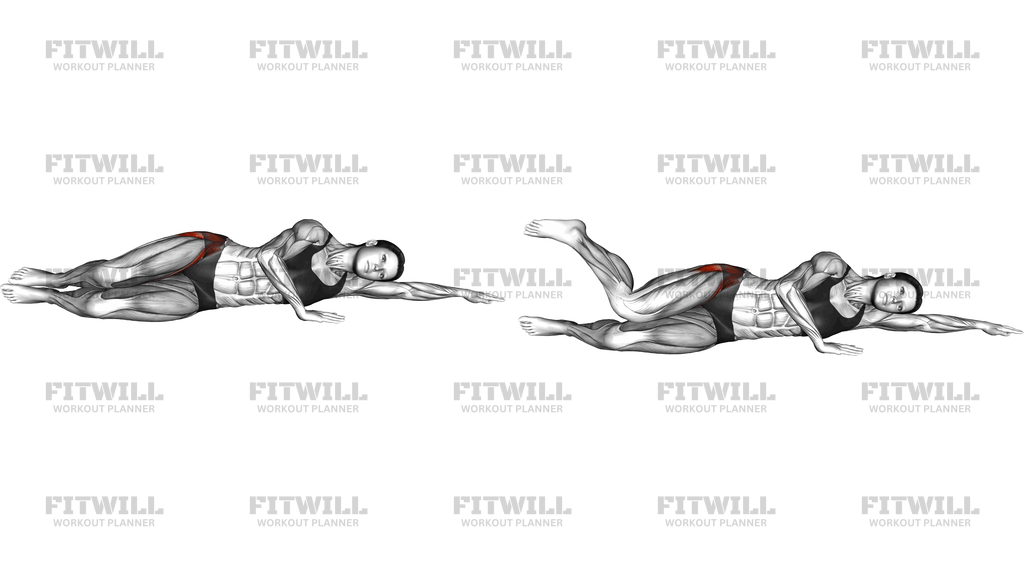
The Side Lying Reverse Clamshell is a bodyweight hip exercise performed from a side-lying position with the legs kept long and extended rather than bent, as they would be in a traditional clamshell. From this stacked position, the top leg lifts straight up toward the ceiling and lowers back down with control, driving the work through the side of the hip. The highlighted area of emphasis is the gluteus medius, the muscle on the outer hip that stabilizes your pelvis every time you stand, walk, or balance on one leg.
This variation is especially useful for people who want direct hip abduction work without heavy equipment. Runners, cyclists, and anyone who spends long hours sitting often develop weak or underactive gluteus medius muscles, which can show up as hips dropping side to side during walking or single-leg movements. Because the leg stays extended, the exercise places a longer lever arm on the hip, making the side hip muscles work harder than they would in the bent-knee version at the same range.
Setup matters more than most people expect. Your hips and shoulders should stay stacked vertically, neither rolling back nor tipping forward, and your head can rest on your extended bottom arm while the top hand braces the floor in front of your torso for balance. If the torso rotates during the lift, the hip muscles lose tension and the movement becomes a partial-body twist rather than targeted abduction work.
To execute the movement well, lift the top leg toward the ceiling only as far as you can keep the leg straight, the hips stacked, and the toes pointing forward rather than up. The lift itself is usually modest, often 30 to 45 degrees, and that is fine. The muscle is challenged most by slow, deliberate lowering, so resist gravity on the way down instead of letting the leg drop.
Common use cases include warm-ups before squats or runs, rehab-style programming for hip stability, and higher-rep glute finishers at home. It pairs naturally with traditional clamshells, side-lying leg raises, and side planks in a hip-focused routine.
Because no equipment is required beyond a comfortable floor surface, you can train both sides in a few minutes anywhere. Keep the reps moderate and controlled, aim to feel the work on the side of the hip rather than the front of the thigh, and stop short of the point where the lower back or top of the hip starts to pinch or compensate.
Fitwill
Log Workouts, Track Progress & Build Strength.
Achieve more with Fitwill: explore over 9600 exercises with images and videos, access built-in and custom workouts, perfect for both gym and home sessions, and see real results.
Start your journey. Download today!




Instructions
- Lie on your right side on an exercise mat with both legs extended straight and stacked, your body forming one long line from head to heels.
- Rest your head on your extended bottom arm and place your top hand flat on the floor in front of your torso to brace your balance.
- Draw your belly button gently in and tighten your core so your ribs and pelvis stay stacked; check that neither hip has rolled forward or back.
- Point the toes of both feet forward, keeping the top kneecap facing the same direction as the bottom kneecap.
- Exhale and lift the straight top leg toward the ceiling, leading with the heel and letting the movement come from the hip, not the waist.
- Stop the lift at the highest point where your hips remain stacked and your leg stays straight, usually around 30 to 45 degrees.
- Pause for a beat at the top and squeeze the side of the hip that is doing the lifting.
- Inhale and lower the leg slowly back to the stacked position, taking about two to three seconds so it does not fall or rest heavily on the bottom leg.
- Complete your repetitions, then roll over and repeat the full set on the left side.
Tips & Tricks
- If you feel the work in the front of the thigh or the hip flexor, your top hip is drifting forward; shift the whole body slightly back and lift within a smaller range.
- Do not let the toes rotate toward the ceiling as you lift. Turning the leg open recruits the front of the hip and reduces gluteus medius involvement, so keep the toes pointing forward throughout.
- A common mistake is hiking the waist to gain height, which shows up as a gap opening between your ribs and the floor. Brace the core and accept a shorter lift instead.
- Keep the bottom leg actively engaged by pressing it gently into the floor. A limp bottom leg lets the whole pelvis tilt and steals stability from the top-side hip.
- If your top hip flexor cramps, shorten the range slightly and move more slowly; cramping usually means the front of the hip is compensating for a sleepy outer hip.
- The reverse clamshell uses a long lever, so the leg feels heavier than in a bent-knee clamshell. Slow down or reduce the range rather than bending the knee to make it easier.
- Place a small cushion under your head if your neck strains from resting on your arm. A neutral neck keeps the focus on the hip.
- Do not let the top foot drift forward past the bottom foot. Aligning the legs directly on top of each other keeps the abduction path clean.
- For more challenge, add a light ankle weight or a resistance band looped just above the knees, but only once you can keep the hips perfectly stacked for a full set.
Frequently Asked Questions
What muscles does the Side Lying Reverse Clamshell work?
The primary muscle is the gluteus medius on the side of the hip, supported by the gluteus minimus, parts of the gluteus maximus, and the tensor fasciae latae. The core works isometrically to keep the torso from rolling.
How is the Side Lying Reverse Clamshell different from a regular clamshell?
In a regular clamshell the knees are bent about 45 degrees and you rotate the top knee open like a shell. In the reverse clamshell the legs stay extended and the straight top leg lifts toward the ceiling, creating a longer lever and greater demand on the outer hip.
Is the Side Lying Reverse Clamshell suitable for beginners?
Yes, it requires no equipment and the range of motion is naturally small. Beginners should focus on keeping the hips stacked and lifting slowly rather than chasing height.
How high should I lift my top leg in the Side Lying Reverse Clamshell?
Lift only as high as you can keep the leg straight and the hips stacked, which for most people is around 30 to 45 degrees. Going higher almost always causes the torso to roll backward and reduces the work on the target muscle.
Why do my hips roll backward during the exercise?
Rolling happens when the leg is too heavy for the outer hip to control, so the torso twists to help. Reduce the range, slow the tempo, and keep your top hand pressing lightly into the floor to stay anchored.
Can I do the Side Lying Reverse Clamshell every day?
Because it is a low-load activation exercise, it can be performed frequently, such as in daily warm-ups or before runs. Treat it like a mobility and activation drill rather than a heavy strength session.
What can I use instead of the Side Lying Reverse Clamshell if lying down is uncomfortable?
Standing hip abduction, side planks with a leg lift, or banded side steps train a similar hip abduction pattern. If lying on your side is the only issue, a standing cable or banded leg raise is the closest substitute.
Should I feel this in my lower back?
No, the work should sit in the side of the hip. If your lower back works or aches, your waist is hiking to lift the leg; brace your core, shrink the range, and reset with the hips stacked.
How many reps and sets of the Side Lying Reverse Clamshell should I do?
Two to three sets of 10 to 15 controlled reps per side is a solid starting point. Rest briefly between sides so the second set is performed with the same control as the first.
Is the Side Lying Reverse Clamshell safe if I have hip pain?
The movement is gentle, but any exercise that produces sharp or pinching pain should be stopped. Reduce the range or consult a qualified professional before continuing if discomfort persists.