Dumbbell Seated W Press
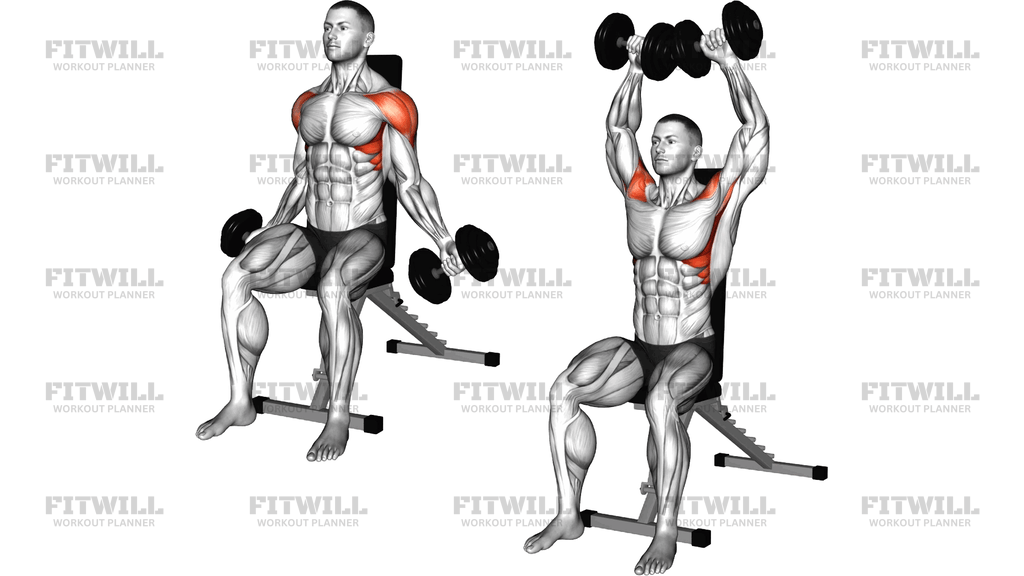
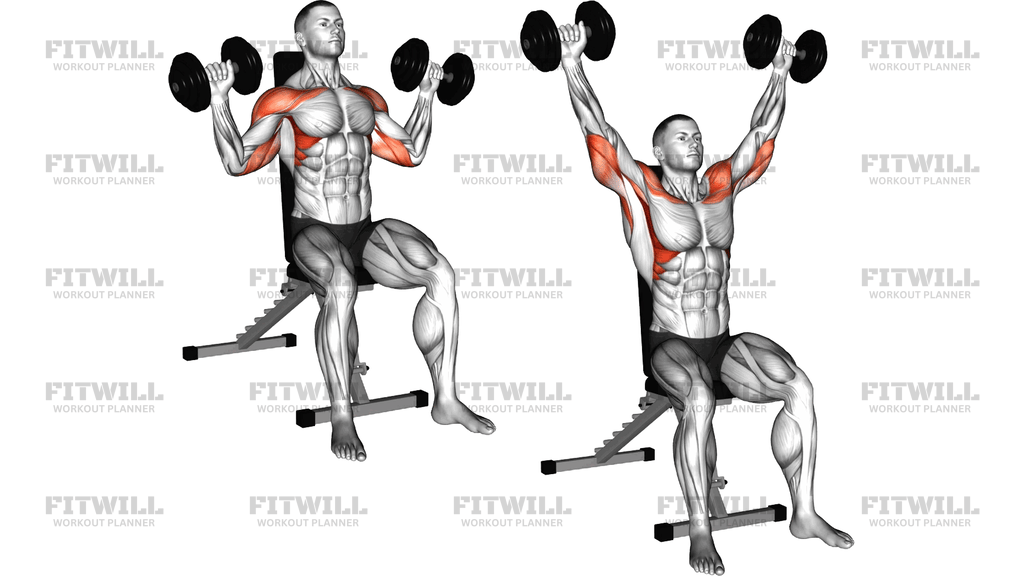
The Dumbbell Seated W Press is a shoulder press variation where your arms start in a W shape — elbows low and bent roughly 90 degrees, dumbbells held just outside each shoulder — and finish overhead in a wide V. Instead of pressing straight up alongside your head, the dumbbells travel up and slightly outward on a fixed diagonal path, which keeps your elbows wide the whole way. That outward angle shifts more of the work onto the side delts compared with a conventional neutral-grip or close-path press.
You perform it seated on a bench with back support, which is one of its main advantages. Sitting down removes the tendency to lean back and turn the movement into an incline chest press, so the shoulders have to do the lifting. It also makes the exercise approachable for lifters who find standing presses unstable, and the dumbbells let each arm work independently, so a stronger side can't quietly take over for a weaker one.
The primary muscles involved are the deltoids, with the side delts taking a large share because of the outward pressing angle, and the front delts assisting as the arms extend overhead. The triceps straighten the elbows at the top, the upper chest contributes when the dumbbells move slightly forward and out, and the upper traps help stabilize the shoulder girdle. Your upper back and core work isometrically to keep your torso upright and your shoulder blades controlled throughout each rep.
Setup matters more than people expect. The angle of the bench, the position of the dumbbells at your start, and where your wrists sit all determine whether the press feels smooth on the joints or pinchy at the top. Set the bench close to vertical or at a very slight incline, plant your feet flat on the floor, and bring the dumbbells up to shoulder height with your elbows tucked just in front of your ribs before you begin pressing. If the dumbbells drift too far behind your head or your elbows flare backward, you lose the clean W-to-V path that defines this press.
To execute it well, think of pushing the dumbbells up and out along a slight diagonal until your arms are extended in a wide V overhead, with the inner heads of the dumbbells nearly touching over the middle of your body or slightly wider. Control the descent along the same path back into the W. Because the arms end up wide, you don't need heavy weight — the leverage is longer than in a standard press, so the side delts get loaded hard with moderate dumbbells.
This press fits well as a main shoulder movement on upper-body days, as a variation after barbell or neutral-grip pressing, or as a hypertrophy-focused choice for lifters who want more side delt volume without doing endless lateral raises. It's also useful for people whose shoulders feel uncomfortable with the elbows pulled all the way forward at the bottom of a strict press, since the W starting position keeps the elbows lower and closer to the torso.
[ Workout Log & Planner ]
Put your next workout in Fitwill
Keep your plan and training log ready when you are.


Instructions
- Set an adjustable bench to vertical or a very slight incline so your back, shoulders, and head are fully supported, and sit with your feet flat on the floor about hip-width apart.
- Bring a dumbbell in each hand up to shoulder height, letting your elbows drop so they sit close to your ribs and slightly in front of your torso, with your palms facing forward and forearms roughly vertical — this is the W position.
- Pull your shoulder blades down and back, brace your core, and keep your lower back in contact with the bench pad rather than arching off it.
- Press both dumbbells up and slightly outward along a diagonal path, letting your elbows move out to the sides as you extend.
- Finish with your arms almost straight overhead in a wide V, dumbbells held slightly wider than your shoulders, wrists stacked over your elbows.
- Pause briefly at the top without clanging the dumbbells together or shrugging your shoulders up toward your ears.
- Lower the dumbbells under control along the same outward path, bending your elbows until they return to the low, tucked W position at shoulder height.
- Exhale as you press up, and inhale steadily as you lower the dumbbells back to the start.
- Complete your reps, then set the dumbbells down on the floor or a rack by hinging forward slightly at the hips — never just drop them from shoulder height.
Tips & Tricks
- The most common mistake is turning this into a standard press by pulling the dumbbells inward over your head. Keep the diagonal path so your arms actually reach the wide V at the top — that angle is what targets the side delts.
- If your shoulders pinch at the top, lower the weight slightly and check that your wrists are stacked over your elbows rather than drifting behind your head.
- Don't let your elbows collapse inward at the bottom. If your forearms tip toward your body, the W shape is lost and the press becomes a narrow chest-dominant movement.
- Because the wide path lengthens the lever, expect to use roughly 20 to 30 percent less weight than your normal seated dumbbell press. Chasing your regular press weight usually costs you the path.
- Keep your head neutral and your gaze forward. Craning your chin up to 'make room' for the dumbbells usually means the path is drifting too far behind you.
- Avoid driving the dumbbells up with a lower-back arch. If your ribs flare and your back peels off the bench, reduce the weight and re-brace before the next rep.
- Lower for two to three seconds on every rep. Rushing the eccentric is especially costly here because the side delts do a lot of their work controlling the outward path on the way down.
- If you struggle to get the dumbbells into the start position safely, use a slight knee kick or have a partner hand them to you rather than wrenching them up with a twisted torso.
- Full lockout with a hard squeeze isn't necessary — stop just short of jamming the elbows so tension stays on the shoulders instead of dumping into the joints.
Frequently Asked Questions
What muscles does the Dumbbell Seated W Press work?
It primarily targets the deltoids, with a strong emphasis on the side delts due to the wide V finishing position. The front delts, triceps, upper chest, and upper traps assist, while your upper back and core stabilize your torso against the bench.
How is the Dumbbell Seated W Press different from a regular seated dumbbell shoulder press?
In a standard press the dumbbells travel nearly straight up and finish close together over your head. In the W Press the dumbbells move up and outward on a diagonal, so you start in a W shape and finish in a wide V, which loads the side delts more and typically requires a lighter weight.
Why do I need to use lighter dumbbells for the W Press than my normal press?
The outward angle lengthens the lever arm between your shoulder and the dumbbell, which increases the torque your delts must handle. Trying to match your standard press weight usually forces the path inward and turns it back into a regular press.
Is the Dumbbell Seated W Press good for beginners?
Yes, provided the weight is modest. The bench support and fixed diagonal path make it easier to learn than a standing press, but beginners should master the W-to-V path with light dumbbells before adding load.
Where exactly should my elbows be at the start of each rep?
Your elbows should sit low and close to your ribs, slightly in front of your torso, with your forearms vertical and palms facing forward. That low, tucked position forms the W and sets up the outward pressing angle.
My lower back arches off the bench when I press — what should I fix?
That's usually a sign the weight is too heavy or your core isn't braced. Reduce the load, exhale as you press, and keep your ribs stacked over your hips so your lower back stays in contact with the pad.
Can I do this exercise standing instead of seated?
You can, but the seated version is the point of this variation. Standing removes back support and makes it much easier to lean back and cheat, which shifts work away from the shoulders and toward the chest and lower back.
What can I substitute if I don't have dumbbells?
A cable machine with two handles set at shoulder height works well, since the cables provide resistance along a similar outward diagonal. Light resistance bands anchored under your feet can also mimic the W-to-V path, though the resistance profile differs.
Should the dumbbells touch at the top of the press?
Not necessarily. In this variation the arms finish in a wide V, so the dumbbells typically stay outside shoulder width. Forcing them together at the top usually means you've pulled the path inward and lost the side-delt emphasis.
Is the W Press safe for people with cranky shoulders?
Many lifters with irritated shoulders find it more comfortable than a strict press because the elbows stay low and wide rather than driving deep forward at the bottom. Start with light weight and a shorter range, and stop if you feel sharp pain or pinching.