Dumbbell Bent Over Twisting Row
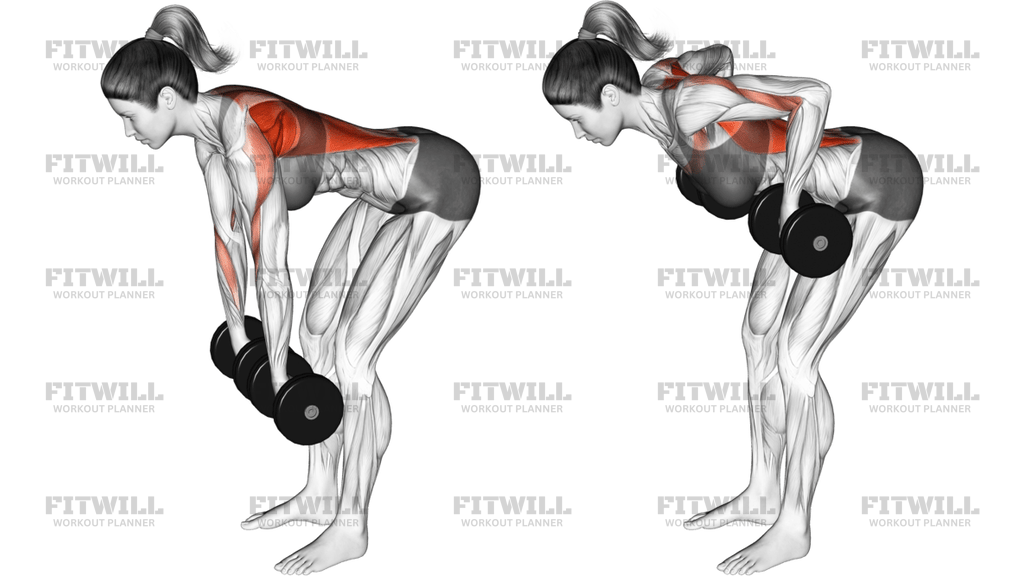
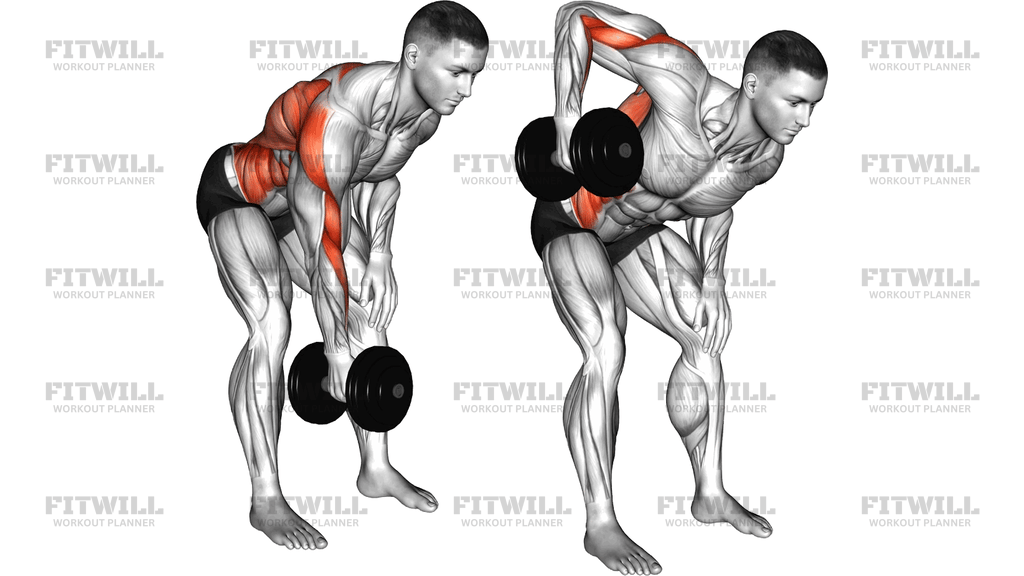
The Dumbbell Bent Over Twisting Row is a single-arm row variation performed from a bent-over stance where you deliberately rotate your torso toward the working side as you pull the dumbbell up. Instead of keeping your chest square and pulling straight up, the twist lets the working shoulder travel up and back, lengthening the lat through a slightly larger range and finishing with the upper back turned toward the ceiling. The free hand typically rests on the same-side thigh or knee for light support, and one dumbbell is all the equipment you need.
This movement works the lats, rhomboids, and mid-traps as the primary movers, with the rear shoulder and biceps assisting on the pull. What makes it different from a standard bent-over row is the rotation: as your trunk turns, the obliques and spinal stabilizers on both sides have to control the twisting forces, so you get meaningful trunk work on top of the pulling work. Because only one side is loaded at a time, each side of your back has to pull its own weight, which is useful for cleaning up left-right strength differences.
Setup matters here more than in most row variations. Your hinge position, foot stance, and where you brace the free hand all determine whether the twist comes from the upper back and trunk or whether it degrades into a sloppy torso swing. A solid hip hinge with soft knees, a braced trunk, and a flat back gives the row a stable base; without it, the rotation simply turns into momentum that your lower back absorbs.
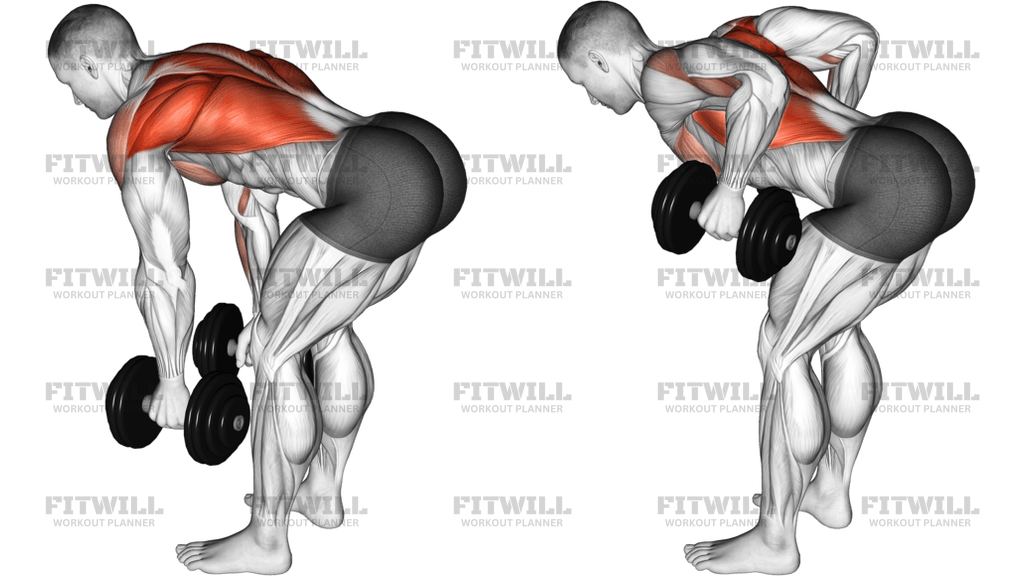
To execute it well, hinge forward until your torso is close to horizontal, let the dumbbell hang with your arm long, and think about driving the elbow up and back toward your hip while your chest rotates toward the loaded side. The dumbbell should finish somewhere near your ribs or hip, not dangling out in front of your shoulder. Lower it under control until the arm is fully extended again, letting the shoulder blade travel forward so the lat gets a real stretch at the bottom before the next rep.
This row suits lifters who want to add unilateral back volume without a bench, trainees dealing with grip or shoulder asymmetries, and anyone whose standard rows have stalled. Moderate weights and deliberate tempo usually produce better results than max loads, since heavy dumbbells tempt you to swing the torso and turn the twist into a yank. Keep the free-hand brace honest and let the pulling arm do the work.
[ Workout Log & Planner ]
Put your next workout in Fitwill
Keep your plan and training log ready when you are.


Instructions
- Stand with your feet about hip-width apart, hold one dumbbell in your right hand with a neutral grip, and let it hang at your side.
- Hinge forward at the hips, pushing them back and softening both knees until your torso is close to parallel with the floor; rest your left hand on your left thigh or knee for light support.
- Brace your abs and set your back flat and long, with your neck in line with your spine rather than craned up.
- From the hanging position, pull the dumbbell up toward your ribs by driving your elbow up and back, letting your trunk rotate to the right so your chest turns toward the ceiling.
- Finish the pull with the dumbbell near your hip or lower ribs, elbow drawn high behind your torso, and your upper back turned upward.
- Pause briefly at the top, feeling the lat and shoulder blade pull back, then lower the dumbbell under control along the same path until your arm is fully extended.
- Let the shoulder blade drift forward slightly at the bottom so the lat lengthens, then start the next rep from that full stretch.
- Exhale as you pull and rotate up, inhale as you lower the weight back down.
- Complete all repetitions on one side, stand up slowly, switch the dumbbell to your left hand, brace your right hand on your thigh, and repeat with the same tempo.
Tips & Tricks
- The rotation should come from your upper back and trunk turning as a unit; if your hips are swinging toward the dumbbell every rep, the twist has become momentum rather than muscle work.
- Keeping the free hand on the same-side thigh is support, not a crutch; if you find yourself pushing hard off the leg to heave the weight, drop to a lighter dumbbell.
- A common mistake is pulling the dumbbell out in front of the chest instead of toward the hip, which shifts work toward the front shoulder and away from the lat; aim the elbow back, not out to the side.
- If your lower back fatigues before your lat does, your hinge is too shallow or your weight is too heavy; deepen the hip bend slightly and reduce the load so the pull, not the torso, does the work.
- Avoid twisting the wrist at the top of the rep; the neutral grip should stay neutral while the trunk rotates, which keeps the shoulder in a friendlier position.
- Do not let the working shoulder shrug toward your ear as you pull; think shoulder blade down and back toward your spine instead of up toward the neck.
- Control the stretch at the bottom for a full second or two; letting the dumbbell drop out of the top position is where most reps are wasted on this exercise.
- Because you rotate toward the loaded side, the obliques on the opposite side work to control the turn; keep them tight so the trunk moves smoothly rather than collapsing.
- Swap the braced-hand side if you feel uneven pressure on your lower back from always standing the same way; the point is matching work, not matching a habit.
Frequently Asked Questions
What muscles does the Dumbbell Bent Over Twisting Row work?
The latissimus dorsi of the working arm is the main mover, supported by the rhomboids, mid-traps, and rear shoulder. The rotation also recruits the obliques and lower back muscles to control the turn.
Why rotate the torso during a bent-over row instead of keeping it square?
Rotating toward the working side lets the shoulder blade travel further and takes the elbow through a longer path, giving the lat a fuller stretch and contraction. It also adds trunk rotation control to an otherwise static position.
Is the Dumbbell Bent Over Twisting Row suitable for beginners?
It can be, as long as the weight is light and the hinge position is learned first. Beginners should start with a small range of rotation and only turn as much as they can control with a flat back.
Should I brace my free hand on my thigh or knee?
A light brace on the same-side thigh or knee steadies your torso and reduces lower back fatigue. Keep it supportive rather than forceful, or you will start levering yourself up with the leg.
How heavy should the dumbbell be for this row?
Choose a weight you can pull toward your hip without your hips swinging or your chest dropping. If the rotation is happening from momentum at the start of the rep, the dumbbell is too heavy.
What is the most common mistake with the Dumbbell Bent Over Twisting Row?
Turning it into a torso swing by yanking the dumbbell up and letting the hips rotate freely. Keep the hips set in the hinge and let only the upper trunk turn as the elbow drives back.
How far should I twist at the top of the pull?
Turn enough that your chest faces partly upward and the dumbbell finishes near your hip or lower ribs, but not so far that your knees and feet leave their stance. The rotation ends when your back position starts to change.
Can I do this exercise if a standard barbell row bothers my lower back?
Many lifters tolerate it better because the free-hand brace and lighter single-arm load reduce spinal demand. Still, set up with a solid hinge and moderate weight, and stop if you feel strain rather than muscular effort.
What can I use instead of a dumbbell for this row?
A kettlebell works well because the handle sits similarly, or you can use a cable handle for a smoother resistance curve. The key is a single-sided load that lets the torso rotate freely.
Should I do the Dumbbell Bent Over Twisting Row before or after heavier back exercises?
It usually works best after your main heavy pulls, where it can add targeted unilateral volume and rotation work with a moderate load. Doing it first while fresh makes it tempting to go heavy and lose control of the twist.