Standing Double Opposite Vertical Open And Double
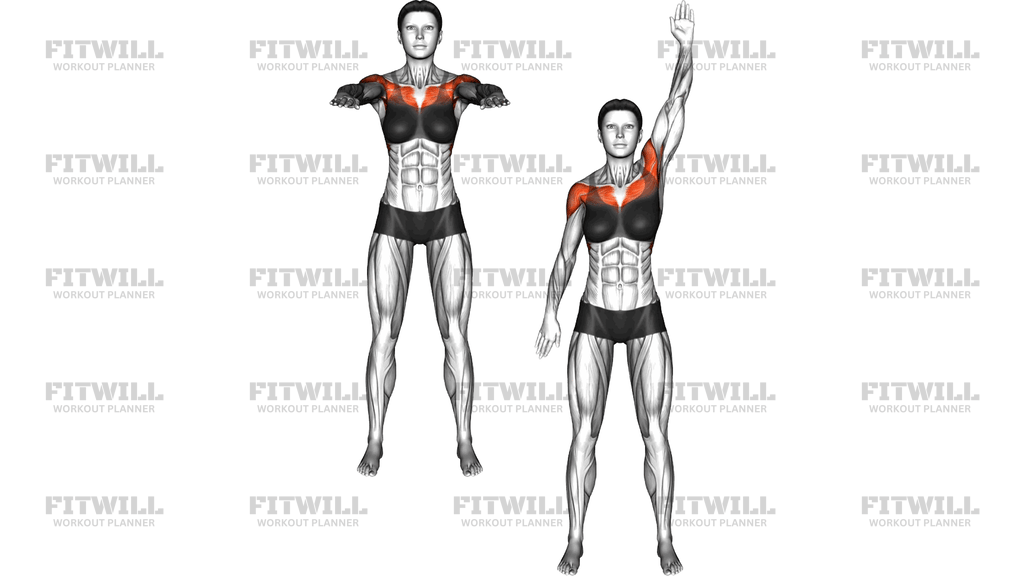
Standing Double Opposite Vertical Open And Double is a bodyweight shoulder drill performed from a tall standing position. You begin with both arms lifted straight out to your sides at shoulder height, then raise one arm vertically overhead while the other arm lowers toward your hip. The two arms trade positions in a continuous, scissor-like rhythm, passing each other at shoulder level on every repetition. The working muscles light up on both sides of the body at once, which is what makes the double opposite pattern distinct from a plain one-arm raise.
The main demand falls on the side shoulders, which lift and control the arm through the vertical arc. The upper traps assist as the arm travels overhead, the front shoulders help on the upward drive, and the muscles between the shoulder blades work to keep the shoulder girdle organized instead of letting it ride up toward your ears. Because you are standing with no external load, your core and postural muscles are quietly working the whole time to stop your torso from leaning or twisting as the arms switch.
This movement suits a wide range of people. Beginners can use it to learn what a proper overhead reach feels like without weight, and more experienced lifters often use it as a warm-up before pressing or as a high-rep finisher that flushes the shoulders with blood. It is also a practical option when you have no equipment available, since all you need is enough space to stand with your arms spread wide.
Setup matters more than it might seem for a simple-looking drill. Your feet, spine, and shoulder position determine whether the arms move cleanly through the vertical path or whether you start compensating with shrugs and back lean. Stand with feet about hip-width apart, weight spread evenly, ribs stacked over the pelvis, and eyes forward before the arms ever start moving.
To execute it well, keep the elbows straight but not locked, and think of the hands drawing long vertical lines rather than swinging forward or back. Each repetition should end with the working arm fully extended overhead and the opposite arm relaxed down by the hip, then the arms trade roles with a smooth, even tempo. Controlled speed is the whole point here; this is a coordination and control drill as much as a strength one.
The most common errors are shrugging the shoulders, arching the lower back to fake extra overhead range, and rushing the switch so the arms start swinging in arcs instead of tracking vertically. Slow the tempo down, keep the neck long, and let the shoulder do the lifting rather than momentum. If one side feels tighter or weaker, that asymmetry is useful information, and doing a couple of extra reps on the stiffer side is a reasonable way to address it over time.
[ Workout Log & Planner ]
Put your next workout in Fitwill
Keep your plan and training log ready when you are.


Instructions
- Stand with your feet about hip-width apart, toes pointing forward, and your weight spread evenly across both feet.
- Tighten your midsection slightly, draw your ribs down, and keep your gaze straight ahead so your head stays stacked over your spine.
- Raise both arms straight out to your sides until they are level with your shoulders, palms facing down, elbows straight but not locked. This is your starting position.
- Keeping both elbows extended, lift your right arm straight up overhead while simultaneously lowering your left arm down until it rests by your left hip.
- At the top, reach fully with the overhead arm so the shoulder is packed down rather than shrugged up toward the ear.
- Reverse the motion with control: bring the right arm back down to shoulder height as the left arm travels straight up overhead, the two hands passing at shoulder level.
- Continue alternating arms for the desired number of repetitions, keeping the hands tracking vertical lines in front of the shoulder line rather than swinging forward or behind you.
- Exhale as the arms switch positions and inhale as they briefly settle, keeping the breath steady rather than holding it.
- After your final rep, lower both arms back to your sides, take a breath, and reset your posture before starting the next set.
Tips & Tricks
- If you catch yourself shrugging as the arm reaches overhead, imagine pushing the floor away with your feet and lengthening your neck; the trap takes over very easily in this drill.
- Do not let the lower back arch when the arm goes overhead. If your ribs flare up, you are borrowing range from the spine instead of the shoulder, so reach slightly less far and keep the torso tall.
- The hands should pass each other at shoulder height, not in front of your chest. If they drift forward, slow down and picture two vertical rails running through each shoulder.
- Keep the palms facing down or slightly inward throughout. Rotating the palms to face forward changes the feel of the lift and usually pulls the shoulder into a shrug.
- A tempo of about two seconds per arm switch works well. Faster is not better here, because momentum hides the coordination the exercise is meant to build.
- If one arm feels stiffer reaching overhead, spend a few extra controlled reps on that side rather than forcing a bigger range on both sides equally.
- Your arms stay straight, but a locked elbow is different from a straight one. Keep a soft, live elbow so the shoulder, not the joint, absorbs the direction change.
- Treat this as a warm-up or high-rep control drill rather than a maximal strength lift; somewhere between ten and twenty controlled switches per set is a sensible range.
- If standing balance is shaky at first, narrow the stance is not the fix, widening it slightly is. A slightly wider base makes it easier to keep the torso still while the arms move.
Frequently Asked Questions
Which muscles does Standing Double Opposite Vertical Open And Double work the most?
The side shoulders do most of the lifting as each arm travels through the vertical arc. The upper traps and front shoulders assist, and the muscles around the shoulder blades and trunk work to keep your torso steady as the arms alternate.
Is this exercise good for beginners?
Yes. Because it uses no load, beginners can focus purely on learning a clean overhead arm path without shrugging or arching the back. It is one of the friendlier ways to introduce vertical arm work.
Why do both arms move in opposite directions instead of lifting together?
The opposite pattern means one side lifts while the other lowers, so both shoulders are active on every rep and your trunk has to resist twisting. That anti-rotation demand is a big part of what makes this version valuable.
How high should each arm reach at the top?
Reach until the arm is fully extended straight overhead, in line with or slightly behind the ear. If you have to lean back or shrug to get there, shorten the range slightly and build up over time.
What is the most common mistake with Standing Double Opposite Vertical Open And Double?
Rushing the switch so the arms start swinging in wide arcs instead of tracking straight up and down. Slow the tempo down and imagine each hand sliding along a vertical rail beside the shoulder.
Can I use this as a shoulder warm-up before pressing?
Absolutely. It raises the shoulders through their full vertical range with light demand, which makes it a natural lead-in to overhead presses or lateral raise work.
How many repetitions should I do?
Somewhere between ten and twenty switches per set works well, with each switch taking about two seconds. This is a control drill, so quality reps matter far more than a high count.
What can I substitute if standing arm raises bother my shoulders?
Try reducing the range so the top arm only goes to about ear height, or perform the same opposite pattern seated to remove any balance demand. If a movement causes pain rather than effort, it is worth getting it assessed.
Do I need any equipment or a lot of space?
No equipment is needed, and you only need enough room to stand with both arms spread wide. That makes it easy to do at home, in a hotel room, or as a break from desk work.