Lying Double Glute Lift Heel Tap
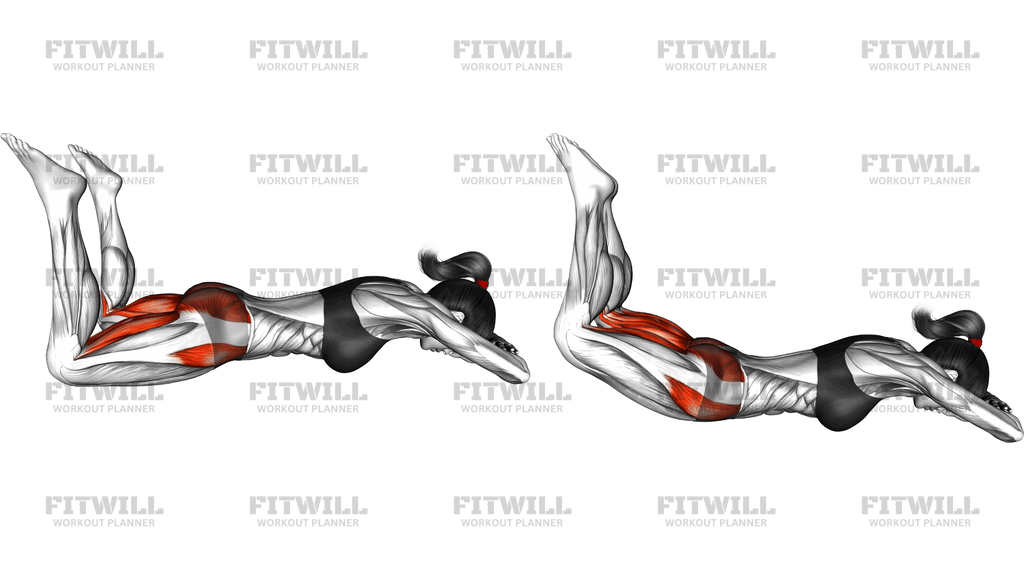
The Lying Double Glute Lift Heel Tap is a body weight floor exercise performed face down. You lie prone with your knees bent to roughly ninety degrees so your lower legs point toward the ceiling, then drive both knees off the floor by squeezing the glutes and tap your heels together at the top of each rep. The bent-knee position shortens the hamstrings, which limits their contribution to hip extension and forces the gluteus maximus to do most of the lifting work.
This is a great low-load glute activator. Because you are working against only the weight of your own legs, it suits beginners learning what a glute contraction actually feels like, lifters who want a warm-up before squats or hip thrusts, and anyone rebuilding hip extension after time away from training. The prone position also gently challenges the muscles along the spine to hold your torso still while the legs move.
The setup matters more than it looks. Your hips should stay in contact with the floor and your ribcage should stay relaxed against the mat. If your lower back arches and lifts your chest or tilts your pelvis, you shift work away from the glutes and into the lumbar spine. Keeping the knees bent and the thighs close together at the start keeps the movement in the hip joint, where it belongs.
Execution is simple but easy to rush. Squeeze the glutes to raise both knees a few inches off the floor, tap the heels together at the top without letting the thighs flop outward, then lower the knees back toward the floor under control without fully resting between reps. The lift is small — a few inches is plenty — and quality of the squeeze matters far more than range.
You will see this movement used in glute-focused circuits, Pilates-style floor work, and rehabilitation-style warm-ups. It pairs well with bridges and bird dogs as part of a short hip routine. Move slowly, breathe steadily, and stop if you feel pinching in the lower back rather than effort in the buttocks.
[ Workout Log & Planner ]
Put your next workout in Fitwill
Keep your plan and training log ready when you are.


Instructions
- Lie face down on an exercise mat with your legs straight and your forehead resting on your stacked hands.
- Bend both knees to about ninety degrees so your lower legs point toward the ceiling and your feet are a few inches apart.
- Keep your hips, pubic bone, and ribcage heavy against the floor and brace your abdominals lightly.
- Exhale and squeeze both glutes to lift your knees a few inches off the floor, keeping the thighs close together.
- At the top of the lift, tap your heels together briefly while holding the knee lift.
- Pause for one second at the top, feeling the contraction in the buttocks rather than the lower back.
- Lower both knees back toward the floor slowly, stopping just before they touch so tension stays on the glutes.
- Inhale as you lower, then exhale again as you start the next lift.
- Complete your set without rocking the torso or letting the pelvis tilt from side to side.
- When finished, lower the legs fully, straighten them, and rest on your stomach for a few breaths before standing up.
Tips & Tricks
- If your knees barely lift at all, the exercise is still working — the bent-knee glute lift has a short range and forcing height usually comes from the lower back instead.
- Keep the heels at hip width or slightly inside; letting the feet drift wide turns the heel tap into an outward leg sweep that loses glute tension.
- A common mistake is pushing the toes toward the ceiling so hard that the calves take over — keep the feet relaxed and let the hips do the lifting.
- If you feel your lower back working instead of your glutes, reduce the lift height to two or three inches and re-focus on the squeeze.
- Do not let your shoulders shrug or your neck press into your hands; the upper body stays completely passive throughout the set.
- Avoid bouncing the knees off the floor between reps — the controlled stop just above the mat keeps constant tension and makes the set noticeably harder.
- Tempo matters here: try a one-second lift, one-second heel tap, and two-second lower to feel the glutes working without adding load.
- If your hip flexors or the front of your thighs cramp, straighten the legs briefly between sets and shorten your working sets.
- Place a thin towel under the hip bones if the floor feels uncomfortable; padding under the pelvis will not change the movement.
Frequently Asked Questions
What muscles does the Lying Double Glute Lift Heel Tap work?
The gluteus maximus is the prime mover, with the upper glutes and hamstrings assisting. Your lower back and core muscles work statically to keep the torso still on the floor.
Why are the knees bent in this exercise instead of the legs staying straight?
Bending the knees shortens the hamstrings across the hip, which reduces their ability to extend the hips and places more of the lifting demand on the glutes.
Is the Lying Double Glute Lift Heel Tap suitable for beginners?
Yes. It is a low-load body weight movement, and the lift only needs to be a few inches. Beginners should prioritize feeling the glutes squeeze over achieving visible height.
How high should my knees lift during the heel tap?
Two to four inches of knee clearance is enough. Lifting higher typically comes from arching the lower back rather than stronger glute contraction.
Why do I feel this in my lower back instead of my glutes?
You are likely lifting too high, arching the spine, or rushing the reps. Reduce the range, brace your abdominals lightly, and slow the tempo so the hip muscles drive the lift.
Can I do the Lying Double Glute Lift Heel Tap every day?
Because the load is low, it can be used frequently as an activation drill or warm-up. Treat harder, higher-rep sets like any resistance training and allow normal recovery between them.
What can I use instead if lying face down is uncomfortable?
Glute bridges, quadruped bent-knee kickbacks, or standing cable kickbacks train similar hip extension patterns. Choose the variation that lets you keep your spine neutral without discomfort.
Should my heels actually touch during the tap?
A light, brief contact is the goal. The tap is a checkpoint that your thighs stayed aligned and your glutes held the lift — it is not a kick, so keep it controlled.
How many reps should I do?
Ten to fifteen controlled reps per set works well, either as a warm-up before lower-body training or for two to three sets within a glute circuit.