Kneeling Back And Side Leg Lift
The Kneeling Back And Side Leg Lift is a bodyweight floor exercise performed from a hands-and-knees position, where you extend one leg straight behind you and lift it toward the ceiling, then also raise it out to the side. It is one of the most accessible ways to train the glutes and hips without equipment, because your hands and one knee form a stable tripod while the free leg moves through its full range.
This movement is especially useful for people who sit for long hours, since prolonged sitting tends to leave the glutes underactive and the hips tight. It also suits beginners who are not ready for loaded hip extensions like barbell thrusts, and it works well as an activation drill before squats, deadlifts, or running. Because one leg works at a time, it quickly exposes and helps correct left-to-right differences in hip strength.
The primary target is the gluteus maximus during the backward lift, while the side lift shifts emphasis to the gluteus medius and the outer hip, the muscles responsible for lifting the leg away from the body and stabilizing your pelvis with every step. The hamstrings assist on the back lift, and your core, particularly the deep abdominals and lower back muscles, works continuously to keep your trunk from twisting as the leg moves.
Setup matters more than it looks. Your hands should sit directly under your shoulders and your working knee directly under your hip, with the spine long and neutral from head to tailbone. If your back sags or rounds, or your supporting knee drifts out of line, the leg will move but the intended muscles will contribute far less. A mat under the supporting knee makes the position comfortable enough to hold for full sets.
To execute well, extend the working leg straight back with the foot flexed, then raise it using the buttock rather than momentum. The lift is modest; height is not the goal. For the side version, keep the knee or leg roughly perpendicular to your torso as it travels outward instead of swinging up toward the ceiling, which would rotate your lower back instead of working the hip.
You can use the Kneeling Back And Side Leg Lift as a warm-up, as a stand-alone glute session at home, or as a finishing movement after heavier lower body work. Keep the reps slow, stop the lift at the point where your hips stay level, and treat control as the measure of a good set rather than how high the foot travels.
[ Workout Log & Planner ]
Put your next workout in Fitwill
Keep your plan and training log ready when you are.


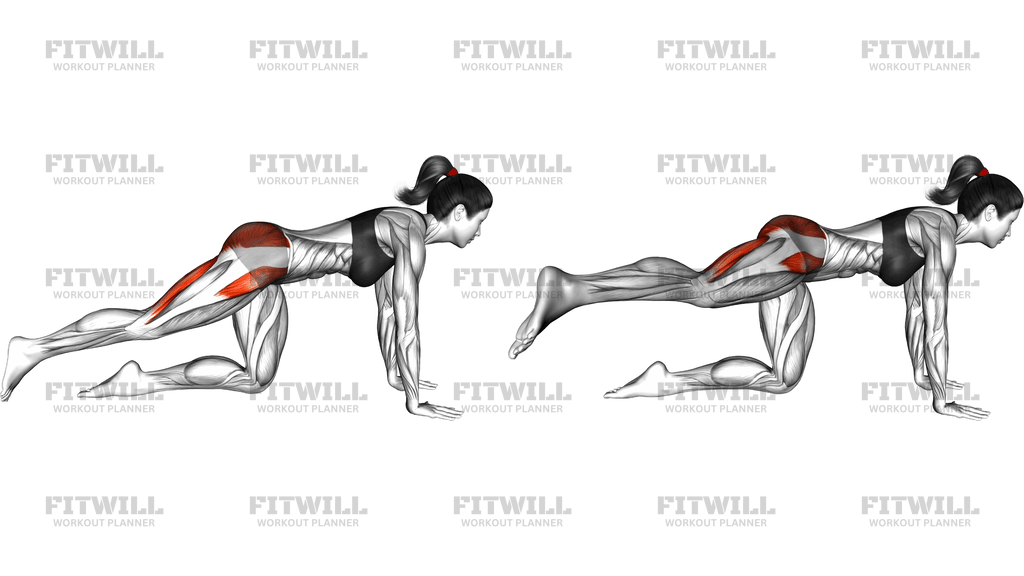
Instructions
- Place an exercise mat on the floor and kneel on all fours, with your hands directly under your shoulders and your fingers pointing forward.
- Position one knee directly under your hip as the support leg and let the other leg extend straight behind you with the knee straight and the toes resting on or just above the floor.
- Create a long, neutral spine from the crown of your head to your tailbone, then lightly brace your abdominal muscles as if protecting against a poke to the belly.
- Exhale and squeeze the glute of the extended leg, raising the straight leg backward and upward until it reaches hip height or slightly above, with the hips staying square to the floor.
- Pause for a beat at the top, feeling the contraction in the buttock rather than in the lower back.
- Inhale and lower the leg back down with control until the toes lightly touch or hover near the floor.
- For the side lift, keep the same kneeling position and raise the extended leg out to the side, keeping it in line with your hip rather than letting it drift upward toward the ceiling.
- Lower the leg back toward the center under control, avoiding any swinging or momentum.
- Complete all repetitions on one side, then switch legs and repeat, rechecking your hand and knee alignment before starting the second side.
Tips & Tricks
- The most common mistake is lifting the leg higher than the hip can allow, which arches the lower back. Cap the height where your pelvis stays level, and you will feel the glutes working harder, not less.
- If your torso rotates on the side lift, imagine a glass of water balanced on your lower back and keep it from spilling; reduce the range until you can move the leg without twisting.
- Pad the supporting knee with a folded towel or mat. Discomfort there causes people to shift their weight backward and round the spine, which dulls the glute contraction.
- Keep the neck relaxed by looking down at the mat rather than forward, so the head stays in line with the spine throughout both lifts.
- Flex the foot of the working leg and lead the back lift with the heel. Leading with the toes tends to shift work toward the hamstrings and reduces glute emphasis.
- For more glute involvement on the back lift, think about pushing the heel toward the ceiling with the leg slightly rotated outward instead of simply raising the foot.
- If your wrists bother you, spread your fingers wide and press through the base of the palm and fingertips, or make loose fists and rest on the forearms.
- Slow the lowering phase to two or three seconds. Most people rush the return, and the muscle work happens on the way down just as much as on the lift.
- If you cannot feel the glute working, tap or squeeze it deliberately before the first rep; establishing that mind-muscle connection often corrects a hamstring-dominant pattern.
Frequently Asked Questions
What muscles does the Kneeling Back And Side Leg Lift work?
The backward lift mainly targets the gluteus maximus with help from the hamstrings, while the side lift emphasizes the gluteus medius and outer hip. Your core and lower back muscles stabilize the trunk the entire time.
How high should I lift my leg in the Kneeling Back And Side Leg Lift?
Lift only to about hip height or slightly above, and only as far as you can keep your hips level and your lower back neutral. Extra height usually comes from arching or twisting, not from stronger glute work.
Is the Kneeling Back And Side Leg Lift good for beginners?
Yes, it is an excellent beginner exercise because it requires no equipment, the kneeling position provides stability, and the range can be kept small. Beginners should focus on smooth reps with a level pelvis before chasing height.
Why do I feel this exercise in my lower back instead of my glutes?
That usually means you are lifting too high or arching your spine to gain range, so the lower back muscles take over. Shorten the lift, squeeze the glute to start each rep, and keep the pelvis square to the floor.
Should my supporting knee stay directly under my hip during the lift?
Yes, keeping the knee under the hip maintains a stable base and lets the glutes do the work. If the knee drifts or your weight shifts, the movement loses both its stability and its target.
What can I substitute if kneeling is uncomfortable?
Standing leg lifts while holding a chair or wall, hip bridges, or side-lying leg raises train similar hip muscles without loading the knee or wrist. Pick the option that lets you keep a neutral spine.
How many reps and sets of the Kneeling Back And Side Leg Lift should I do?
Two to three sets of 10 to 15 controlled reps per leg per direction works well for most people. Since the exercise uses only bodyweight, quality and tempo matter more than piling on reps.
Can I do the back and side lifts together in one set?
Yes, many people alternate, performing a back lift and then a side lift within the same set to hit both the gluteus maximus and the outer hip. Just reset your torso position between directions so you never move with a twisted trunk.
Is it safe to do this exercise every day?
For most healthy people, yes, since it is a low-load bodyweight movement often used for daily glute activation. If you feel persistent soreness in the hips or lower back, give the area a rest day and reduce your range.