Lying Raised Glute Abduction Around The World
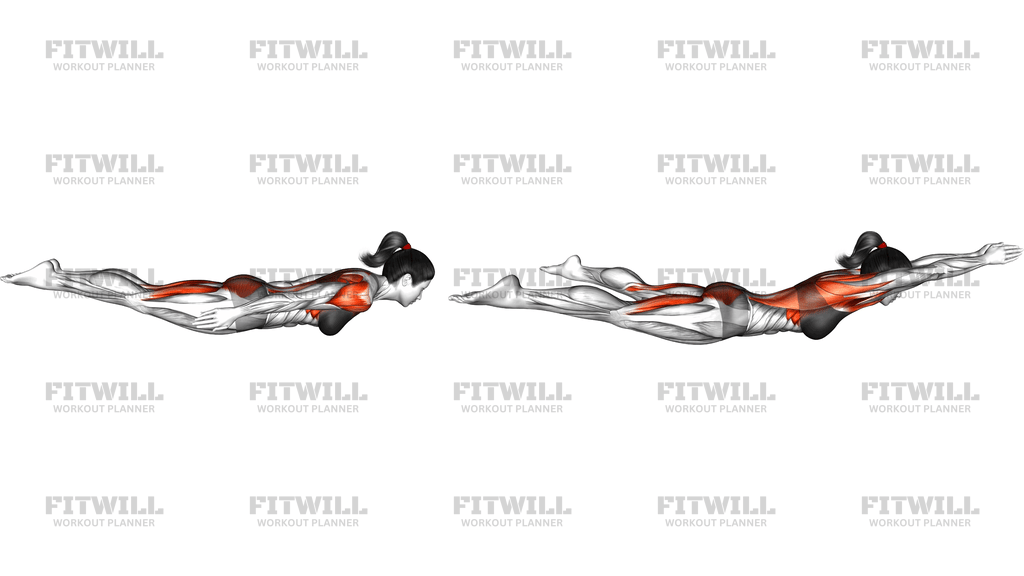
Lying Raised Glute Abduction Around The World is a prone body-weight movement where you lie face down with your legs lifted off the floor and sweep them out wide and around in a controlled circular arc. Because you are working against gravity with no machine or band assistance, the side-glute muscles have to do all the work of moving the legs away from the midline while the lower back and core hold your trunk steady. The raised-leg starting position is what separates this from a standard floor abduction: your hips are already under tension before the arc even begins.
This exercise targets the gluteus medius and gluteus maximus, with the outer hip muscles and hamstrings assisting as the legs travel through the arc. Holding the legs off the floor for the whole set also keeps constant demand on the spinal erectors and deep core, which must brace to stop your lower back from sagging or arching excessively. It is essentially two jobs in one: dynamic hip abduction and isometric trunk control.
It suits lifters who want to build hip stability without equipment, people rehabbing or prehabbing the outer hips under the guidance of a professional, and anyone programming glute work at home or as a finisher after squats, hip thrusts, or lunges. Because the resistance is only your leg weight, the exercise is easy to scale by adjusting how high you hold the legs and how large you make the circle. That makes it a reasonable starting point for beginners, though the prone position takes some practice to hold comfortably.
The setup matters more than it looks. Lying flat with your face down means your neck, spine, and pelvis should be in one long line before you lift anything. If your hips rock side to side or your lower back over-arches as the legs sweep, the work shifts away from the glutes and onto the lumbar spine. Keeping the pubic bone pressed into the floor and the abdominal brace firm preserves the intended hip-dominant movement.
To execute it well, think of the legs drawing a wide, smooth circle rather than jerking out and back. Sweep the legs apart to a comfortable width, circle them around as if tracing the perimeter of a plate, then bring them back together without letting the feet touch the floor between reps. Move slowly enough that you could pause the legs anywhere in the arc. Three controlled passes in each direction per set is a common way to structure the around-the-world pattern.
A few practical points keep this safe and effective. Keep the range of motion pain-free and moderate; the goal is tension in the outer hips, not maximal height. If your lower back pinches, reduce how high the legs are lifted and shorten the circle. Breathe steadily throughout instead of holding your breath, and stop the set when you can no longer keep the legs from touching down between reps.
[ Workout Log & Planner ]
Put your next workout in Fitwill
Keep your plan and training log ready when you are.


Instructions
- Lie face down on an exercise mat with your legs straight behind you and your forehead or cheek resting lightly on the floor.
- Extend your arms out in front of you or place them alongside your body with palms facing down, whichever helps you feel stable.
- Brace your abdominal muscles and press your pubic bone gently into the floor so your pelvis is level before your legs move.
- Lift both straight legs a few inches off the floor so your hip flexors at the front of the thighs lengthen and your glutes take on the load.
- Keeping the knees locked soft but straight, sweep both legs out wide to the sides in a smooth arc, as if drawing the top half of a circle.
- Continue the arc until the legs are back together behind you, then reverse the direction to complete the around-the-world pattern, or repeat in the same direction for your planned reps.
- Exhale as the legs sweep outward and inhale as they return together, keeping the breath continuous rather than holding it.
- Do not let the feet touch down between reps; if they do, end the set or reduce the leg height.
- At the end of the set, lower the legs under control to the floor, then walk your hips side to side or press back into a child's pose to reset your lower back before the next set.
Tips & Tricks
- The most common mistake is letting the lower back arch and the hips lift as the legs get tired, which turns a glute exercise into a lumbar extension exercise; keep the pelvis heavy on the floor throughout.
- If you feel the work mostly in your hamstrings, your knees are probably bending as the legs sweep; think about pushing the heels away from you to keep the legs long.
- Avoid making the circle as wide as possible early on; a smaller arc with constant tension on the outer hips beats a huge arc where the legs swing and rest.
- Do not crane your neck up to look forward; keep the face down or the gaze at the floor so the neck stays in line with the spine.
- If your shoulders or arms fatigued from pressing into the floor, slide your hands slightly wider or further overhead; the arms are for balance, not for lifting the chest.
- Tempo is the loading tool here since there is no added weight; try a two-to-three second sweep out and the same speed back before adding reps.
- Alternating direction each rep (one circle clockwise, the next counterclockwise) keeps tension even on the left and right outer hips.
- If the floor is hard on your hip bones, place a folded towel or mat under the pelvis rather than raising the legs higher to compensate.
Frequently Asked Questions
Which muscles does Lying Raised Glute Abduction Around The World work?
The main movers are the gluteus medius and gluteus maximus, which spread the legs through the arc. The hamstrings, outer hip muscles, spinal erectors, and deep core work to keep the legs lifted and the trunk stable.
Why are the legs raised the entire time in this exercise?
Holding the legs off the floor keeps constant tension on the glutes and outer hips, so there is no rest between reps the way there is when the feet touch down. It also adds an isometric demand on the lower back and core.
Is Lying Raised Glute Abduction Around The World suitable for beginners?
Yes, because the only resistance is the weight of the legs. Beginners should use a smaller circle, keep the legs lower to the floor, and do fewer reps until they can hold the pelvis still.
My lower back aches when I do this movement. What should I change?
Lower the leg height, shrink the arc, and re-brace the abs so the pubic bone stays pressed into the floor. If discomfort continues, stop and check with a qualified professional before continuing.
Should I circle the legs clockwise or counterclockwise?
Do both directions across your sets, or alternate direction each rep, so both outer hips get even work through the full arc. The around-the-world pattern works either way as long as the sweep stays controlled.
What can I use instead if lying face down is uncomfortable?
A standing cable or band abduction, a side-lying hip raise, or a seated machine abduction train the same glute function. These let you support the trunk differently while still targeting the outer hips.
How many reps and sets should I do?
Because the resistance is light, this exercise responds well to higher reps and slower tempo. Two to four sets of eight to twelve full circles, or timed sets of twenty to forty seconds, is a practical range.
Do I need any equipment for Lying Raised Glute Abduction Around The World?
No, it is a body-weight movement. An exercise mat is helpful for comfort on the hip bones and forehead, and a folded towel under the pelvis works in a pinch.
How do I know I am feeling it in the right place?
You should feel a burn along the sides and back of the hips during the sweep and a steady fatigue in the trunk from holding the legs up. Sharp pain in the lower back or a pinching feeling at the front of the hips means the setup needs adjusting.